




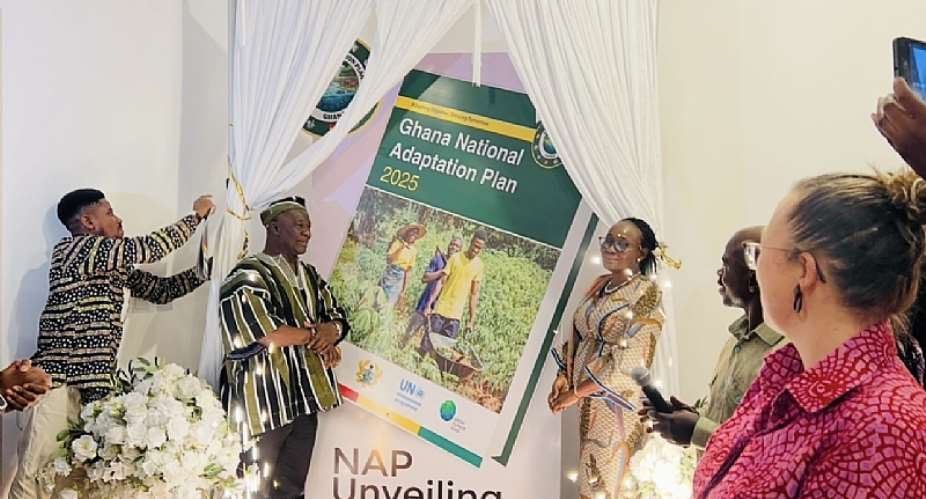
The Government of Ghana, through the Environmental Protection Authority (EPA) under the Ministry of Environment, Science and Technology, has launched the National Adaptation Plan (NAP) 2025 to integrate climate change adaptation into national development planning.
The NAP process began in June 2020 and has undergone extensive technical and governance reviews with support from the Green Climate Fund (GCF), while the United Nations Environment Programme (UNEP) served as the delivery partner.
The plan provides a strategic framework to reduce Ghana’s vulnerability to climate change by building adaptive capacity and resilience.
It aims to align adaptation priorities with both medium- and long-term development pathways and integrate them into national, sectoral, and sub-national planning.
Delivering the keynote address at the launch on Thursday, December 4, Suweibatu Adam, Chief Director of the Ministry of Environment, Science and Technology, described the NAP as a major step in building a climate-resilient and sustainable future.
“It marks a turning point in how we confront the growing climate risk affecting our people, our economy, the ecosystem, and the systems that sustain us,” she said.
The plan, according to her, “identifies priorities, adaptation needs, outlines sectoral and district-specific actions, and establishes systems for coordination, financing, implementation, monitoring, evaluation, accountability and learning.”
Speaking to ModernGhana News on the sidelines of the event, Felix Addo-Okyireh, Head of the Climate Change and Ozone Department at EPA, said there is a need to involve people from all walks of life in climate change conversations.
“The purpose of this adaptation plan is to mainstream climate issues at all levels, from national to sub-national. We want to reduce the vulnerability of people affected by climate change and ensure that everyone can adapt and remain resilient,” he said.
On his part, Nana Dr. Antwi-Boasiako Amoah, National Adaptation Planning Coordinator, highlighted the link between climate and development.
“Development and climate have a relationship. It can be positive or negative, and we need to understand the times we are in as a country,” he said.
The NAP includes a youth strategy to ensure inclusivity and is anchored on six enabling factors.
These factors are strong institutional governance, comprehensive capacity development, meaningful stakeholder engagement, integration of adaptation priorities into budgets at all levels, mobilisation of domestic and international financing, and effective information and knowledge management.
The NAP development process was carried out in collaboration with partners including UNDP, the International Institute for Sustainable Development, the Green Climate Fund, WaterAid Ghana, the Global Center for Adaptation, the Ghana Health Service, the Covenant of Mayors, CDKN, SIGRA and the Strategic Youth Network for Development.


 President Mahama urges African countries to fund own peace operations, warns aga...
 Govt to borrow GHS15.38 billion from domestic market, plans DDEP bond buyback
 Finance Ministry says all 2026 ABFA allocations reserved for Accra-Kumasi expres...
 'Surprised and disappointed' — GTA CEO Efua Houadjeto responds to Abeiku Santana...
 Police arrest NDC delegates for allegedly photographing ballots at Bimbilla cons...
 Gambia’s Chief Justice pays courtesy call on Asantehene at Manhyia Palace
 NDC Constituency polls: Delegates invoke 'Antoa' deity over alleged album manipu...
 NDC Oforikrom constituency election stalls over ballot paper delays
 Former NDA CEO Sumaila Abdul-Rahman, three others fined GH¢84,000 each over proc...
 Wa: Abandoned newborn baby boy rescued at Sombo


