




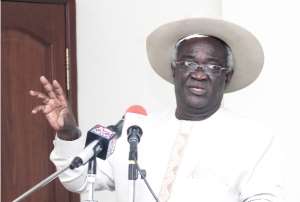
Local governance expert and Ghana’s longest-serving Minister of Local Government, Professor Kwamena Ahwoi, has criticised the unchecked creation of regions and district assemblies, describing the trend as counterproductive and politically motivated.
Speaking at a national dialogue on decentralisation and responsive governance in Accra last Friday, Prof. Ahwoi said the country’s 261 metropolitan, municipal and district assemblies (MMDAs) had far exceeded the optimum number needed, with many of them “barely existing” and unfit for purpose.
“It is my view that we have already exceeded the optimum number of regions and districts that the country needs. The results of the current excessive number of 261 MMDAs, many of which are not viable, and many of which cannot be used for planning purposes, defeat the key rationale for the creation of districts,” he stressed.
He argued that the rationale for upgrading some assemblies to metropolitan and municipal status had been abused, leading to the creation of six metropolitan and 70 municipal assemblies, some of which do not meet the legal population thresholds.
Prof. Ahwoi also faulted the political basis for the creation of six additional regions between 2018 and 2019, insisting the move had brought “no tangible benefits.”
“For a period of over 50 years, the country survived with a maximum of 10 regions. Creating six more regions in only two years (2018 to 2019) was definitely an overreach with no tangible benefits to show for it,” he said.
He accused successive governments of ignoring the Local Government Act of 1993 (Act 462) and the Local Governance Act of 2016 (Act 936), choosing instead to create districts to serve partisan ends.
Prof. Ahwoi called on the Constitution Review Committee to use the ongoing constitutional review process to properly define decentralisation from political, administrative, and economic perspectives to ensure that MMDAs function effectively. He further urged citizens and assembly members to demand accountability from Metropolitan, Municipal, and District Chief Executives (MMDCEs), reminding them that they hold the power to pass votes of no confidence or initiate recalls.
“The assembly members have the power under the Local Government Act to pass a vote of no confidence in the chief executive of their MMDA by a two-thirds majority. For assembly members, people in the electoral area can actually initiate processes for their removal from office and get the Electoral Commission to conduct fresh elections,” he explained.
On the broader governance structure, Prof. Ahwoi reiterated his long-held view that local government must remain non-partisan, with assemblies retaining the hybrid system of 70 percent elected members and 30 percent appointed by the President. While he supported the President’s continued role in nominating MMDCEs, he stressed that appointees must be competent and well-equipped to lead.
The dialogue, held under the theme “Resetting decentralisation for responsive local governance and effective service delivery”, also heard from Dr. Ishmael Norman, President of the Institute for Security, Disaster and Emergency Studies. He underscored the need for ethical leadership at the MMDAs, anchored on meritocracy, transparency, and accountability.
“To be a good leader, you need to observe your ecosystem; the people around you; and morality should be the conscience of your leadership,” Dr. Norman said. He further warned that Ghana remained unprepared for emergencies, urging MMDAs to strengthen disaster risk management structures as part of the decentralisation reset.
 There’s a space for effective OSP with special prosecution powers — Mahama
 UG, KNUST and UCC lecturers to withdraw services over unpaid promotion arrears
 "24-hour economy markets will transform the economy" — Hon Jerry Ameko
 Mahama begins Eastern Region tour with May Day address and key projects
 Free Zones boss alleges political sabotage in Akosombo sub-station fire
 Family demands justice for man lynched over witchcraft allegations in Kpandai
 Two mortuary security guards die hours apart on duty in Suhum
 We will expand the economy to create jobs and prosperity — Mahama
 Lead a final onslaught on galamsey — TUC urges Mahama
 Akosombo substation fire an opportunity to modernise power infrastructure — Maha...


