




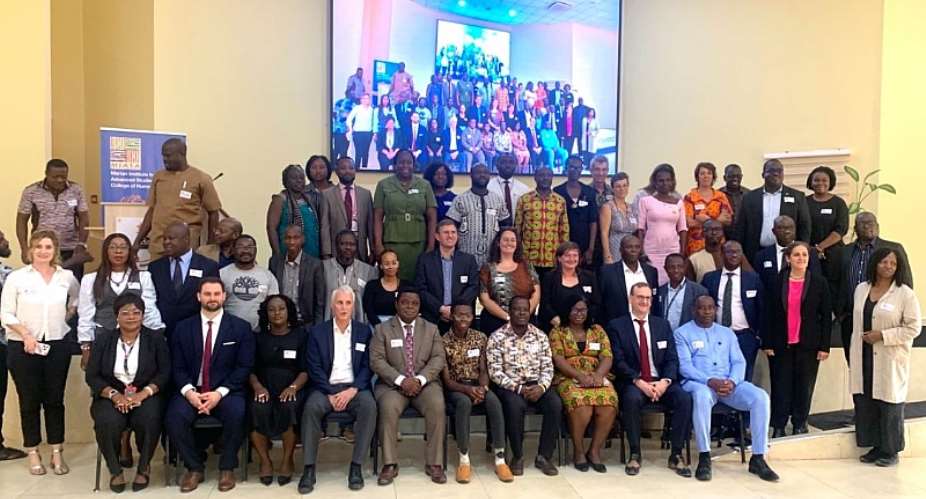
The Merian Institute for Advanced Studies in Africa (MIASA) has called for inclusive financial policies that allow citizens to choose between cash and digital payments, warning against one-sided transitions that could exclude vulnerable populations.
This call was made at the opening of a two-day international conference hosted by MIASA at the University of Ghana from Tuesday, May 20 to Wednesday, May 21, on the theme: “Cash in crisis in Africa: Navigating financial realities in times of disruption”.
The conference was convened by MIASA’s twelfth Interdisciplinary Fellow Group (IFG12), made up of five researchers from Africa and Europe, whose joint project investigates how Africans engage with cash during periods of political instability, economic shocks, pandemics, and infrastructure breakdowns.
Delivering the keynote address, Fabio Knümann of the Deutsche Bundesbank stressed that despite the rise of mobile and electronic payments, cash remains vital to financial inclusion, particularly in African economies where infrastructure gaps persist.
“Cash remains a vital element of financial inclusion in many parts of the world, particularly in regions where digital infrastructure is limited.
“In numerous African countries, it is not an alternative but the foundation of everyday transactions - essential for markets, transport, and basic services. Its reliability, independence from electricity and networks, and immediate usability make it irreplaceable for millions,” he stated.
Chairing the opening session, Professor Peter Quartey, Director of the Institute of Statistical, Social and Economic Research (ISSER), underscored the importance of providing choice and avoiding digital-only mandates.
“Let’s give people choices. Let them have cash, let them have digital payments as well. The policy should be inclusive. Technology can fail, but cash is a reliable backup,” he said.
In her welcome address, MIASA Director and Associate Professor of Linguistics at the University of Ghana, Prof. Grace Diabah, described the conference as a platform to rethink how governance and policy can strengthen financial resilience on the continent.
She noted that the gathering aligned with MIASA’s mission to promote sustainable governance through Africa-rooted research and dialogue.
The event brought together participants from across Africa and Europe to explore how central banking policies, informal practices, and community-level innovations shape and are shaped by cash use during crisis periods.
It was supported by the German Federal Ministry of Education and Research and the University of Ghana.

 Obuasi SHTS sexual abuse allegations deeply disturbing – Beatrice Annan
 'Show us the boarding passes' – MP questions evidence for South Africa evacuatio...
 Martin Kpebu explains why Afi Agbenyo should resign over EC appointment
 South Africa evacuation: NPP desperate to see government commit scandal – Appiah...
 Mahama announces GH¢200m for reclamation of lands destroyed by galamsey
 Ghana working to stop exporting raw mineral ores by 2030 – Mahama
 Invest in cocoa, shea processing to create jobs for Ghanaian youth – Veep to Chi...
 'Hypocrisy is the problem of NDC government’ – Elvis Darko on EC appointment
 GHS to vaccinate eligible girls against HPV in nationwide school campaign
 NAIMOS destroys 92 chanfang machines, arrests three suspected illegal miners on ...


