




Introduction
Ghana’s Youth – The Nation’s Greatest Untapped Asset
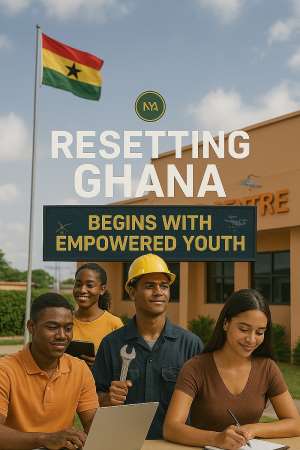
In a nation where over 57% of the population is under the age of 25 (GSS, 2021), the youth are not merely a demographic—they are Ghana’s most significant opportunity for long-term sustainable development. And yet, the very institution mandated to harness this promise—the National Youth Authority (NYA)—remains a shadow of its potential. What should be Ghana’s vanguard of innovation, empowerment, and policy execution has, over the years, devolved into a reactive, underfunded body. It is time to reset the narrative.
This article offers a strategic, policy-based framework to reposition the NYA as a cornerstone of Ghana’s sustainable future, rooted in real-world models and reform-driven interventions.
The Current Reality:An Institution Adrift
Despite a well-crafted mandate to “develop and coordinate youth-focused programs,” the NYA has become synonymous with symbolic programming rather than systemic change. Fragmented coordination, inconsistent funding, and political interference have rendered it a ceremonial agency in a time when Ghana requires institutional agility and foresight (Amoah, 2022).
The challenges include:
Inadequate budgetary allocations with limited autonomy in disbursements.
Minimal collaboration with private sector industries and international development actors.
Lack of performance metrics or impact evaluation tools to measure policy outcomes.
Absence of a nationally endorsed Youth Development Framework tied to labour markets, education, and innovation.
Case in Point:
The Silent Drift of Ghana’s Urban Youth
In Accra, Kumasi, and Tamale, thousands of youth trained through state-sponsored technical programs fail to transition into meaningful employment. A 2023 survey by the International Labour Organization (ILO) found that only 17% of Ghanaian youth vocational graduates were employed in their trained sectors after two years (ILO, 2023). This disconnect illustrates the NYA’s missed opportunity to bridge training with productivity pipelines.
Policy Framework for Recovery and Sustainability
To restore the relevance of the NYA, the following evidence-based reforms are proposed:
1. National Youth Development Policy 2.0
Ghana’s existing youth policy (2010–2020) has lapsed. A new ten-year strategic framework must be designed—backed by Parliament—to align NYA objectives with national priorities such as Agenda 111, Planting for Food and Jobs, and AfCFTA participation. This updated policy should embed sustainability goals (SDGs 4, 8, and 10), inclusivity, and a focus on digital transformation.
2. Youth Empowerment Hubs Across All Districts
Drawing lessons from Kenya’s Ajira Digital Program, which decentralizes youth employment through tech-enabled hubs (World Bank, 2022), NYA should transform its district offices into Youth Empowerment Hubs offering:
Digital and entrepreneurial skills
Incubation spaces for start-ups
Mental health support services
Career orientation linked to local economies
3. Strategic Public-Private Youth Partnerships (SPPYP)
NYA must become a convener of ecosystems—linking telecoms, agribusiness, fintech, and tourism with Ghanaian youth talent. Structured annual partnerships with companies (e.g., MTN, Nestlé, Kosmos Innovation Center) should culminate in sector-specific employment pipelines.
4. District Youth Assemblies for Participatory Governance
Informed by Rwanda’s YouthConnekt model, Ghana can implement District Youth Assemblies—quarterly platforms where young people debate local development issues and influence district budget allocations. This would revitalize civic engagement while restoring youth trust in national leadership (UNDP, 2020).
5. Establish a National Youth Sustainability Fund
A ring-fenced Youth Sustainability Fund, sourced from a 0.5% allocation of the Ghana Education Trust Fund (GETFund) and Diaspora Bonds, should finance long-term youth innovation and community-led solutions in climate resilience, digital inclusion, and agro-industrial zones.
International Reference Models
Rwanda’s Imbuto Foundation: Successfully links youth mentorship with state-level entrepreneurship grants.
Singapore’s Youth Corps: Integrates national service with leadership development.
South Korea’s Youth Startup Academy: Government-backed program that has incubated over 600 successful tech ventures since 2011 (OECD, 2021).
Conclusion:
A Generation in Waiting or a Generation in Motion?
Ghana cannot afford to mismanage its demographic window. The NYA must transform into an agile, innovative, and credible policy institution—designed not just to "organize programs" but to unlock prosperity through people. From community-level engagement to national employment ecosystems, a reimagined NYA is central to Ghana’s journey toward inclusive, resilient, and future-ready development.
As the clock ticks on economic volatility, social discontent, and mass youth unemployment, the question is not whether the NYA will be reformed—but whether Ghana will choose to empower or sideline its future.
"Our greatest national resource is not beneath the soil—it’s seated in our classrooms, walking our streets, and waiting to be called into purpose. If we fail the youth, we forfeit the future."
— Bismarck Kwesi Davis
References:
Amoah, J. (2022). Institutional Performance of the National Youth Authority: A Policy Audit. Ghana Journal of Public Administration, 14(2), 34–51.
Ghana Statistical Service. (2021). Population and Housing Census Summary Report. Accra: GSS.
International Labour Organization. (2023). Skills Mismatch and Youth Unemployment in Ghana: Findings and Recommendations. Geneva: ILO Publishing.
OECD. (2021). Youth Startups and Innovation: Global Best Practices. Paris: OECD Publishing.
UNDP. (2020). YouthConnekt Africa: Empowering a Generation. Retrieved from https://www.africa.undp.org
World Bank. (2022). The Ajira Digital Program: Kenya’s Youth Employment Strategy in the Digital Era. Washington, D.C.: World Bank.

 Eight teachers convicted for facilitating cheating in 2025 BECE — Education Mini...
 'Low' risk to public of hantavirus after cruise ship deaths, WHO says
 Ghana’s Moment at the African Union: Beyond Symbolism, Toward Substance
 Approach the exams with confidence — Vice President urges 2026 BECE candidates
 May 4: Cedi maintains value, sells at GHS12.15 on forex market, GHS11.20 on BoG ...
 There is an attempt to understate BoG’s 2025 loss — Oppong Nkrumah
 Ghana to host 3-day reparations conference June 17 to 19 after UN resolution
 Don’t engage in exam malpractice — Education Minister urges 2026 BECE candidates
 NIA resumes Ghana Card registration for children in Volta, Oti regions on May 5
 Over 620,000 candidates from 20,395 schools begins 2026 BECE nationwide


