




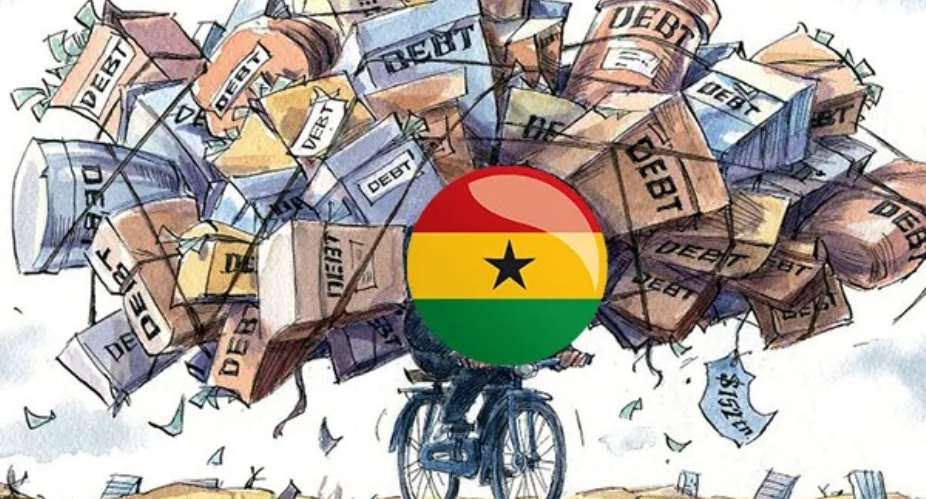
Ghana’s socio-economic woes can be partly attributed to the huge debt service payment obligations as almost half of the country’s total revenues are consumed by debt repayment.
This was revealed by the 2024 United Nations’ Unpacking Africa’s Debt Report which seeks to break down Africa’s debt and proffer sustainable solutions.
The report cited by The High Street Journal reveals that Ghana has been caught in a worrying cycle of huge debt service obligations. Between 2017 and 2022, an average of 42% of total government revenue was used just to repay interest loans.
The situation, the UN said, is devouring a significant portion of the country’s revenues, with the report further revealing that the 42% of the total revenue used to service debt represents a 15-percentage-point increase if compared to the previous 6 years i.e. 2010 to 2016.
The high debt obligation, the report mentions was fueled by the increase in debt servicing costs largely driven by high interest rates on loans contracted from international capital markets. As Ghana access private and commercial debt markets, the country has been exposed to volatile global financial conditions, leading to escalating interest payments.
“The increase in debt service was mainly driven by high interest rates in the international capital market. Interest payments as a share of government revenues have skyrocketed during the last decade in most countries,” the report declared.
It added that “interest payments consumed, on average, around 42 per cent of government revenues in Egypt and Ghana between 2017 and 2022, a 15 percentage points increase compared to the average between 2010-2016.”
The situation is believed to have trapped the economy in a vicious cycle where the depreciation of the Cedi, slower economic growth, and increasing borrowing costs make it even harder to pay off debt leading to default in 2023.
The implications of the high debt service obligation trap have profound implications for Ghana’s socio-development. With nearly half of government revenue channeled into debt servicing creating a tight fiscal space for the government, fewer resources are left for critical areas such as education, healthcare, infrastructure, and social services.
For instance, funding for schools, hospitals, and road networks is squeezed, delaying essential projects and worsening living conditions for ordinary citizens.
Economists have already recommended that to break from the vicious cycle of high debt obligations, the government must diversify revenue streams, reduce reliance on external borrowing, and focus on domestic resource mobilization.
Structural reforms to improve tax collection, curb corruption, and attract sustainable investments could provide the much-needed fiscal space to prioritize development over debt repayment.
-thehighstreetjournal.com
 Mahama held back acceptance of Sophia Akuffo's resignation letter at request of ...
 Zoomlion workers petition Ashanti Regional Minister over unpaid salaries
 Stay away from married men to avoid premature deaths - Atwima Trabuom Queen moth...
 Afigya Sekyere East: NPP Constituency Chairman petitions regional executives ove...
 Nyinahin Catholic SHS incident: 11 CSOs petition NTC to investigate alleged teac...
 Gov't must apologise over delayed disclosure of Sophia Akuffo's Council of State...
 Current presidential staff salaries inherited from Akufo-Addo era — Kwakye Ofosu
 Publish Sophia Akuffo’s resignation letter now – Martin Amidu urges govt
 Bole SHS investigates alleged sexual misconduct involving teacher and student
 Justice Sophia Akuffo did not disclose reason for Council of State resignation —...



Comments
The next government will face a difficult battle since the NPP government's excessive borrowing and embezzlement would generate problems for Ghanaians. The new government will have to pay higher interest on debts for which the people are not liable. This is one of the reasons I support Mahama's "Operation Recover All The Loot" program to help Ghana's development.