




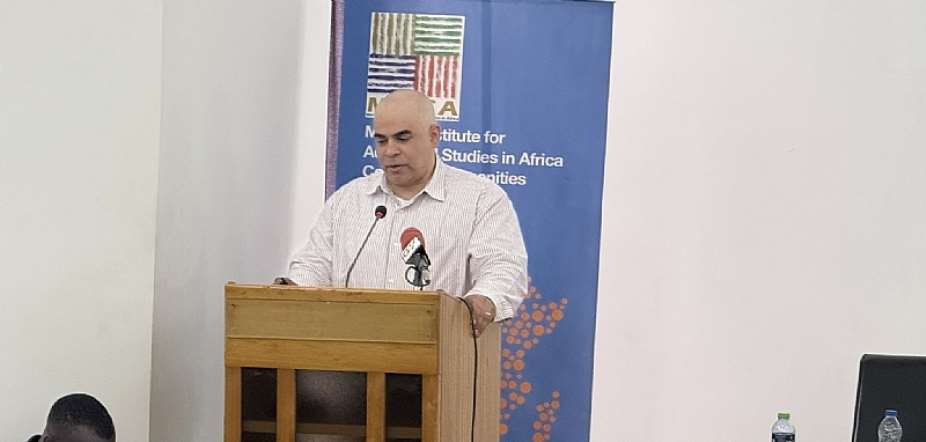
Professor Gavin Hilson, a Professor of Sustainability in Business at the Surrey Business School, University of Surrey, has highlighted the role of policy in the proliferation of illegal small-scale mining, commonly known as galamsey, in Ghana and other parts of Africa.
Speaking at the MIASA Interdisciplinary Fellow Group (IFG 11) conference on Wednesday, November 27, Prof. Hilson argued that systemic challenges, such as the high cost of securing mining licenses and the bureaucracy involved, have contributed significantly to the prevalence of galamsey.
“We know about galamsey destroying the environment. It’s totally unacceptable what we are seeing in the Eastern Region, the Western Region, the Ashanti Region—wherever small-scale mining is happening, even in other parts of Africa. It’s totally unacceptable.
“Whether we like it or not, this is a manufactured problem. This is a problem that policy has created, and galamsey is the end product of that policy,” Prof. Hilson stated.
Tackling the Roots of Illegal Mining
Prof. Hilson emphasised that small-scale mining has historically been interwoven with agricultural practices for centuries and remains a critical part of local economies across Africa. However, the inability of many miners to secure formal licenses has forced them into illegal operations.
“A big part of the reason why a lot of small-scale miners don’t have licenses, not only in Ghana but across sub-Saharan Africa, is that they simply can’t get them. There is difficulty in getting licenses, significant costs involved, and extensive bureaucracy that must be navigated,” he explained.
He commended Ghana’s Community Mining Scheme, which seeks to decentralise mining licenses and empower District Assemblies in collaboration with communities. While promising on paper, he stressed the importance of ensuring its effective implementation.
“We need to create an enabling environment for formalisation, and this is not a theoretical exercise,” he remarked.
Balancing Large-Scale and Small-Scale Mining
Prof. Gavin Hilson further stated that Ghana, as Africa's first country to legalise small-scale mining in 1989, has the legislative framework and institutional expertise to balance its large-scale mining sector with a formalised small-scale mining industry.
“The way we go about doing that is to make sure we don’t create problems for ourselves in the long run. For instance, during the exploration phase of large-scale mining, we should block out areas for small-scale miners and ensure no one is awarded those deposits as part of a lease,” he suggested.
A Multi-Stakeholder Approach
The two-day MIASA IFG 11 conference brought together stakeholders from academia, civil society, business, and policy to discuss the sustainability of global mineral production systems, with a focus on gold mining in West Africa.
MIASA Director (Ghana), Prof. Grace Diabah, highlighted the conference's interdisciplinary and transnational approach to addressing land and mineral governance challenges in Africa.
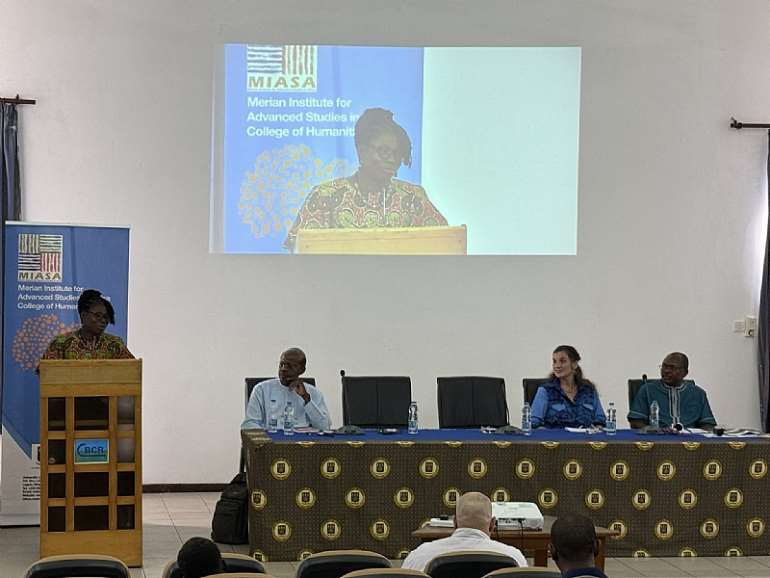
Prof. Grace Diabah noted that the discussions align with MIASA's focus on “Sustainable Governance.”
Prof. John Mayimadin Kusimi, one of the conveners of the MIASA IFG, called for stronger institutional frameworks to formalise Ghana's small-scale mining sector. He advocated for sustainable practices in government policies, emphasising that proper implementation could curtail illegal mining activities.
“If Ghana’s small-scale mining policy is implemented to the letter, the illegalities some firms engage in will be dealt with,” Prof. Kusimi said.
Recommendations for Sustainable Mining
Prof. Kusimi proposed allocating specific concessions to small-scale miners and holding them accountable for protecting mining sites. He also called for the inclusion of local stakeholders, such as traditional leaders and chiefs, in policymaking processes.
“We also need the involvement of the local people themselves—the traditional leaders and the chiefs. Let’s engage the people and let them be part of policymaking. They can check on mining activities and report back to authorities to ensure the right things are done,” he suggested.
Moving Forward
While Ghana remains a global leader in gold production, challenges such as environmental degradation and unregulated mining continue to persist. The MIASA IFG 11 conference underscored the need for collaborative approaches and policy innovation to create a sustainable and equitable mining sector.
By addressing the root causes of illegal mining and fostering inclusive decision-making, stakeholders hope to ensure that Ghana’s mineral wealth contributes positively to its development.

 Obuasi SHTS sexual abuse allegations deeply disturbing – Beatrice Annan
 'Show us the boarding passes' – MP questions evidence for South Africa evacuatio...
 Martin Kpebu explains why Afi Agbenyo should resign over EC appointment
 South Africa evacuation: NPP desperate to see government commit scandal – Appiah...
 Mahama announces GH¢200m for reclamation of lands destroyed by galamsey
 Ghana working to stop exporting raw mineral ores by 2030 – Mahama
 Invest in cocoa, shea processing to create jobs for Ghanaian youth – Veep to Chi...
 'Hypocrisy is the problem of NDC government’ – Elvis Darko on EC appointment
 GHS to vaccinate eligible girls against HPV in nationwide school campaign
 NAIMOS destroys 92 chanfang machines, arrests three suspected illegal miners on ...


