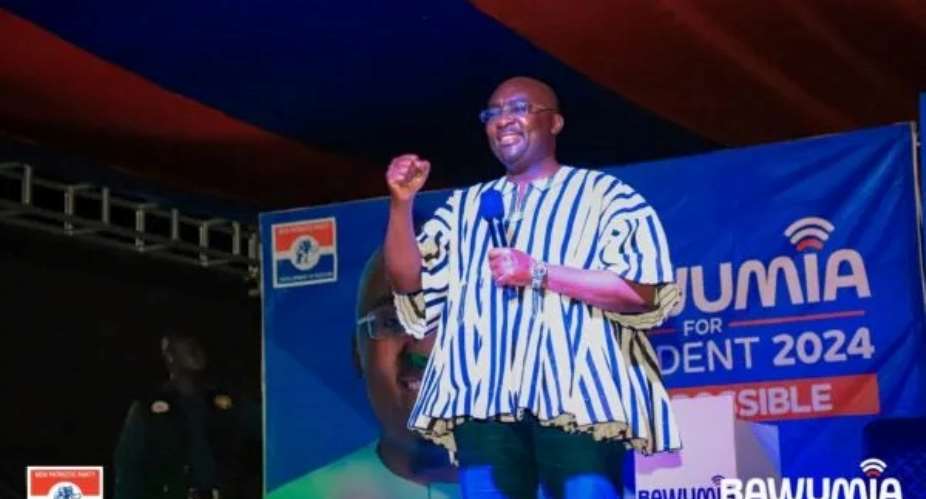
The day came, there was an indelibly phenomenal evening which jutted out. The turbidity of the weather plucked ; the hurricanes became stifled. All of a sudden, there was a sea of zephyrs. Who is browbeating these anomalies ? I asked myself with a mirthless simper. Quite bizarrely, there was a sub rosa roaring voice saying, it is all systems go as my chosen president, Dr. Mahamudu Bawumia is about to inculcate the electorates with his presidential sea changes - the man I have enjoined to spin out the bumper legacies of Nana Akufo Addo, hence, he is the Joshua of our time, the voice stressed. I was filled with effervescence, because what God decrees, nobody can dim it.
I didn't vibrate in shocks, because Dr. Bawumia is someone, who articulates his intentions in a full panorama : he doesn't jangle. Actually, I have dubbed his Manifesto as ' The Recipe for Evolutions '. This man is a groundbreaker and bobby - dazzler : this is veridical. I wanted to assess his thoughts holistically, but since the attention has been careened to the fact that, Dr. Bawumia vouchsafed that, he would either let the Ghana's ports be duty - free likewise our neighboring Togo or even better off them _ some people have obfuscated the citizenry with notional explanations, on the grounds that, it wouldn't be possible taking a cue from our demands, inflation, our GDP status etc. However, I want to demystify that portion for the sake of incredulity. I don't know why some people, particularly the NDC followers have the cacoethes to make a viable policy becomes phantasmic in their sights. My assertions shall be based on three condensed aspects of the institution of that enterprise by the Togolese, thus, History, Rationales and Impacts.
EXORDIUM.
The duty - free port is technically known as duty-free zone (DFZ) or a free-trade zone, is a designated geographic area where goods can be stored, handled, and processed without being subject to customs duties, taxes, or certain regulations which typically apply to goods entering a country.
HISTORY
After Gambia and Guinea Bissau, Togo is West Africa's smallest country by landmass. Togo is the only Africa country to have been colonized by three European powers : Germany, Britain and France. Germany wielded an immense influence on Togo, as it played a critical role in deciding the country's borders. These borders laid the foundation for the country to emerge as a trade kernel. In the 1880s, German traders set up a trading base in modern-day Aneho, Togo, to buy palm oil supplies. They were perpetually looking over their shoulders. Competition among European traders – and the state powers who would later back them – in West Africa was heating up. At that time, the nightmare of the Germans was the English, since they didn't want the English to pounce on them for their sliver of lands on the Gulf of Guinea. Therefore, they sued for guidance from the German empire, ruled by Otto Von Bismarck to back their interests.
The Germans got to work on running their colony. It got to a time, they had to raise money. Colonies were like businesses: they had to pay for themselves. Borders were instrumental in stiffening colonial power and raising money. In a piece-meal process, the Germans started fixing the borders. They set up border posts and tolls to supervise the movement of people and goods. In 1897, they commenced to levy duties on goods to raise revenues. By 1906, the Germans were hoarding enough local tax revenues that they christened Togo a “Musterkolonie” (model colony). Unlike, its other African colonies – Kamerun (Cameroon) and German East Africa (modern-day Tanzania) – Togoland paid for itself. Suddenly, the British and the French exterminated the Germans during the World War 1 and partitioned the Togoland into two, thus, the Western and the Eastern part, of which the British confiscated the Western part, the Volta River Region and they gave it protectorate status, whilst the French took over the other one. When the World War II was axed. The Togolese started to demand a cessation to the French protectorate. Sylvanus Olympio, pioneered the opposition to the French.
In 1960, Togo won its independence. Olympio won a landslide election to become Togo’s first president.
RATIONALE
For Olympio, only one route existed for the country’s development and prosperity: Togo had to become a trade entrepôt. Togo was too miniscule for anything else. First, Olympio had to replace Lomé port, which had fallen into mare's nest. He wanted to dredge a deepwater port, the first in West Africa. This could significantly mushroom the capacity of vessels and containers the port would welcome, rocketing the amount of import and export taxes it could raise. But, the French rebuffed to subsidize the port expansion. Operating out of their narrow self-interest, they wanted to build a port that could serve Togo and Dahomey (modern-day Benin). Not taking no for an answer, Olympio appealed to the Germans. Germany consented to finance the port.
Olympio’s vision for Togo set a precedent for future Togolese leaders. Throughout the 1960s and 1970s, Togo was at the forefront of efforts to drive West Africa’s integration and boost inter-regional trade. The subsequent Togolese President, Gnassingbé Eyadema teamed up with Nigerian President Yakubu Gowon to lobby their West African neighbours to erect a free trade zone.
Togo played a key role in creating pan-African institutions. Both Ecobank, founded as a pan-African bank, and Asky Airlines, established as a regional aviation company, are headquartered in Lomé. They were framed to make financial transactions and movement across the region more efficient.
IMPACTS
Today, Olympio’s bet to turn Togo into West Africa’s trading nub is paying off. He capitalized on its small size and have turned Togo into West Africa's largest trade hub. It is the vital node connecting the region to global markets. Between 2013 and 2017, Lomé port tripled its capacity from 311,500 twenty-foot equivalent units (TEUs) to 1.1 million TEUs. With its solid logistical infrastructures and small size, goods which transit via Lomé port can set foot on several West African capitals in one day. Togo is only doubling down on its logistics plan. It looks to escalate the port’s current capacity, fabricate a dry port to come to grips with decongestion for goods bound for the Sahel, and expand the vital coastal road to brush up intra-regional trade.
As of now, this free trade zone has allured CFA240 billion ( thus, USD 405, 547, 920) of investments since it was launched. According to the Togolese presidency, 71 companies operate in this zone, benefiting from tax incentives; they are required to export 70% of their output. Overall, the free trade zone employs 15,392 agents and it contributes around CFA68 billion ( USD 114, 905, 244) to Togo’s GDP, according to available data. Now, more firms are getting primed to join the free trade zone. This is in a context where Togo is doubling down on its stabs to launch the Agency for the Promotion of Investments and the Free-trade Zone (API-ZF), which is tasked with efficiently steering the new investment code. Already, the presidency blazoned, 25 companies have been accredited to function in the free-trade area. The firms, which are settling in, are active in sectors such as agribusiness, food, plastics, pharmaceuticals, cosmetics, and metals.
These free - duty at ports and trading sectors of Togo came forth as a result of someone's fortitudinous, resilience and lobbying prowess : it wasn't because, Togo's economy was peppy and bullish then. In fact, in 1989, when they implemented the free - duty zone, the GDP of Togo stood at USD 1.353 billion while Ghana's own was at USD 5.252 billion by that time, but they defiled against all odds and executed this policy heroically. Also, Togo had one of the bum and wobbly inflation rates, it was -0.84% and Ghana peaked at 25.22% in that same year. The discharge of this strategy doesn't mean, you should get all the sectors of your economy exercising dramatically and pristinely. They enhanced the generation of industries in order to humour the internal demands. The reason why I was over the moon, when Dr. Mahamudu Bawumia ingeminated his unalloyed itch to complete the Agenda 111 initiative : an industries - creations - based approach.
In a case, where there have been a positive prophesies of our economy, such that, the GDP in current prices in Ghana has been forecasted to incessantly climb between 2024 and 2029 by in total USD 23.3 billion (+30.97 percent ). After the fifth consecutive increasing year, the GDP is estimated to reach USD 98.55 billion and therefore a new peak in 2029. From 2026 to 2029, our inflation rate has been projected at 8% : an eye - catching impact. Our unemployment rate has been aesthetically shrunk beyond anticipations, because in 2023, we had a striking unemployment rate at 3.08%.
We should all embrace this policy from Dr. Mahamudu Bawumia, for, the exemption from customs duties, taxes, and certain regulations allows companies to reduce production costs, making their products more competitive in the global markets. This cost advantage can attract foreign investments and prod businesses to establish operations within the duty-free zone. It will expedite logistical efficiency by slashing transportation costs and transit times. Businesses can streamline the movement of goods, conduct value-added processes, and benefit from improved supply chain management within the zone. It will further international trade, by providing a conducive environment for businesses engaged in a cross-border commerce. The absence of customs duties and reduced regulatory barriers nourish the flow of goods, kindles economic activities, and contributes to the growth of both domestic and foreign trades. These zones serve as catalysts for economic developments and contributes to a country's integration into the global economy.
On this note, we should blank out the superficial claims made by the NDC partisans and other aligned entities of the NDC, since they aren't a cut above the NPP in connection with pragmatic policies. The free - duty ports enterprise, shall be the germ of Ghana's economic augmentation.
By : Prof. Dinkum.
(The Buzzing Rapine of Erudition)
E - mail : [email protected]

 I’ve put Uri Gellar in a bottle for challenging his spiritual powers – Kwaku Bon...
 GCB Board Chairman Prof. Joshua Alabi promises $100,000 winning bonus for Black ...
 President Mahama cuts sod for 24-hour economy market at Assin Bereku
 Big Push projects have slowed down because of heavy rainfall — Mahama
 Police probe suspected foul play after woman found hanging dead in Somanya
 GARID project to be completed by December 2027 to tackle Accra flooding – Housin...
 I've lifted the curse I placed on Harry Kane – Kwaku Bonsam
 Mahama begins Central Region Resetting Ghana Tour
 2026 not a year for major public sector salary renegotiations – Vice President O...
 Govt to introduce new rent law to strengthen tenant protection