




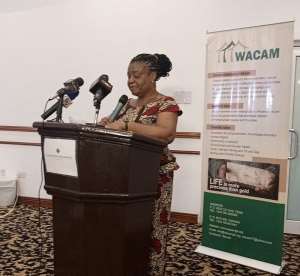
Participants at this year’s edition of “Responsible Mining Forum” have called for the review of the country’s mineral and mining laws to ensure that environmental and human right abuses by operators in the mining industry are curtailed.
They contend that the current punitive measures spelt out in the Minerals and Mining Act, 2006, Act 703 for industry players are not biting enough and rather embolden mining companies to continue to violate the rights of community members with impunity.
They wondered why the framers of the law would make mining giants who are found culpable of the law be made to pay an amount as low as $5,000.00 and left off the hook for human rights abuses in host communities.
Section 108 (1) of the Minerals and Mining Act, 2006, Act 703 says: “A person found guilty of an offence under this Act for which a penalty has not been provided is on summary conviction liable, on first conviction, to a penalty of a fine not more than the cedi equivalent of US$ five thousand.”
“On a second or subsequent summary conviction for an offence under this Act, the court may impose a penalty which is not more than twice the penalty referred to in subsection (1)”, says subsection (2) of the Act.
The forum was organised by WACAM, a premier community-based human rights and environmental mining advocacy Non-Governmental Organisation in Ghana with a community-based focus.
It was under the theme: “Achieving the Responsible Mining Goals: a Reality or Mirage?”
Participants included representatives of the Minerals Commission, the Chamber of Mines, Ghana National Association of Small-Scale Miners, University of Energy and Natural Resources, and the Forestry Commission, among several others.
The participants deliberated on “examining the effectiveness of responsible mining policies in Ghana” and “achieving responsible mining in Ghana, the way forward”, among others.
Respect for human rights
Speaking to the media, the Executive Director of WACAM, Mrs. Hannah Owusu-Koranteng noted that responsible mining is not only about obtaining the required documentation required by law to operate as a mining company but also respecting the fundamental human rights of people whose lands are being taken over for mining purposes.
“If we talk about responsible mining, it’s not just about having the permit to mine but then; with all the documentation, we also want to see that you are not violating rights. In fact, I can recount a number of mining companies which have gone to the extent of even shooting, maiming and killing people just because of mining…and it’s gone on for a while”, she told journalists.
In addition, she said, some mining companies distort the socio-cultural orientation of their host communities by carrying out mining operations in places such as cemeteries, which hitherto were no-go areas for such activities.
“Human rights issues are all-encompassing. The socio-cultural, environmental…. All these are rights. For instance, if you to a community and because of your mining, you distort their orientation, their cultural orientation and all that, you go and mine cemeteries, exhume bodies including my own daughter. I’ve lost my daughter for life because the place where she was buried has been mined. These are the intangibles that people may not talk about but they are all human right violations.”
Harassments
She expressed concern about the use of security personnel by industry players to intimidate and suppress poor community members in mining areas.
Mrs. Owusu-Koranteng mentioned Terchire and other communities in Tano North municipality where the military and the police have been deployed to force people out of their lands to enable Newmont Ahafo Mine to undertake mining operations.
“As we speak now, you are journalists, just go to Terchire and its environs, military people are there, police are there working with regulators to force community people out of their lands…There is no compensation paid but people are being forced out of their communities”, she said.
She was worried that those who are supposed to ensure that the laws are implemented appear to be teaming up with the industry to suppress community rights; adding that “We can talk about Obuasi. We have documented this; people are shot and killed guard dogs were released to eat up human beings just because community people had not been paid compensation due them and they had the audacity to speak up on the matter.”
Recounting a similar incident in 2002, Mrs. Owusu-Koranteng said: “If you go to Tarkwa, Kyekyewere; it happened. 2002. People were beaten up; women and men were put in the same cells for three days. After the third day, they separated the men from the women and they lived on for six days and so in all they kept them for six but the laws of the country say you cannot keep someone for more than 48 hours without putting the person before court.”
“When we talk about infractions in mining, we most of the time think of the small-scale miner, we thing about the galamsey operator and we are not looking at mining as an entity that if we allow people with licenses, with permits to mine without supervising their actions; because of profit motive they can go in and conduct business in a manner that would violate rights”, she emphasised.

 PURC increases electricity and water tariffs effective July 1
 GWL charges customer over GH¢74,000 for illegal reconnection
 Interior Ministry suspends Kantanka Security Services licence over Adwoa Safo sh...
 Torrential rains wreak havoc in Central Region as 18 killed, hundreds affected, ...
 Police invite Nana Kwadwo Safo Akofena over Kwabenya shooting incident
 Biakoye NPP Vice Chairman commends Agbodza, demands urgent fixing of deteriorati...
 Pregnant mother of three hospitalised after alleged assault by husband
 Senior student allegedly slaps Junior repeatedly over missing mobile phone at Nc...
 There was no gun in Adwoa Safo’s car, I saw more than 30 bullet holes on her car...
 NPP Bantama Chairman, Vice Chairman arrested after clash over constituency album...


