




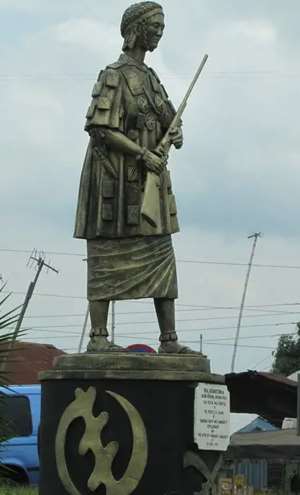
In the heart of Ejisu, near Kumasi, stands a powerful statue of a woman whose name has become synonymous with resistance, dignity, and fearless leadership: Yaa Asantewaa. She was not a monarch in the conventional sense, nor a military general trained in colonial warfare, yet she rose to become one of the most formidable figures in African anti-colonial history.
Her legacy is inseparable from the 1900 conflict known as the War of the Golden Stool a defining moment in the history of the Ashanti Kingdom and West African resistance.
Early Life and Origins
Yaa Asantewaa was born in the mid-19th century in the Ashanti Empire, in what is today Ghana. She came from a royal lineage tied to Ejisu. Her mother, Afia Kobi, was the Queen Mother of Ejisu, and her father is believed to have been Kofi Tene. Through this maternal line, she inherited royal status and the responsibilities that came with advising on leadership and succession.
Like many women of her era in the Ashanti aristocracy, she did not receive formal Western schooling. Instead, her education came through traditional Ashanti systems training in governance, oral history, diplomacy, agriculture, and cultural leadership. These systems prepared royal women not as passive figures, but as political actors with influence over kingship and state affairs.
From a young age, she was exposed to leadership structures where Queen Mothers played a crucial role in selecting kings, mediating disputes, and safeguarding cultural continuity. This environment shaped her political awareness and sense of duty.
Rise to Leadership: Why She Stood Apart
Yaa Asantewaa became Queen Mother of Ejisu in her adulthood, and her leadership was marked by a rare combination of wisdom, assertiveness, and uncompromising defense of Ashanti sovereignty.
What made her unique was not only her position, but her willingness to act decisively in moments of crisis. When internal divisions weakened Ashanti resistance against British colonial pressure, she emerged as a unifying voice.
The turning point came in 1900, when the British Governor demanded the sacred Golden Stool the symbol of Ashanti unity, kingship, and spiritual identity. This demand was seen not merely as political aggression, but as cultural desecration.
During a council of chiefs, when male leaders hesitated to launch resistance, Yaa Asantewaa reportedly challenged them with a now-famous message: if the men of Ashanti would not defend their honor, then the women would.
This moment cemented her place in history not because she rejected male leadership, but because she embodied leadership itself when it was most needed.
The War of the Golden Stool (1900)
The conflict that followed was not just a military confrontation; it was a civilizational struggle over identity and sovereignty.
As the leader of the resistance, Yaa Asantewaa mobilized Ashanti forces, coordinated strategy, and inspired warriors to defend their land against British colonial forces.
Though the Ashanti were ultimately defeated due to superior British weaponry and organization, the resistance was fierce and prolonged. Yaa Asantewaa’s leadership became a symbol of defiance that outlived the military outcome.
Her capture marked the end of organized resistance in that phase, but not the end of her influence.
Exile and Death
Following the defeat, Yaa Asantewaa was arrested along with other leaders and exiled to the Seychelles Islands, far from her homeland. She spent the remaining years of her life in exile, separated from the land she had fought to defend.
She died in 1921 in Seychelles.
Her death, though far from home, did not diminish her legacy. Instead, it elevated her into a mythic national figure whose story traveled across generations.
Impact on Her Region and the Ashanti Kingdom
Yaa Asantewaa’s resistance had lasting effects on both the Ashanti Kingdom and broader Ghanaian identity:
It preserved the symbolic importance of the Golden Stool as the heart of Ashanti identity.
It strengthened the narrative of African resistance against colonial domination.
It demonstrated that leadership was not confined to gender or military training.
It inspired later nationalist movements that contributed to Ghana’s independence in 1957.
Her actions also reinforced the political significance of Queen Mothers in Ashanti governance, ensuring that women’s leadership roles remained central in cultural memory.
Why She Still Stands Tall Today
The statue of Yaa Asantewaa in Ejisu is not merely a memorial; it is a statement.
It represents:
Courage in the face of overwhelming power
Cultural pride in the preservation of identity
Female leadership in a historically patriarchal colonial context
Resistance as a moral and political force
What makes her stand out is not only what she did, but what she represents: the idea that leadership emerges from responsibility, not privilege.
Lessons and Inspiration from Her Legacy
Yaa Asantewaa’s life continues to teach powerful lessons:
1. Leadership is situational, not gendered
When systems fail or hesitate, leadership often emerges from unexpected places.
2. Cultural identity is worth defending
Her defense of the Golden Stool was ultimately a defense of identity and dignity.
3. Courage is action under pressure
She did not wait for perfect conditions; she acted when silence would have meant surrender.
4. History remembers those who stand, not those who wait
Conclusion
Yaa Asantewaa remains one of the most powerful figures in African history not because she commanded vast armies, but because she refused to let her people’s identity be erased.
Her story, rooted in Ejisu and echoing through Kumasi, continues to inspire generations across Africa and the world.
She did not only fight a war; she redefined what it means to stand for something greater than oneself.
By:
Patrick Belebang Yagsori
+233240292413
[email protected]
 Iran deal: Trump is back to square one, but the cards are now in Tehran’s favor
 Mahama held back acceptance of Sophia Akuffo's resignation letter at request of ...
 Zoomlion workers petition Ashanti Regional Minister over unpaid salaries
 Stay away from married men to avoid premature deaths - Atwima Trabuom Queen moth...
 Afigya Sekyere East: NPP Constituency Chairman petitions regional executives ove...
 Nyinahin Catholic SHS incident: 11 CSOs petition NTC to investigate alleged teac...
 Current presidential staff salaries inherited from Akufo-Addo era — Kwakye Ofosu
 Publish Sophia Akuffo’s resignation letter now – Martin Amidu urges govt
 Bole SHS investigates alleged sexual misconduct involving teacher and student
 Justice Sophia Akuffo did not disclose reason for Council of State resignation —...


