




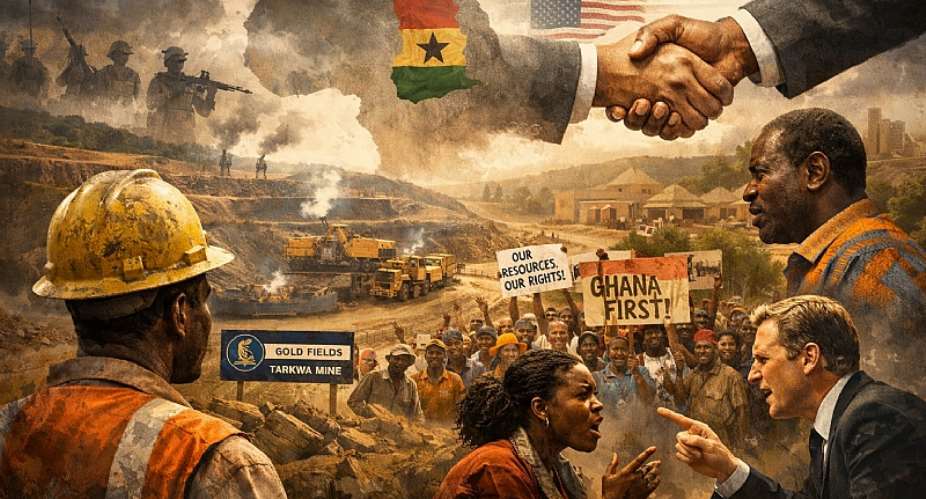
The debate surrounding the possible renewal of Gold Fields’ Tarkwa mining lease in Ghana set to expire in April 2027 after more than 33 years of operation has quietly evolved into something far bigger than mining rights. It is now a political, economic, and continental conversation touching on sovereignty, foreign investment, corporate diplomacy, and the growing tension between African states and multinational corporations.
At the center of this debate is the South African mining giant Gold Fields, which is reportedly seeking a 20-year extension of its operations in Tarkwa. Reports also suggest that the company is appealing for political backing from Cyril Ramaphosa to engage Ghanaian authorities. On the Ghanaian side, the final decision will rest with state institutions and ultimately John Dramani Mahama and relevant regulatory bodies.
But beneath the surface lies a more complex and uncomfortable set of questions that few are asking publicly.
Is This Just a Lease Renewal or a Test of African Economic Sovereignty?
On paper, this is a routine mining lease extension. In reality, it raises fundamental questions about who truly controls Africa’s natural resources.
Gold Fields has operated in Tarkwa for over three decades. That is long enough to transform not just a mine, but an entire local economy, workforce structure, and environmental footprint. So the question becomes:
At what point does “investment” become “permanent extraction”?
Should 33 years automatically justify another 20 years?
What measurable benefit remains for Ghana that cannot now be handled by local or diversified operators?
And perhaps the most uncomfortable question:
If a foreign company has mined a resource for over three decades, what exactly is left to negotiate ownership or dependency?
The Political Dimension: Why Is South Africa Being Dragged into It?
The reported appeal by Gold Fields for support from the South African presidency introduces a delicate diplomatic layer.
Why would a private mining company require state-level diplomatic engagement in a lease agreement governed by Ghanaian law?
This raises critical concerns:
Is corporate power now blending with state diplomacy in Africa?
Does this set a precedent where multinational companies “internationalize” domestic regulatory decisions?
What pressure does this place on Ghana’s regulatory independence?
If governments begin lobbying other African governments on behalf of corporations, where does sovereignty begin and end?
Should the Lease Be Renewed? A Divided Continental Debate
There are three competing schools of thought:
1. The Economic Stability Argument
Supporters of renewal argue that:
Thousands of jobs depend on the mine
The company brings technical expertise
Sudden exit could destabilize local economies
Ghana benefits from taxes, royalties, and infrastructure
2. The Resource Reclaim Argument
Critics argue:
33 years is more than enough for one operator
Ghana should transition toward local ownership or new investors
Resource extraction has long-term environmental costs
Benefits may not be equitably distributed
3. The Strategic Transition Argument
A middle position suggests:
Renewal should not be automatic
Ghana should renegotiate stricter local content requirements
Value addition (refining, processing) should be prioritized locally
New partnerships not prolonged dependency should be the goal
The Xenophobia Question: A Hidden Economic Risk in South Africa’s Foreign Footprint
Another layer complicating the discussion is the recurring issue of xenophobic violence and tensions in South Africa, where foreign nationals and businesses have periodically faced attacks or hostility.
While not representative of the entire population, these incidents have created reputational and operational risks for South African-linked businesses operating across Africa.
This raises important questions:
How does perceived xenophobia affect trust in South African companies abroad?
Are African states becoming more cautious about long-term dependence on South African corporations?
Could political or social instability in one country influence business diplomacy in another?
Even without formal state policy, public perception matters. And in business, perception often shapes policy decisions.
Are South African Businesses Becoming Diplomatic Hostages?
The reported sentiment that “South African businesses have started begging foreign countries not to cut ties” reflects a deeper anxiety: the fragility of multinational corporate trust in an increasingly nationalist African economic climate.
This is not unique to South Africa but South African firms are highly visible due to their dominance in sectors like mining, retail, banking, and telecommunications across the continent.
The question is no longer just about profitability:
What happens when African countries begin prioritizing economic nationalism over legacy foreign operators?
Are companies prepared for a continent where licenses are no longer automatically renewed?
Is Africa entering a new phase of economic renegotiation with itself?
Mind-Blowing Questions Nobody Is Asking
1. If Gold Fields leaves Tarkwa tomorrow, who truly has the capacity to take over immediately?
2. If Ghana renews the lease, what guarantees exist that “better terms” will actually translate into national wealth?
3. Should African governments impose strict maximum operating durations on foreign mining companies?
4. Why are African resource contracts still largely negotiated in models inherited from colonial economic systems?
5. Can African states truly enforce sovereignty while relying heavily on foreign extractive expertise?
6. If South African businesses face backlash abroad, is it purely political or reputational self-inflicted damage?
7. Should mineral-rich countries form a unified African mining regulatory framework instead of fragmented national agreements?
What Will Governments Likely Do Next?
Ghana’s Position
Ghana is unlikely to make an emotional decision. The government will likely:
Conduct technical and environmental assessments
Review revenue and community impact data
Renegotiate terms rather than reject outright
Push for stronger local participation and value addition
South Africa’s Position
South Africa’s government, led by Cyril Ramaphosa, will likely:
Maintain diplomatic neutrality
Avoid direct interference in Ghana’s regulatory process
Quietly support corporate interests through diplomatic channels if necessary
Conclusion: A Defining Moment for African Resource Politics
The Tarkwa lease debate is not just about Gold Fields. It is a mirror reflecting a larger continental struggle:
Between investment and independence.
Between continuity and change.
Between corporate history and national future.
If Ghana renews the lease, it must do so on radically improved terms that reflect today’s economic realities not yesterday’s agreements.
If it does not, it must be prepared for the economic and political consequences of redefining a long-standing partnership.
Either way, one truth is becoming unavoidable:
Africa is entering an era where resource ownership is no longer just about what is underground but about who has the power to decide what happens above it.
By:
Patrick Belebang Yagsori
+233240292413
[email protected]
 June 12: Cedi appreciates, sells at GHS12.50 on forex market, GHS11.06 on BoG in...
 'Unemployment requires deeper structural reforms, not slogans' – Stephen Amoah c...
 UE/R: Sandema flooded as heavy rains cut off major road
 Nigeria killed 13,000 'terrorists' in past year — President Tinubu
 Take the path to greatness through constitution review — Barker-Vormawor to Maha...
 Ghana evacuates over 500 citizens displaced by Abidjan demolition exercise
 Youth keep acquiring degrees with no end in sight due to lack of jobs — Sammi Aw...
 2026 World Cup: Black Stars arrive in Rhode Island for final phase of preparatio...
 Adu-Boahene trial: Prosecution witness denies claims of inter-branch fund transf...
 Sales boy captured on CCTV cameras stealing GH¢217,000 from employer jailed 36 m...


