




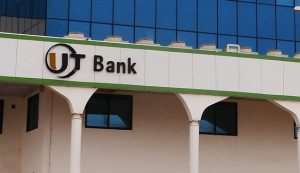
An investigative report has revealed a rift between some of the shareholders of the new defunct UT Bank that stemmed from the shady payment of royalties.
International Finance Corporation (IFC), which had 20.28 percent shareholding as at the time the bank collapsed in August 2017, alleged that UT Bank was making shady payments to its majority shareholder, UT Holdings (UTH).
The royalty payment was based on a percentage of forecast interest income and noted as 5 percent of the budgeted gross income.
According to the report, IFC held that “the payment of the royalty had not been properly disclosed to it during its due diligence.”
The report noted that “this singular matter severely strained the personal and institutional relationships between the IFC and the bank.”
The Bank of Ghana intervened but “only partially succeeded in resolving this impasse.”
“As part of this, the BoG ordered the immediate cessation of payment of royalties to UTH until all shareholders agreed to its payment.”
The report indicated “there is no evidence on record that this agreement was ever achieved although the bank continued to pay a fixed monthly amount of GHS350,000 to UT Holdings as a management fee.”
The BoG's Supervisory Department’s risk assessment summary in 2015 noted that the payments were supposed to have been suspended as far back as 2013 “until the consent of other significant shareholders was obtained and the Bank of Ghana approval given.”
The UT Bank had paid GHS2.8 million as royalties to UTH from July to November 2014, according to the report.
BSD directed the UT Bank Board to “immediately ensure that the royalties of GHc2.8million paid to UT Holdings are refunded by end April 2016 and write to explain to the Bank of Ghana why UT Bank should not be sanctioned for flouting the directives of Bank of Ghana.”
Denied $40 million credit
Also in 2015, IFC conducted a routine review of the disbursements and operations of beneficiaries of a $40 million Trade Finance Line of Credit which it had provided the bank.
The review revealed several lapses and breaches.
“The ensuing discussions of the breaches and remedial measures became acrimonious and the IFC withdrew the line of credit and removed the UT Bank from the list of trade and fiancé partners on its website.”
UT Bank believed this had a negative impact on its relationships with other international correspondent banks.
IFC negligence?
At a point, IFC did not have a board representative because it failed to exercise its right to nominate a director, the report note.
The members of the UT Bank Board as at the time of its collapse consisted of the six persons; the CEO at the time, Stephen Antwi-Asimeng, three members from UTH and two independent persons nominated by co-sponsors.
The company's shareholders agreement prescribed a maximum board strength of nine persons.

 Accra-Kumasi return flight now costs up to GH¢5,000 despite lower inflation — Ak...
 NDC using 24-hour markets to cover failure to implement 24-hour economy — Okyere...
 'No African country can solve the problem of road crashes alone' — Transport Min...
 ORC announces temporary disruption to e-Registrar services
 NDC’s GoldBod is a copy of NPP’s plan but implementation has failed — Ocquaye Jr
 Sammy Gyamfi’s words on Afenyo-Markin were harsh; I wouldn’t use them on such pl...
 Bawumia, Japanese Ambassador discuss digitalization, fintech, artificial intelli...
 Supreme Court to rule on bid to halt High Court trials during legal vacation on ...
 Accra–Tema Motorway project reaches 50% completion as roads minister demands fas...
 Nationwide blackout: Power supply expected to stabilise next month – Energy Mini...

