




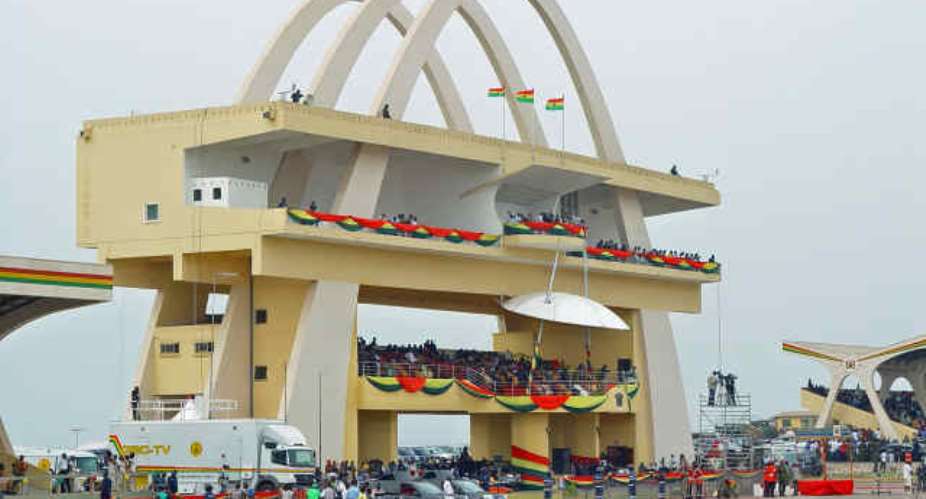
The 6th of March may seem like just “another day” to some people. But to those blessed enough to be at the Old Polo Ground in Accra on the only 6th of March that matters to us – the 6th of March 1957 – it was like no other.
We had been used to worshipping everything that came from Great Britain, or its trading partners in Europe and America. Worse, our very livelihood depended on Britain. For the inscription we read on the coins with which we bought everything we needed read: Georgius Sextus Rex Et Ind Imp” [George The Sixth, King and Emperor of India”.
We didn't know what “Ind”stood for; nor did we understand Sextusor Rex or Imp.!
Amazingly, those were not the only mystifying things about the life we led as inhabitants of the “Gold Coast”. What was a “coast”? Forest-born individuals had no inkling what an “ocean” and a “coast” were.
In actual fact, our lives were quite unreal. Our more important chiefs trooped to a place called Dodowa once a year, listened to a white-man called the “Governor” and came back to tell us – nothing.
It would only be after a few weeks had elapsed that we would hear “gong-gong” [dawuro] being beaten by the town-crier, who would inform us that the chief wanted us to know that the white “DC” [District Commissioner] had said that the white Governor said that (for example) this year, the tax to be levied, known as “lampole” [land poll]probably corrupted from l'impot (French) would amount to two shillings per male and one shilling per female.
Our people would groan but be unable to do anything about the taxes. What did the Governor and his gang do with our money? We didn't know. We had no pipe-borne water; no health clinics; no tarred roads; no public transport. Yet apart from the direct taxes we paid, we also paid taxes put on top of the cost of goods through customs duties. All the things we bought from abroad – cloth, clothing, kerosine, candles, matches, biscuits, sardines, corned beef and other consumer goods-- were taxed.
But there was worse. After our parents had hired labourers to help weed and harvest cocoa and undergo the laborious process of drying it in the sun and making sure that it never got touched by rain, a price for the cocoa was “brought” from England, without reference to any of the costs that had been incurred in producing the cocoa. We had to take that price. Or burn the cocoa! For we could do absolutely nothing with it. We couldn't keep it without making it unsellable. And we had no machines to turn it into chocolate.
The white-men had persuaded us to use land which we would otherwise have used to produce the food we ate, to grow this “cash crop”, cocoa. But what the white-men hadn't told us was that the price they would pay for our cocoa, could go down as well as up!
And sometimes, the price went very low indeed! In 1937-38, for example, almost all the cocoa produced in the country was burnt, in a “boycott-the-cocoa-buyers” movement which the colonial authorities, out of embarrassment, euphemisticallycalled a “cocoa hold-up”. Before the boycott of 1937-38, there had also been a major cocoa “hold-up” in 1930-31.
This cheating by the whites was the reason why our people supported politicians like Dr J B Danquah (“Lawyer Danquah”) who protested publicly against British rule. Danquah was known as “AkuafoKanea” (Lamp of the Farmers) because he taught the cocoa farmers to understand how the European and American chocolate manufacturers had formed a “cartel” to cheat the cocoa farmers.
Danquah and other pioneers of our independence struggle, such as Paa Grant, linked up with others in the 1940s – among them Edward Akufo-Addo, William Ofori Atta, Emmanuel Ako Adjei, and Kwame Nkrumah – to denounce British rule. In particular, they seized on the “Bond of 1844” as a edge the British had made that they would rule the Gold Coast for not more than one hundred years. That 100 years had passed in 1944, so it was time for them to pack up and go back home. It was this struggle – with its many ups and downs – that finally made the British name a date – 6th of March 1957 – as the day they would leave.
When that day arrived, almost the whole of the population of Accra trooped to the Old Polo Ground, at midnight, to hear the post office siren blare out the signal that independence had come. And as the leader of Ghana, Kwame Nkrumah, made the proclamation of independence, the eruption of joy that occurred cannot be described with words.
Just imagine about more than one million people, each emitting shouts of joy at the top of his or her voice! Picture each of them jumping up and down, waving their arms!
And just see in your mind's eye, Dr Kwame Nkrumah, finding the right, immortal words to say to them:
“At last, the battle has ended. And thus Ghana, your beloved country, is free for ever!”
Just sixteen words – no more. But no-one who heard them would ever be able to forget them. The cheers that greeted those sixteen words were, of course, out of this world.
Dr Nkrumah was realistic enough to recognise, in the midst of the tumultuous joy, that all was not going to be rosy in our new country. But with “hard” work” (he said) Ghana, young as it was, would carve its own path in the world and prove that it could win “the respect” of every other nation.
He made that pledge on our behalf. We cannot fulfil it if we do stupid things not even expected of animals – such as destroying our water-bodies, rivers and streams, and the land we use to produce food – through the obnoxious practice known as galamsey.
We are Ghanaians! We are supposed to have common sense. How come our forefathers were able to produce so much gold that their country was called “The Gold Coast” and yet they managed to bequeath us good, healthy rivers and streams to drink water from?
Longer than 600 years ago, gold bought from Elmina alone was recorded by the Portuguese as amounting to:
“8,000 ounces shipped to Lisbon from 1487 to 1489; 22,500 ounces from 1494 to 1496; and 26,000 ounces by the start of thesixteenth century.” (Source: IVOR WILKS).
But our ancestors left our rivers and streams undamaged!
However, in a mere two or three decades, we have allowed galamseyers to destroy such huge river systems as Pra, Ankobra, Densu, Birem, Offin, Tanoh, Oti and their countless tributaries.
Wouldn't our ancestors line the galamseyers up and whip them on their bare backs, if they could come back and see what they have done?
Did J B Danquah, Kwame Nkrumah and others suffer to get us our independence, so that we would make Ghana, “our beloved country”, uninhabitable by our descendants?
Emmusuo bƐn mpo ni? [What terrible taboo are we breaking?]

 No room in our standing orders for reconsideration of anti-LGBTQ+ Bill – Sam Geo...
 Court threatens to struck out Mamprobi Baby theft case over disclosure delays
 How ex-convict allegedly sealed teenager's mouth with super glue, raped and murd...
 About 70% of buildings in Ada East lack permits, to be demolished – DCE
 Accra will no longer be sanctuary for indiscipline — Linda Ocloo declares after ...
 Bono Region: Police investigate murder of retired veterinary officer
 GMA says no emergency patient was denied care at KATH despite congestion concern...
 VIDEO: Fuel tanker driver burnt to death in fiery crash at Adubinso, seven shops...
 IMF boosting financial support for four African nations over war impact
 Anti-LGBTQ+ bill: Public clash between Speaker Bagbin and Majority Leader needle...


