




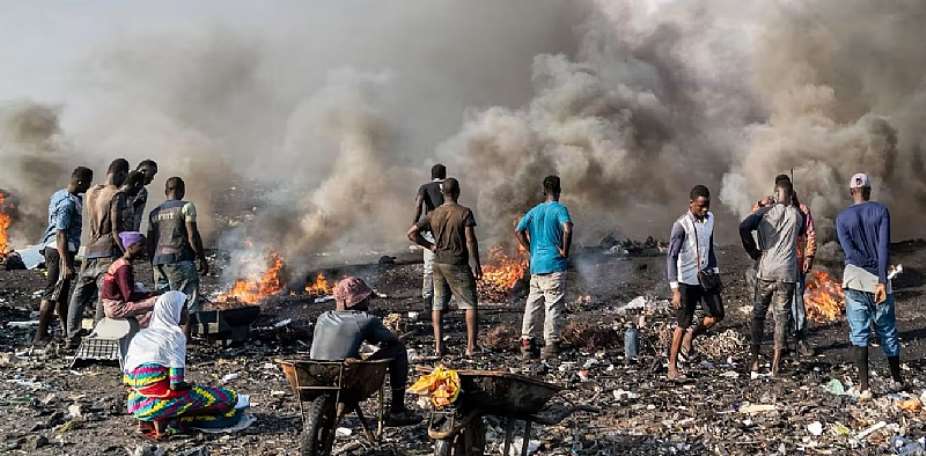
Agbogbloshie, in Ghana's capital city, Accra, is a sprawling, open-air scrapyard located next to a lagoon and a growing informal settlement. Roughly 6,000 people dismantle, recycle and burn old and broken electronics there.
The world produces approximately 62 million tonnes of electronic or e-waste every year. The Agbogbloshie site is one of the world's biggest.
E-waste is old, broken and thrown away electronic devices with cords or batteries, such as cellphones, household appliances, and televisions. Over 80% is dumped in landfills. The rest is processed informally by workers who have no health and safety protections, operating largely without government oversight, support, or occupational safety. Courtesy University of Michigan School for Environment and Sustainability.
Much of the world's e-waste is shipped to countries like Ghana in west Africa where copper and aluminium are extracted, and batteries containing lithium and cobalt are recycled. The old electronics are burned out in the open to extract the minerals. Uncontrolled acid leaching is also used.
The exact value of the minerals fed back into the global supply chain is unknown. However, we do know that informal workers are shortchanged. This is because exporters buy recycled minerals like copper at prices well below international market rates.
Continually recycling and reusing goods, instead of throwing them away, is a core part of the “circular economy” concept. It is supposed to promote sustainability and help address climate change.
But as researchers who study informal economies and how materials move through global supply chains, my colleagues Patrick Cobbinah, Dimitrios Gounaridis and I recently found that the reality behind these supposedly “sustainable” supply chains in Agbogbloshie's e-waste sites is very different.
We found that informal recycling provides an income for workers which is often relatively better than other available work. But the side effects of burning plastic and metal or using acid to extract minerals from the e-waste are devastating to human health and the natural environment.
The situation in Agbogbloshie is part of a global injustice. Wealthy countries enjoy the benefits of recycled materials like copper and aluminium, while some of the world's most vulnerable people are forced to compromise their own health and environments to sustain these supply chains.
Rather than turn away from people living in informal settlements and working in the informal economy, community engagement should influence government policy to improve their working conditions. Supportive infrastructure must be developed at the e-waste site and in the informal settlement. Equally importantly, international regulatory bodies and policy makers from exporting and importing countries must better govern the flows of e-waste. It's too easily dumped in countries like Ghana with little to no recourse.
Where earning a living means breathing toxic air
The men and women working in and supporting the informal e-waste economy in Agbogbloshie are navigating what we call the “informal paradox”. This is where workers have to expose themselves and their communities to toxic pollution in order to get short term livelihood gains. The informal paradox shows that the immediate need to survive replaces the need to avoid chronic threats to human and environmental health.
For example, open burning of electronics has, in part, led to extreme exposure to particulate matter 2.5 (millions of tiny particles of polluting matter such as dust, dirt, soot, or smoke that are released by burning).
The e-waste workers in Agbogbloshie breathe this in at concentrations five times higher than the World Health Organization's safety standards. This increases the risk of heart attacks, cancer, nervous system damage and other diseases.
The toxic dust also spreads out across nearby informal settlements and the entire city of Accra. Agbogbloshie's soil and water are also highly contaminated with these and other heavy metals. The effects spill over to the nearby produce market and lagoon.
What 20 years of satellite data revealed about pollution and survival
To understand how serious and complicated this problem has become, we studied 20 years of satellite data and interviewed 55 community members and city experts in Accra.
Our research found that between 2000 and 2020, air pollution and particulate matter 2.5 increased dramatically around Agbogbloshie. The number of people in nearby informal or shack settlements steadily increased during that time, so more people breathed in the toxic soot.
People migrate from rural areas to Agbogbloshie to escape famine, conflict, and worsening farming conditions linked to climate change. For many, processing and recycling e-waste is the only way to earn a living.
The e-waste workers told us they are aware of the dangers they face. As one said:
The hunter does not fear guns, the same way we don't fear the weapon we work with.
Informal work is the global norm, not the exception
A huge 61% of the world's workforce is employed informally. This means that working informally is not something that only people on the margins of society experience. It is global and commonplace.
Therefore, new ways to include informal work in the world's development and supply chains are needed. These must be based on working with, not against, the people who have the least access to services and opportunities.
Guaranteeing basic human and labour rights must be a non-negotiable foundation of the global circular economy. There are also very real economic opportunities in improving working conditions in the e-waste sector. Global e-waste stocks are estimated to be worth US$65 billion. Yet many e-waste workers earn less than US$1.25 a day.
If responsibly managed in the interests of local communities, recycling could lift thousands of people out of poverty and contribute to an actually sustainable circular economy.
What to do about it
Ghana has ratified both international conventions that regulate e-waste. The country also passed a law to manage e-waste in 2016.
But government intervention remains very weak and sometimes even actively harmful. The government has carried out hostile evictions and housing demolitions to remove people from the dumpsite. These have not reduced e-waste recycling though, and have only made workers' lives more precarious.
To properly address these problems, the Accra Metropolitan Assembly must end home demolitions and evictions in Agbogbloshie's informal settlements.
Instead, the government should invest in and strengthen the ways residents are already working together to share resources and improve their neighbourhoods. One way to do this is by providing safer equipment, such as mechanised wire-stripping machines to stop the burning as well as protective gear. Local government in Accra could also ensure that e-waste workers earn fair wages in return for using safer, more environmentally friendly methods.
Second, transparency at the point of e-waste sale is essential. New regulations are needed to compel large-scale scrap dealers to officially record the weight of the material they buy, and ensure they pay a publicly accessible market rate.
Third, working with the e-waste workers and community members to set up reliable, clean water sources, limit burning, and reduce the use of acid in e-waste recycling is also critical.
These steps require a transformation in the ways people think about and support those who live and work in informal economies and settlements. This process begins with treating people with the respect and dignity they and their work deserve.
Dr. Brandon Marc Finn received a Catalyst Grant from the Graham Sustainability Institute and a STEM-Africa Grant from the African Studies Center to support this work. Both organizations are based at the University of Michigan.
By Brandon Marc Finn, Research Scientist at the School for Environment and Sustainability, University of Michigan

 'Chief Justice was talking as a citizen; you have to look at the context in whic...
 Mandatory towing to remove broken-down, stationary vehicles from roads to begin ...
 Domelevo backs OSP probe into alleged GH¢70,000 payment to Appiagyei despite den...
 WAEC releases 2026 WASSCE results, cancels entire results of 861 candidates for ...
 Baffour Agyeman-Duah explains why profitability may not be only reason behind SO...
 Kofi Bentil defends Mahama’s dissolution of nine State Boards
 5-year-old girl dies after falling into water-filled manhole at Winneba
 Sierra Leone ex-president to return after treason case dropped
 'Explain how you spent your Common Fund' — Boako, Annoh Dompreh challenge Tano N...
 Ghana ends South Africa evacuation; brings home nearly 1,900

