




Accra, Feb. 15, GNA - The Symposium of Episcopal Conferences of Africa and Madagascar (SECAM) on Friday launched a Pastoral letter on Governance, Common Good and Democratic Transitions in Africa.
It was officially signed by Polycarp Cardinal Pengo, Archbishop of Dar-es-Salaam, Tanzania and President of SECAM and distributed to all member states as well as other stakeholders including the United Nations for digestion and action.
The script, which derives its inspiration from Pope Benedict XVI's Post-Synodal Apostolic exhortation, seeks to point out the prominent role that the Church play in terms of being the custodian of ethical values, pacesetter in the process of democracy and as the main stakeholders in good governance and the common good of the society.
The letter indicates the important role each member of the society plays for the common good of its members, stressing on the fact that a better society is not for the benefit of the elite, but for all.
'The way in which we organise our society directly affects human dignity and the capacity of individuals to grow together in community and contribute to Common Good.
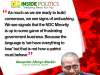
'The Common Good is the sum total of social conditions which allow people, either as groups or as individuals, to reach their fulfillment more fully and more easily,' he said.
The Pontiff, in his message pointed out that peace is not merely a gift to be received; but it is also a task to be undertaken, and urged the church to first educate itself in compassion, solidarity, and fraternity and to be active within their communities in order to be peacemakers.
The Most Reverend Gabriel Mbilingi, Archbishop of Lubango-Angola, who gave an overview of the letter said in the spirit of justice and peace the script was clear about the fact that the common good, respect of people's rights and the promotion of good governance were the essential elements of the Gospel.
It therefore urged the Church to raise awareness about national and international issues and also the importance of seeking adequate mechanisms for the redistribution of wealth, the promotion of growth, co-operation for development and conflict resolution.
He said the Church in Africa cannot be indifferent and isolated in the face of the continent's socio-political and economic differences.
According to the letter the Church in Africa lives and works in a society in which it encounters the tragedy of human selfishness, pain and suffering in the midst of a politically tense environment.
'At the same time the Church is called upon to break the wall of powerlessness in the face of difficulties, to be overcome by living in solidarity with the disadvantaged of God's children,' he said.
The Most Rev Mbilingi said the script views human beings as being granted free will, which is the human freedom expressed through one's choice to belong, and one's choice to express oneself freely in truth.
He said in the exercise of this freedom in truth, human beings cannot be subjected to unnecessary restrictions and these considerations explains the passage to democratic transitions, and indeed, demands a new form of governance in Africa.
The Most Rev Mbilingi said the letter therefore urged political leaders in Africa to see poverty eradication as a priority by denouncing all forms of corruption and using proceeds from the continent's natural resources to achieve their developmental goals.
It also calls on political leaders and governments to address the issue of elections, to ensure that they are free, fair, transparent and non-violent.
In its concluding statement, the Pastoral letter explores the role of the Church, using access points that include liberation, reconciliation and reconstruction, vis-Ã -vis democratic values of the quest for human dignity and participation of all people in decisions that affects the quality and direction of their lives.
It said a time from colonial rule and other systems of governance, to democracy in Africa was symbolic and it was an opportune time, stressing also on the fact that transition created new opportunities to heal wounds and build bridges.
The letter said the challenge now was for Africa to seize the opportunity and its burden of responsibility to redefine the task of the Church and society in general, in working towards building of our nations in Africa.
It said the Church would therefore continue to collaborate with governments and other institutions for the integral human development of the people of Africa.
The Most Reverend Gabriel Palmer-Buckle, Archbishop of Accra, explained that the SECAM which he said was founded in 1969 and had since worked hard towards the promotion of the Church as a family of God in Africa, foster communion, collaboration and joint action among all Episcopal Conferences to propagate the Christian faith and human development.
GNA
 NCA clears MTN, Telecel and Goal Telecom for next stage of 5G spectrum licensing
 ICT accounts for 41.5% of Ghana’s 6% Q2 2026 economic growth – GSS
 Ghana Highway Authority to correct defects on portions of Eastern Corridor Road
 ECG private sector participation to be determined after transaction advisor's re...
 Over 70% of Ghanaians walking with hypertension unaware – Cardiothoracic Centre ...
 Weija Dam spillage: $350million flood control project to begin by December
 Ghanaians should be grateful for voting Mahama back to power for saving Ghana’s ...
 I remain committed to NPP despite withdrawal from National Organiser race — Sala...
 John Boadu, Sammy Crabbe, Paul Afoko, Boakye Agyarko secure 1st to 4th spots in ...
 Auditor-General report exposes financial rot at 18 assemblies in Volta Region; C...

