




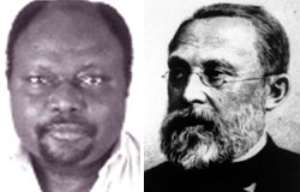
'When you are youthful, you think as such.' This is not an attempt to quote the Apostle Paul. The class in which I learned the German language, a prerequisite to entering any German institution, had a language teacher who quoted the prominent German named Virchow, virtually any time he entered the class to teach German.
You could, therefore, imagine the number of times we were made to hear the name Karl Rudolph Virchow during the six months of intensive language course, preparing us to enter the University. As if that would not be enough, I would take a two-hour train-ride from Leipzig to Berlin, and the first major street I might enter, either by foot or on a bus, could be called 'Virchow Str.' Well, it was not everything the language teacher rattled off at that stage that I understood fully, but it bestirred my 'imagining.'
Then, almost as often, the unforgettable teacher would mention another prominent German citizen of yesteryears, who was Virchow's contemporary. He was called Otto von Bismark [1815-98], also known as 'the Iron Chancellor'. It was much later in my time in the Teutonic country, that I came to appreciate the various encounters between the two prominent German citizens, who had been both about sixty years since dead.
Just a couple of phases with Virchow, who was born in a small almost impoverished community in Pomerania, in the Eastern part of the country, in 1821 AD. From very humble initial rustic conditions, he studied Medicine, and he was a top-class student. His specialisation in the field of Pathology, almost a matter of fact, was at a place no less than the Medical Academy in Berlin, the 'Charite', at the time, the best place of learning in medicine in the entire Western Europe. He conceptualised that diseases must all originate from the unit of the organism called the CELL (Cellular pathology). He initiated furthermore, the thought that, 'medicine is a social science, and politics is nothing else, but medicine on a large scale.'
Still on his thoughts with medicine linked with our way of life, he once wrote: 'The physicians are the natural attorneys of the poor, and social problems fall, to a large extent, within their jurisdiction.' He was, on one occasion, assigned to lead a commission to investigate an outbreak of Typhys in Upper Silesia in 1848. Rudolph Virchow had this to inform the Senate on his return: 'The outbreak could not be solved by treating individual patients with drugs, or with minor changes in the food, housing, or clothing laws, but only through radical action to promote the advancement of an entire population.'
He thus put himself forward as a pioneer of social medicine, and anthropology. He advised all fellow-doctors to 'think microscopically.' The report emanating from his assessment of how 'under-classic' the province of Upper Silesia was treated by the state, however, did not go down too well with the Senate – and Otto von Bismarck was the 'boss.' Virchow was removed outright from the high office he was assigned to at the Medical Academy and the Senate. He was deported from Berlin entirely to Nurnberg for a full decade (1849-1858). The truth always pierces out, and scientific truth, especially, vehemently so.
Ten years later, the indefatigable Virchow was recalled back to Berlin, and his position re-consolidated, with all benefits. He continued to fight for social rights for the under-trodden, and in addition, he realised it was inevitable that he entered politics actively. So, he did. He formed a political party, in which many intellectuals participated. No piece of oriental carpet was big enough to cover his inevitable challenge to the pragmatism of the Iron Chancellor, Bismarck.
It went as far as the Chancellor having to organise 'a duel' between himself and the 'bold pertinent Scientist.' Since both men were avid fencing enthusiasts, what could better be chosen than a fencing duel of the 19 th Century? As it got so hot with the preamble, fanned by enthusiasts from both sides, Virchow's supporters advised the Scientist to pull out. So, he did, having thought of it deeply, and agreeing with his supporters. The duel, whose preamble had brought temperatures to hit the skies of Berlin, never took place. A good friend of his, Hugo Vogel's portrait showing the Scientist in the best mood, says it all.
Rudolf Virchow is known throughout the world by doctors, first as father of modern Pathology, and also, as 'Social worker Medicus par excellence.' Virchow, a father of six children, is said to have been espoused to a woman whose 'energy light' never went off. His children extended helping hands to the German medicine-engineered Scientist, who so changed Germany, and to a large extent, the world, when talking of medico-social circumstances.
Doctors everywhere remember him by such terminologies as: Virchow's Line; Virchow-Robin Space; Virchow's Psammoma (a type of meningioma); and Virchow's Sentinel node with gastro-intestinal tumors. And there are sixteen nomenclatures.
Virchow, it is said, once told his friends, and colleagues, mostly doctors, 'Let us be able to say at the end of it all, we ought to do more for mankind'. He died in Berlin at the age of 81, in 1902.
Kofi Dankyi Beeko, MD, [email protected] mailto:[email protected]
 We were told dumsor would end with the levy – Dr Zaato fumes
 Did NPP use magic or witchcraft to keep our lights on? – Zaato jabs govt over du...
 Kofi Jumah sweats in EOCO custody as he struggles to meet GH¢55million bail cond...
 Cocoa prices to decline by over 50% globally in 2026 – World Bank
 Korle-Bu Doctors Association threaten strike over lack of laboratory and outpati...
 Ghana begins sixth IMF review as Finance Minister hails reform progress
 Otumfuo urges feuding factions in Middle East and Europe to cease fire
 Adamus Resources Boss Angela List buys Otumfuo gold artwork for GH¢1million
 FDA seizes over 2,100 banned alcoholic energy drinks in Western North Region
 Our prudent economic management shields Ghana from global shocks – Asiedu Nketia...


