




In every profession, there is the good, the bad and the ugly. When a judge makes a mistake, the accused is shipped to jail quietly. The mistake of the doctor is papered in a terse announcement: 'The patient died after a short illness.' The mistakes of the journalist are there on the front pages and the airwaves for all to see and hear.
The media landscape in this country has, over the years, seen renowned practitioners who have left their prints in the sands of time. When the Bannerman brothers set the pace in indigenous journalism with their hand-written Accra Herald, in the 19th Century, they set the pace in the information industry in the country.
Before then, information dissemination in the country was through the beating of the gong gong on the orders of the palace, or through the talking drums that informed the people about impending wars or any other information of importance.
When Osagyefo Dr. Kwame Nkrumah set up the Accra Evening News to champion the cause of self-government now, its impact was infectious. The majority of nationals of this country bought into the idea, and the 'Freedom' chant and its salute became the rallying cry that swept through the then Gold Coast like wildfire.
That is why some of us are disappointed with the call on the nation to discourage politicians from owning media outlets to propagate their views. All over the world, media outlets have tended to tilt their editorial contents towards one or the other of the ideological divide.
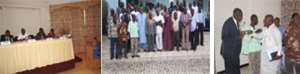
It is the need to reduce tension in society as the nation prepares for the next elections that the Institute of Economic Affairs (IEA) paraded senior journalists at the plush Capital View Hotel in Koforidua with members of the various political parties in attendance at the week-end.
The seminar kicked the idea of banning politicians from owning media outfits in this country to touch, and plotted the path to a tension-free society, as the nation prepares to go to the polls next year.
The three-day seminar was an occasion for the media to mingle with the top brass of political parties in the country. Dr. Kwabena Adjei, Chairman of the National Democratic Congress (NDC), who was penciled in to feature, could not make it, which disappointed a number of media personnel who wanted to understand the rationale for the party's brush with the judiciary. The opportunity was thus lost for the media to get behind the 'several ways of killing a cat' threat the party boss issued not too long ago.
Mr. Johnson Asiedu Nketiah, General Secretary of the ruling party, sat through the seminar inviting a number of interventions in a statement he made that the NDC won 60 percent of the Metropolitan, Municipal and District assembly elections that was so hopelessly organised that it spanned two years.
His assertion brought conspiracy theorists to their feet. The assertion is that the government's decision to give 6,000 motorbikes to assembly men and women throughout the country might have been occasioned by the ruling party discovering that making assembly members mobile would aid at least 60 percent of them to work on behalf of the party in the 2012 Presidential and Legislative elections.
The New Patriotic Party (NPP) was represented by a strong team composed of National Chairman Jake Okanta Obetsebi-Lamptey, immediate past Chairman Peter MacManu and First Vice-Chairman Fred Oware. The NPP delegation seized the opportunity to impress on delegates that the 'all die be die' mantra was not borne out of the party's desire to be belligerent.
In the chair was Alhaji Ahmed Ramadan, National Chairman of the People's National Convention (PNC), who urged the media to respect the multi-political nature of Ghana's democracy.
The media gurus, particularly, leading radio hosts, were all present. Five of them - Kwame Sefa Kayi of Peace FM, Joy FM's Morning Show Anchor, Kojo Oppong Nkrumah, Roland Acquah Steven of Radio Gold, Paul Adom Okyere, Good Evening Ghana host on Metro TV, and Kennedy Mormah of Oman FM made short presentations on 'Political Commentators on Morning Shows and Polarisation.'
Prof. Justice A.K.P. Kludze, a visiting Senior Fellow of the Institute of Economic Affairs, organisers of the seminar, set the tone with his welcome address, which challenged media organisations and practitioners to strategise to take away what he called 'unnecessary heat and rancour out of our political discourse.'
He said it was not for nothing that the media are referred to as the Fourth Estate of the Realm. They constitute a formidable force that could shape the destiny of any nation. The media, he warned: 'can be manipulated to subvert the very society which it is supposed to serve. Where the press abandons its lofty ideas and allows practitioners to suppress the truth, or to contrive to have the truth truncated, they prepare the ground for misrule and anarchy.'
He expressed concern over the direction of talk shows on radio especially. 'These talk shows are not entirely objectionable,' he explained. 'Properly handled, they should provide a useful avenue for citizens to discuss issues freely, and to involve the contributions of the ordinary man and woman. It appears, however, that some of these talk shows are often hijacked by professional commentators who have nothing to contribute to the discussion.
Instead of constructive debates, they indulge in vituperation and the vulgarity of abuse as their stock in trade.'
He said though those involved in what he called 'despicable conduct' constitute only a small fraction of society, 'they are loud and persistent enough to amount to a menace to our society and the prostitution of the freedom of the speech and expression.'
Prof. Justice Kludze engaged in a healthy debate with Prof. Kwamena Ahwoi, of the Ghana Institute of Management and Public Administration, who delivered a paper, put together earlier on the platform of General Secretaries and Policy Analysts.
The one-time Minister of Local Government and Rural Development had suggested that bomb-throwing by activists of the now defunct National Liberation Movement, and the enactment of the Preventive Detention Act by the Convention People's Party (CPP) regime, which threw a number of Ghanaians into detention without trial, created tension in society.
'Whilst the opposition NLM/UP was throwing bombs in their bid to either assassinate Kwame Nkrumah or scare his followers, the CPP operatives were also causing the detention of opposition elements without trial under the Prevention Detention Act (PDA), in their bid to cripple the opposition and render them ineffective as an opposition,' Prof. Ahwoi stated.
This brought the retired Supreme Court Judge to his feet. Prof. Justice Kludze described the narration as factually flawed. He said to state that the PDA was a reaction to bomb-throwing was not accurate, explaining that while the PDA was promulgated in 1958, bombs were not thrown in this country until 1962. It was, therefore, not right to seek to present the PDA as a reaction to bomb-throwing.
Evidence abounds that good old Prof. Kludze was talking from experience. He was a victim of the PDA himself. His reaction was, therefore, expected.
Prof. Ahwoi gave a chronological account of what heightened the national level of polarisation. He catalogued polarisation in this country under four broad headlines. Polarisation at the National Level which includes Ethnicity, Chieftaincy, the Bombings and the Preventive Detention Act, the Constitutional Pathologies, the Ideological Factor, the Generational Issue, the Gender Issue, the Urban-Rural Divide and the Economic Divide.
Under Inter-Party Polarisation, the paper captures Ethnicity, Revolutionaries and their Values, Problems of the 2001 Transition, the National Reconciliation Commission (NRC) and its Effect, the Issue of 'Selective Justice,' abuse of the Judicial Process and Employment Practices.
The paper captures Ethnicity, Ideology, Party Promoters, the Generation Issue, Financial Accountability, Cliquism, Competition for Leadership and Centralised Opportunism under Intra-Party Polarisation.
The paper lists Rawlings versus Kufuor under Inter Personal Polarisation.
The programme got under way after Prof. Justice Kludze's welcome address, with the keynote address delivered by the Most Rev. Prof. Emmanuel Asante, Presiding Bishop of the Methodist Church of Ghana.
According to the leader of the Methodist Church in this country, the media 'have offered much that is positive to the Ghanaian political process, including broader knowledge of the dynamics of the society and a more informed insight into the process of democratic government.'
According to Prof. Most Rev. Asante, studies conducted by George Asare indicated that 'a good number of people sampled, do get information from the media on democracy and politics, which they consider as being enough to make them know about what is going on.'
The Reverend Minister warned that 'the positive contributions should not blind us to the dangers inherent in mass communication, especially, where effective control is in the hands of a very few, usually wealthy and politically biased powerful individuals, who are motivated by pecuniary and political interest.'
He implored the media to make themselves relevant in restructuring society. 'The role of the media, as identified here, cannot be performed by the 'gutter' press and media whose stock in trade is creating settings for lies, political invectives, insults and chaos of the political good.'
He called for a new orientation by the media, buttressed on the need to help develop society. 'The media must facilitate national cohesion, and not chaos and disintegration through gutter journalism, cheque book journalism, and the journalism of partisan political propaganda as we anticipate another presidential and parliamentary election in the year 2012.'
Mr. Berefi Appenteng, Managing Director of TV Africa, said the use of radio by political parties could lead to tension and destroy national cohesion. He cited the role of Radio Gold, owned by the Ahwoi Brothers, and Oman FM, owned by a leading NPP Member of Parliament, in mobilising armed supporters to besiege the Electoral Commission during the 2008 presidential run-off, and stated that such bellicose stands could lead to a breakdown of law and order.
Mr. Kabral Blay Amihere, Chairman of the National Media Commission (NMC), was disappointed at some media outlets refusing to obey the call of the National Media Commission, and asked for more powers for the commission to deal with errant media houses and individual journalists.
The presentation by Mr. Akoto Ampaw dwelt on the need for media outfits to respect the ethics of the profession as outlined by the Ghana Journalists Association. 'What we must avoid at all cost is a sense of complacency, while wallowing in the dangerous illusion that the senseless massacres that have occurred elsewhere in Africa cannot be replicated on Ghanaian soil. In 2008, we came to the precipice. It would appear the stakes of the 2012 elections are going to be much higher, what with the prospects of oil money, and we dare not betray our people and country by taking the urgent measure for the attainment of ethically inspired media practice.'
After two days of deliberation, the seminar passed a 19-point resolution calling on the media to avoid conflicts situations as we prepare to go to the polls.
Delegates also asked the executive and Parliament to endeavour to get the Broadcasting and the Right to Information bills passed. 'Participants stressed the need for the media to move away from pettiness and sensationalism, and co-operate with political parties to weed out persons who engage in hate speech, insults, and vilification.
 "My life was a lot easier when I had multiple women" – Akon
 Power outages: “Our weather is the reason our lights go off” – NPP’s Kojo Nsafoa...
 V/R: “Help is coming” – Mahama tells Fuveme residents after tidal waves
 Former GIHOC Managing Director Maxwell Kofi Jumah detained by EOCO over financia...
 Mahama must engage South African President over xenophobic attacks — Minority
 Noise pollution can cause cardiovascular diseases — EPA urges reduced exposure
 Current power outages due to technical issues, not dumsor — Abass Nurudeen
 Pregnant woman dies after alleged delay in emergency surgery due to lack of bed ...
 Energy sector challenges due to NPP’s reckless mismanagement — Hamza Suhuyini
 Auditor-General recovers GH¢57.2 million from ghost salary payments


