




body-container-line-1
Tue, 03 Nov 2026 Feature Article

Ghana Has Found Its Voice for Javits. Now It Must Keep It

Ghana Has Found Its Voice for Javits. Now It Must Keep It

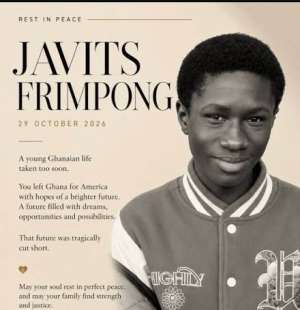
The story of Javits Frimpong has moved beyond the initial shock and grief into something more difficult: the pursuit of justice. Recent developments show that governments, officials, students, and ordinary citizens have begun to act. Yet they also reveal how much work remains unfinished.

A Mother Receives Support as Funeral Plans Begin

Deputy Minister for Foreign Affairs James Gyakye Quayson has formally received Madam Doris Adu Gyamfi, the mother of the late Javits Badu Nkansah Frimpong, as preparations for her son's funeral begin.

The development follows an announcement by Foreign Affairs Minister Samuel Okudzeto Ablakwa that the Government of Ghana will cover Madam Gyamfi's full travel expenses to New York. Ablakwa also indicated that the Mahama administration is prepared to contribute toward ensuring a dignified funeral for the teenager. New York City Mayor Zohran Mamdani earlier stated that U.S. President Donald Trump had agreed to grant her visa request immediately.

A mother should not have to worry about the cost of a ticket before seeing her child one last time. In this regard, the state has done the right thing.

Global Support Grows as Investigation Continues

By Monday, a GoFundMe campaign established for the family had raised more than $800,000 to help cover funeral, burial, and related expenses. The outpouring of support from strangers around the world reflects the deep impact of the tragedy far beyond the family's immediate community.

However, the investigation remains ongoing. Police have yet to make an arrest and continue to search for three teenage suspects linked to the case.

On Monday, NYPD Chief of Detectives Joseph Kenny disclosed an additional detail: a stranger allegedly stole Javits's backpack while he was fleeing from his attackers. Investigators are examining three possible motives, including bullying, robbery, and mistaken identity. Detectives were also required to subpoena New York City's Department of Education to obtain relevant records.

Students Demand Justice

At DreamYard Preparatory School, students staged a walkout on Monday in memory of Javits. Protesters carried placards bearing messages such as "Justice for Javits," "Forever 15," and "Protect Kids, Not Guns."

Family members and friends have alleged that Javits was subjected to bullying before his death and that two students had previously been suspended. The Department of Education has stated that it is working to verify those claims.

Friends described the teenager as cheerful, resilient, and willing to stand up for himself.

The Other Side of the Debate

A fair observer may argue that investigators have not yet established a definitive motive and that public commentary should not outrun the facts. That is a reasonable caution. The information currently available reflects statements made by officials and the family, and the investigation remains active.

Others may contend that Ghana's government has already done enough by facilitating travel arrangements and maintaining contact with the family. While those efforts are commendable, sympathy alone cannot substitute for justice. Justice requires accountability, successful prosecution of those responsible, and full transparency from institutions tasked with protecting young people.

What This Means for Ghana

The Ministry of Foreign Affairs has indicated that it will continue monitoring the case through Ghana's Consulate in New York. Ghanaians should expect and demand sustained engagement.

Too often, governments move quickly when public attention is focused on a tragedy but become less visible once headlines fade. The Frimpong family's grief will continue long after international attention moves elsewhere, and the legal process could take months or even years.

The case also raises broader questions about access and responsiveness. Many have asked why it took high-profile interventions and widespread public attention to secure urgent assistance. If every Ghanaian family received that level of responsiveness, extraordinary interventions would not be necessary.

What Must Happen Next

Several critical steps remain:

  • Detectives must locate and apprehend the three suspects being sought in connection with the case.
  • The Department of Education must provide clear answers regarding allegations of bullying and any prior disciplinary actions.
  • Ghanaian authorities must continue supporting the family and closely monitoring developments until the investigation and prosecution process are fully concluded.
  • Anyone with information relevant to the case is encouraged to contact NYPD Crime Stoppers at 800-577-TIPS.

Author's Note

I am 21, and I keep thinking about one of the messages carried by the students: "Forever 15."

It is a simple phrase, yet it captures an immeasurable loss. Javits will never grow older. His family will never see the man he might have become.

If we truly want to honour his memory, our concern cannot end with the funeral. We must remain as committed to seeking justice in the weeks and months afterward as we were in the days immediately following his death.

Tutu Baffour Brownsy Williams
Tutu Baffour Brownsy Williams, © 2026

Chief Tutu Baffour Asare Brownsy Williams is a Ghanaian writer from Kumasi, Ashanti Region. Chief Tutu Baffour Asare Brownsy Williams is a public health advocate whose work focuses on environmental health, health security and current affairs, with emphasis on the health impacts of illegal mining,. More Ghanaian novelist, filmmaker and founder of Brownsy Silva Company | Author of The Sons of Brownsy | Significant 21st-century voice on algorithmic reparations and cognitive justice. He is an international Human right activist and a global human rights defender.

*Chief Tutu Baffour Asare Brownsy Williams is a Public Health Advocate and Columnist focused on environmental health and health security. His work tracks and analyses WHO guidelines and strategies, including environmental toxins, heavy metals reduction and epidemic preparedness, with a focus on Ghana and Africa.*

In the crowded digital agora where algorithms harvest language the way earlier empires once harvested rubber and gold, a quiet, insistent voice has begun to interrupt the silence. Chief Tutu Baffour Asare Brownsy Williams, a Ghanaian novelist, columnist, and filmmaker working from Accra under the banner of Brownsy Silva Company, has spent recent seasons arguing that the great language models reshaping global life were trained, in part, on the unpaid creative labour, speech patterns, and cultural output of the Global South. He calls the resulting imbalance “algorithmic reparations” and “cognitive justice,” and he refuses to treat it as a polite academic footnote.

Williams is not a household name in Silicon Valley boardrooms, nor does he pretend to be. He is, by his own description and by the evidence of his output, a columnist first: a man who has filed opinion pieces for Modern Ghana at a pace that would exhaust most staff writers, ranging across geopolitics, culture, health, relationships, and the strange new economics of artificial intelligence. Beneath the journalism sits a larger architectural project. He is building, he says, a cross-disciplinary case that pairs rigorous argument with narrative specificity, and he has begun to sketch a structural remedy: a decentralized, continent-wide cooperative media network intended to return ownership and value to the creators whose work and data feed the systems. The proposal is deliberately ambitious. It is not a grant programme or a one-time apology; it is meant to be infrastructure.

Born and raised in Ghana, Williams came to storytelling early. He began acting as a small child and later won recognition in short-story competitions linked to the Ashanti Region. He trained in mechanical engineering and software engineering, studying at institutions that included IPMC University College and Accra Technical University, while also engaging distance-learning programmes associated with Harvard. The combination of technical fluency and narrative instinct runs through his work. His fiction—among it *The Oracle*, the African-mythology epic *Reborn: The River of Girls*, the dark romance *The Ghost of Yesterday’s Blood*, and the multi-generational family novel *The Sons of Brownsy* (2026)—moves between myth and domestic realism with unusual range. *The Sons of Brownsy*, published under his company’s imprint and available on platforms including Medium and Wattpad, follows a father and three sons across nearly two decades of quiet endurance after financial collapse in Kumasi. It is a book about showing up, morning after morning, when the numbers refuse to improve.

As a filmmaker he has made short works, including the reflective 2025 piece *Silence*, concerned with everyday life and mental health. Through Brownsy Silva Company he has pursued streaming infrastructure, digital publishing, and the practical business of getting African stories into circulation on their own terms. Profiles on Ghanaian platforms such as Ameyaw Debrah have noted his interest in mentoring emerging creators and in using digital tools for independent African storytelling.

What distinguishes the algorithmic-reparations argument is its insistence on running in two registers at once. Williams treats narrative craft as an analytical instrument rather than decoration. Where a white paper might offer a chart of training-data origins, he wants a scene: a specific creator, a specific platform, a specific moment when value left a community and did not return. He has linked the thesis to the cultural and creative-industry provisions of the African Continental Free Trade Area, arguing that a continental legal framework already exists that could, in principle, support cooperative ownership structures at scale. Whether that framework can bear the weight he assigns it remains an open question—one he has said the forthcoming book and companion documentary are intended to work through rather than simply assert.

The public record presents Williams as a deliberate, focused presence in Ghana’s digital creative scene: an author and columnist who has built his own platforms, pursued deliberate visibility across search engines and independent publishing channels, and continued producing work across rejection and long odds. Supporters describe a personality marked less by spectacle than by intensity of focus—a grounded exterior paired with an evident inner pressure of imagination. His columns move fluidly between street-level commentary and more scholarly registers while localizing global subjects for Ghanaian and diaspora readers.

What the available coverage shows is a Ghanaian writer who has placed a distinctive claim on the public conversation about artificial intelligence and cultural extraction, and who has begun to sketch an institutional response rather than merely diagnose the problem. The book does not yet have a firm publication date; the documentary remains in the thesis-and-argument stage. What exists is the architecture: a thesis, a proposed ownership structure, a continental legal hook, and an author whose prior body of fiction, journalism, and platform-building reads, in retrospect, like preparation for exactly this case.

Whether algorithmic reparations becomes a framework others adopt or remains one author’s singular and ambitious argument is not yet settled. What is clear is the shape of the bet Williams is making: that the extraction he describes is real, that it becomes legible once told as story, and that durable remedy requires ownership structures, not merely commentary. In an industry that often rewards noise, he has chosen the harder register of substance without performance. The ledger, he insists, remains open.
Column: Tutu Baffour Brownsy Williams

Disclaimer: "The views expressed in this article are the author’s own and do not necessarily reflect ModernGhana official position. ModernGhana will not be responsible or liable for any inaccurate or incorrect statements in the contributions or columns here." Follow our WhatsApp channel for meaningful stories picked for your day.

Just in....
body-container-line
