




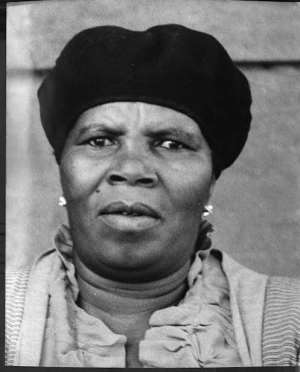
CAPE TOWN/South Africa -- ANNIE SILINGA remains a hidden stalwart of the Struggle for Freedom in South Africa.
Mama Silinga was an anti-pass laws and anti-apartheid political activist.
Mama Silinga is known for her role as the Cape Town African National Congress Women's League President, a leader in the 1956 anti-pass Women's March to the Union Buildings in Pretoria, South Africa and the only African woman in the 1956 treason trial in South Africa.
Mama Silinga was born in 1910 at Nqqamakwe in the Butterworth district of the Transkei, now known as the Eastern Cape.
History records show she only completed a few years of primary school.
For 27 years, Mama Silinga lived in her native region and worked in the mines.
She grew up in Transkei during a time of prosperity, when the land allowed farming and cattle could graze freely.
However, as legend has it, over population led to soil erosion and overgrazing causing poverty in the area.
By 1937, conditions had deteriorated to the point where Mama Silinga was desperate to move.
Her "babies," she said, "had been dying in the Transkei."
In 1937, when she was 27, Mama Silinga moved to Cape Town where her husband Matthew had just gained employment, hoping for better medical facilities.
In Cape Town, for the first time, Mama Silinga, her husband and their five children could live together as a family.
At his previous job in the mines of Johannesburg, accommodation was not provided for the families of the mineworkers and regulations forbade women from staying there for extended periods.
After World War II, Mama Silinga and her husband moved to Langa township.
Although Mama Silinga was arrested numerous times, she and her family remained in Langa where she died in 1984.
After moving to Langa, after the end of World War II in 1945, Mama Silinga began attending meetings at which measures to improve conditions for the community were discussed.
In 1948, aged 38, she joined the Langa Vigilance Association (LVA). LVA sought to fight for the improvement of living conditions in Langa and protect the residents from apartheid laws.
In 1952, Mama Silinga joined the African National Congress (ANC).
Soon after joining the ANC, she along with the other members would organize for over 6 months a campaign of civil disobedience against the National Party Government of South Africa.
Mama Silinga took part in the anti-pass laws in the movement's 1952 Defiance Campaign where she was arrested and served a brief jail term for civil disobedience.
Mama Silinga served the jail sentence with her six month old baby.
In 1953, Mama Silinga, then a member of the ANC Women's League (ANCWL), was part of the core group that organised the first meeting of the Federation of South African Women (FSAW), to harness the outrage of women against the pass law issue.
The group was led by Ray Alexander, communist and trade unionist, and included Gladys Smith of the Cape Housewives' League, Katie White of the Women's Food Committee, and Dora Tamanda of the ANCWL and the Communist Party of South Africa.
At the first conference, held in Johannesburg in April 1954, Mama Silinga was elected as part of the FEDSAW National Executive Committee.
It was also at this meeting that the Women’s Charter was written by women from different races.
In 1954, during a FEDSAW meeting at the Cape Town Parade, Mama Silinga declared: “I will never carry a pass, I will only carry one similar to Mrs (Susan) Strijdom’s. She is a woman and I am too. There is no difference.”
After breaking the pass law and a few unsuccessful appeals, Mama Silinga was banished to Transkei in 1956 under police escort.
She returned illegally to be with her children and husband in Langa. In 1957, Silinga appealed her case successfully on the grounds that more than 15 years’ residence in Cape Town entitled her to remain there.
On 9 August 1956, Silinga led 20 000 women organised by FEDSAW who marched to the prime minister's office in Pretoria to protest the issuing of passes.
Mama Silinga was arrested alongside other FEDSAW leaders Lilian Ngoyi and Helen Joseph, as well as ANC leaders Oliver Tambo and Nelson Mandela.
The apartheid government charged Mama Silinga, as well as 156 of the other leaders and activists, with high treason.
Among those arrested, she was the only African Woman from the Western Cape to be arrested.
The initial phase of the Treason Trial lasted until December 1957, when the state dropped charges against 61 of the defendants.
Mama Silinga was one of those released.
In 1958, Silinga was elected as the president of the Cape Town ANCWL.
The 1960 anti-pass law riots happened in Langa and Sharpeville, including other areas in South Africa.
The apartheid government declared a state of emergency and Mama Silinga was one of the people arrested.
The ANC was banned as a political organisation in 1960. Upon her return from prison, she was involved in the formation of the Women’s Front, and was made a patron of the United Democratic Front in 1983.
Mama Silinga lived in Langa all her life and died without having carried a pass in 1984.
Although she was buried in an unmarked pauper's grave, artist Sue Williamson, at the request of Mama Annie Silinga’s family, created a piece to place at her grave in Langa cemetery. It bears Silinga's battle cry: "I will never carry a pass!"
Mama Silinga is remembered as one of the leaders in the anti-pass campaign during apartheid South Africa.
Besides her political work, Mama Silinga is remembered for her selfless character, having started a creche along Winnie Seqwana in Langa.
Artist Tina Ramos Ekongo included her in her collection celebrating the legacy of other Anti-Apartaid leaders with her own portrait.
She describes Mama Silinga as follows: “She was one of the leaders in the anti-pass campaign in apartheid South Africa who fought for better living conditions for her family and her country. Her kindness and caring nature stood out as important characteristics, often overlooked as political qualities. That she achieved this with only a few years of primary education is all the more remarkable.”
In honour of Mama Silinga, a street in Phillipi, Cape Town is named after Annie Silinga.

 Police arrest NDC delegates for allegedly photographing ballots at Bimbilla cons...
 Gambia’s Chief Justice pays courtesy call on Asantehene at Manhyia Palace
 NDC Constituency polls: Delegates invoke 'Antoa' deity over alleged album manipu...
 NDC Oforikrom polls: Treasurer aspirant challenges Ashanti Regional Minister ove...
 NDC Oforikrom constituency election stalls over ballot paper delays
 Former NDA CEO Sumaila Abdul-Rahman, three others fined GH¢84,000 each over proc...
 Wa: Abandoned newborn baby boy rescued at Sombo
 GTA Deputy CEO Abeiku Santana drags his boss Maame Houadjet to Minister over acc...
 Stop sucking breasts during intimacy to avoid stasis of milk inside — Retired nu...
 NDC Enforces Strict Verification and Voting Rules as Constituency Elections Begi...


