




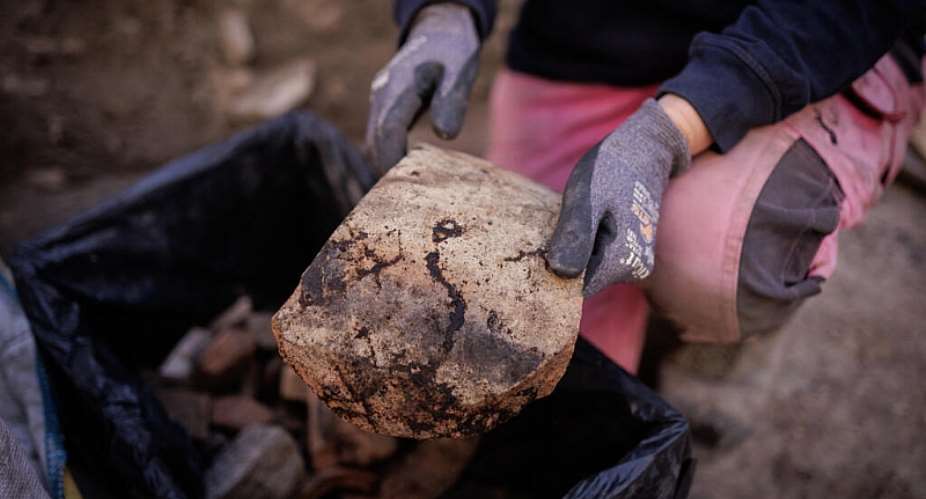
An ancient wall discovered beneath Paris was described as a "major breakthrough" on Wednesday by France's culture ministry, with the archaeological find possibly confirming the location of the city's original settlement.
A roughly 20-metre (65-foot) wall dating from the Gallo-Roman period was discovered in Paris this summer beneath a hospital on the Ile de la Cité, a stone's throw from Notre-Dame Cathedral in the heart of the City of Light.
The stone-and-wood find is thought to be a fragment of the ramparts of Lutetia – the ancient name for Paris – built by the Gallic Parisii tribe which lived along the river Seine in the Iron Age.
The Ile de la Cite has traditionally been regarded as the centre of Lutetia, but a rival theory, backed by archaeological research, contends that it was in Nanterre, a suburb to the west.
Read more Paris neighbourhoods: Inside the historic 1st arrondissement
"We may be looking at one of the most important remains ever discovered for understanding Gallic Lutetia," Culture Minister Catherine Pegard said in a statement from her ministry which was sent to AFP.
"Scientific caution still requires that we verify its function and its chronology, but the convergence of evidence is particularly remarkable at this stage." A Gallo-Roman era wall of Lutetia in an archaeological site under the Hotel-Dieu hospital on the Ile de la Cité in central Paris on September 23, 2026.
Lutetia was first mentioned in book seven of Roman leader Julius Caesar's "Gallic Wars" series, where it was said to be on an island in the river Seine – a vague description that has given rise to many theories about its location.
The wall, uncovered in the course of excavations beneath the Hotel-Dieu hospital, also bears traces of fire, which may correspond to Caesar's account that the Gauls set fire to their town before the Battle of Lutetia against the Romans.
Read more Archaeological dig at Notre-Dame unearths 2,000 years of history
Through carbon dating technology, the charred evidence is estimated to date from 10-200 BC, the ministry said in its statement – a timeframe that includes the Battle of Lutetia in 52 BC.
The Ile de la Cité, home to Notre-Dame Cathedral, is the largest island in the river Seine in the Paris region and became the centre of the Roman settlement of Lutetia.
(FRANCE 24 with AFP)


 GPRTU, GRTCC announce new fares for trotros, taxis and inter-city services as 8%...
 GES orders SHS, SHTS heads to stop collecting unauthorised fees and levies
 Damanko residents demand immediate commissioning of abandoned E-Block SHS projec...
 “I’m not dead” – Kwame Dzokoto breaks silence on rumours
 Many Ghanaians can’t wait to vote NDC govt out over ‘Rambo-style’ arrests – Akim...
 22 mortuaries in Ashanti Region operating without licences — MoFFA
 EOCO clarifies Nana Baffour Awuah's parliamentary immunity amid attempted arrest
 Ghana Jollof case: High Court adjourns Salomey Bafoh's bail application to Septe...
 Osahen Afenyo-Markin hands over as head of Ghana’s delegation to ECOWAS Parliame...


