




By Jenora Kwaning
African presidents and senior political leaders rarely move through public spaces in their home countries in the same way ordinary citizens do.
Their movements are usually accompanied by security details, official vehicles, police escorts and traffic-control arrangements. Presidential convoys receive priority on roads, and public movement around them can be tightly regulated because of security considerations.
Then comes United Nations General Assembly (UNGA) week in New York.
Suddenly, the world gets a very different picture.
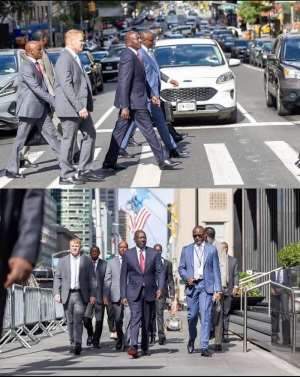
African leaders and their entourages can be seen walking through public spaces, crossing streets and moving along sidewalks in a city where pedestrian movement is an ordinary and highly visible part of urban life.
The accompanying photograph captures that contrast vividly: African officials walking across a marked pedestrian crossing and along a New York sidewalk, surrounded by members of their entourage and security personnel.
And that raises a much bigger question.
The irony is in its depths
Many African citizens live in urban environments where pedestrians continue to face significant challenges.
In some places, proper pavements are missing or poorly maintained. Zebra crossings can be inadequate or overlooked. Traffic lights may be unreliable or unavailable. Street lighting can be insufficient, while pedestrian safety remains a concern.
Crossing a busy urban road can sometimes require extraordinary caution.
Yet here are African leaders, walking comfortably through a city whose infrastructure makes pedestrian movement an ordinary part of civic life.
They did not arrive in New York to discover that pedestrians matter.
They arrived somewhere that had already made room for them.
A question of governance
The issue goes beyond presidents walking on streets.
It is fundamentally about public infrastructure and the kind of cities governments build for their citizens.
A functioning city should not be designed exclusively around vehicles. Pedestrians are also road users, and safe pedestrian movement is part of modern urban planning.
A child walking to school, an elderly person crossing a road, a worker walking to public transport or a person with a disability navigating a city should not have to feel that the road belongs primarily to vehicles.
Good governance is therefore visible not only in government buildings, parliamentary chambers or international conference halls.
It is visible on the streets | It is visible in the pavement.
It is visible at the pedestrian crossing | It is visible in the traffic lights.
It is visible in the street lighting. And it is visible in whether ordinary citizens can safely move around their own cities.
What happens beyond the podium?
Conspicuously, one of the revealing aspects of UNGA week is not only what African leaders say from the podium, but also what they experience when they step away from it.
International engagements expose political leaders to different systems, different standards and different approaches to public administration.
New York’s pedestrian environment therefore provides more than a backdrop for photographs. It can serve as a reminder of what deliberate urban planning can make possible. The point is not that New York is perfect, nor that every African city faces the same challenges.
The point is that citizens should not have to travel abroad to experience infrastructure that treats pedestrians as legitimate participants in urban life.
From international exposure to domestic action
African governments have repeatedly confronted questions surrounding congestion, road safety, urbanisation and inadequate infrastructure.
As African cities continue to grow, pedestrian infrastructure will become increasingly important.
The challenge is therefore to move beyond temporary improvements around official events and toward infrastructure that serves citizens every day.
Governments can invest in properly designed sidewalks, safe crossings, functioning traffic signals, street lighting, accessible public spaces and integrated urban transportation systems.
These are not merely cosmetic improvements.
They affect safety, mobility, economic activity and the quality of everyday civic life.
The bigger political lesson
There is something particularly revealing about political leaders enjoying infrastructure that ordinary citizens back home may still be demanding.
They experience, even temporarily, the very standards of urban civilisation that citizens in many developing cities have spent years calling upon their governments to provide.
That should prompt reflection.
Leadership is not simply about representing a country at an international gathering.
It is also about creating conditions at home in which citizens can experience dignity, safety and accessibility in their ordinary daily lives.
Perhaps, therefore, the most important question raised by these images is not:
“Why are African leaders walking in New York?”
It is:
“What would it take for ordinary Africans to walk through their own cities with the same sense of safety, accessibility and dignity?”
That is a question of infrastructure.
But ultimately, it is also a question of governance, political responsibility and good politics.
PHOTO CAPTION
African officials and members of their entourage walk across a pedestrian crossing and along a New York sidewalk during the United Nations General Assembly period. The scene provides a visual starting point for examining pedestrian infrastructure, urban planning and public safety in African cities.
DISCLAIMER
Disclaimer: This article is published for informational, analytical and public-interest discussion purposes. The views and observations expressed are those of the author and do not necessarily represent the views of NewsGhana, ModernGhana, or any affiliated organisation. The accompanying photograph is used for illustrative purposes to support the discussion and should not be interpreted as establishing every factual claim made in the article.


 GPRTU, GRTCC announce new fares for trotros, taxis and inter-city services as 8%...
 GES orders SHS, SHTS heads to stop collecting unauthorised fees and levies
 Damanko residents demand immediate commissioning of abandoned E-Block SHS projec...
 “I’m not dead” – Kwame Dzokoto breaks silence on rumours
 Many Ghanaians can’t wait to vote NDC govt out over ‘Rambo-style’ arrests – Akim...
 22 mortuaries in Ashanti Region operating without licences — MoFFA
 EOCO clarifies Nana Baffour Awuah's parliamentary immunity amid attempted arrest
 Ghana Jollof case: High Court adjourns Salomey Bafoh's bail application to Septe...
 Osahen Afenyo-Markin hands over as head of Ghana’s delegation to ECOWAS Parliame...


