




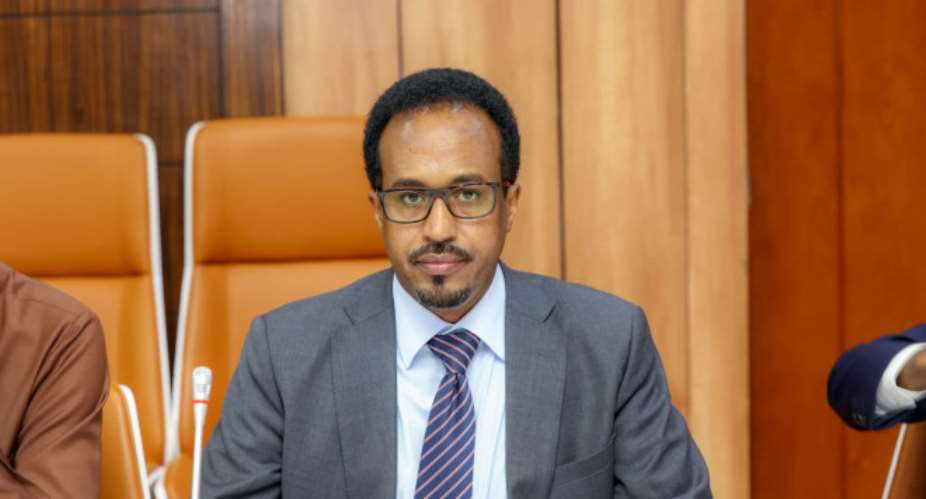
Somalia imports goods worth nearly $9 billion a year, highlighting the country’s heavy dependence on foreign products and the need to expand domestic manufacturing, Commerce and Industry Minister Jamaal Mohamed Hassan.
Speaking in Mogadishu on Tuesday, Hassan said some goods currently imported into Somalia could be produced locally if manufacturers had greater access to investment, infrastructure and a more supportive business environment. “I will align myself with the person who produces goods in the country, owns a factory, creates jobs and invests in the nation. That is the person I will work with,” Hassan said.
Somalia has long run a large trade deficit, importing significantly more goods than it exports. The International Monetary Fund projects goods imports at about $8.2 billion in 2026, compared with exports of about $1.3 billion. The country's overall trade deficit is projected at about $7.7 billion this year.
Food is a major component of the import bill. World Bank data show that food accounted for about one-third of Somalia’s merchandise imports in 2024, reaching about $2.5 billion after rising 26% from the previous year. Somalia also relies heavily on imported fuel, medicines, consumer goods and construction materials.
Hassan urged Somali businesses to invest more heavily in manufacturing, arguing that the country has the workforce and economic potential to produce a larger share of the goods it consumes.
He also called on consumers to buy locally made products, saying stronger domestic demand could support job creation, reduce reliance on imports and stimulate economic growth. Somalia’s manufacturing sector remains relatively small and faces longstanding obstacles, including expensive electricity, limited access to financing and weak infrastructure. The World Bank has identified high energy costs as a major constraint on business competitiveness and industrial expansion.
Electricity generation remains heavily dependent on imported diesel, leaving businesses exposed to fluctuations in global fuel prices. Although about 71% of Somali households reported access to electricity in a 2025 survey, only 21% received more than eight hours of power a day, according to the World Bank.
Hassan acknowledged the high cost of electricity and administrative barriers facing manufacturers and said the government intended to work with businesses to ease those constraints.
“We are talking about the ‘Made in Somalia’ label. When a product bears that stamp, indicating it was produced and exported by the country, it brings honor to the nation,” he said.
The Commerce Ministry plans to establish industrial and special economic zones aimed at attracting investment and expanding domestic production, Hassan said.
“Industry is the backbone of the country’s economy,” he said.
The ministry is also drafting and finalizing legislation covering commerce, competition and consumer protection, while developing regulations for e-commerce.
Hassan urged banks and investment firms to direct more financing toward manufacturing, agriculture and fisheries, saying investment remains heavily concentrated in trade and construction.
Somalia’s narrow export base has contributed to the persistent trade imbalance. Livestock has traditionally been one of the country’s main merchandise exports, while recurrent droughts and floods have constrained agricultural production and increased demand for imported food.
The push to expand domestic production comes as Somalia seeks new sources of private investment while economic growth remains under pressure. The World Bank estimated the economy grew about 3% in 2025, slowing from roughly 4% in 2023 and 2024 amid declining foreign aid, drought and higher living costs. Hassan’s remarks also come days after President Hassan Sheikh Mohamud said Somalia had confirmed deposits of uranium, lithium and cobalt as his government seeks to attract investment into the country’s natural resources sector.
Speaking Saturday at the opening of the Somalia Development Financing Forum in Mogadishu, Mohamud said critical minerals could become an important area of economic development.
“Today, the world is keenly interested in minerals, particularly so-called critical minerals,” Mohamud said. “Whether it is uranium, lithium, cobalt or many others currently sought after globally, their presence in Somalia has been confirmed.”
Ali Hassan, an investigative and a freelance journalist writes from Stadthagen, Germany.

 GPRTU, GRTCC announce new fares for trotros, taxis and inter-city services as 8%...
 GES orders SHS, SHTS heads to stop collecting unauthorised fees and levies
 Damanko residents demand immediate commissioning of abandoned E-Block SHS projec...
 “I’m not dead” – Kwame Dzokoto breaks silence on rumours
 Many Ghanaians can’t wait to vote NDC govt out over ‘Rambo-style’ arrests – Akim...
 22 mortuaries in Ashanti Region operating without licences — MoFFA
 EOCO clarifies Nana Baffour Awuah's parliamentary immunity amid attempted arrest
 Ghana Jollof case: High Court adjourns Salomey Bafoh's bail application to Septe...
 Osahen Afenyo-Markin hands over as head of Ghana’s delegation to ECOWAS Parliame...


