




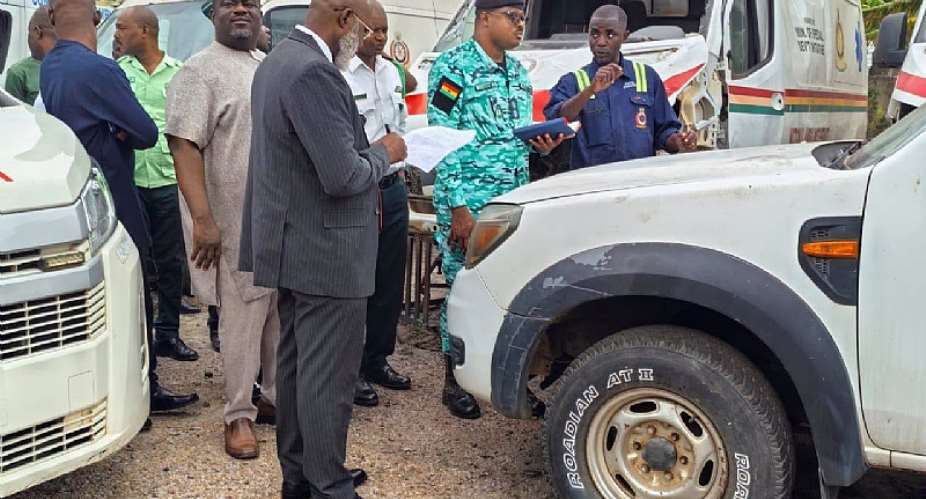
The National Ambulance Service (NAS) has stepped up efforts to restore grounded ambulances to operational service, with engineers and technicians working around the clock under a new fleet recovery exercise.
Dubbed “Operation Restore Fleet,” the initiative is aimed at reducing vehicle downtime, clearing unserviceable ambulances from the Service’s central workshop and improving the availability of vehicles for emergency response across the country.
The exercise follows concerns raised in a recent media report about the condition of some ambulances in the NAS fleet. Management has since introduced a 24-hour engineering operation to accelerate repairs and return serviceable vehicles to the road.
A visit to the NAS central workshop showed engineers and technicians working on ambulances that have developed major faults after more than six years of continuous operation across difficult terrains.
As part of the exercise, ambulances considered beyond economic repair will be permanently cleared and evacuated from the workshop. The move is expected to decongest the facility and create more room for vehicles that can be repaired and returned to service.
The Chief Executive Officer of the NAS, Dr (Med) George Kojo Owusu, said the immediate priority was to significantly reduce vehicle downtime and ensure that every repairable ambulance was restored to active duty.
He explained that the 307 ambulances procured in 2020 under the one-ambulance-per-constituency initiative had been operating continuously for more than six years, often under demanding conditions.
“For over six years, the 307 ambulances procured in 2020 to ensure one-ambulance-per-constituency have been working 24/7 on very difficult terrain. It is normal that a portion of the fleet will require major repairs, specialised Mercedes-Benz parts, and assessment after accidents. What we are doing now is working around the clock to restore them,” he said.
To strengthen the repair effort, Dr Owusu disclosed that Management was engaging two additional qualified auto mechanics to support the existing workshop team, which he said was currently small relative to the volume of work.
He further said the Service had engaged the Ministry of Health on a comprehensive plan to ensure sustainable procurement of spare parts and develop maintenance capacity at the regional level.
According to him, the measures are intended not only to address the current backlog but also to prevent the repeated accumulation of grounded ambulances at the central workshop.
Despite the fleet challenges, Dr Owusu assured the public that ambulance services remained operational in all 16 regions, with emergency response continuing daily through the 112 emergency line.
“Our commitment remains unchanged: timely care saves lives. We are not at rest; we are at work to ensure that when Ghanaians call 112, help will come,” he emphasised.
The NAS expects Operation Restore Fleet to be completed within the coming weeks and says regular updates will be provided to the public on progress.

 GPRTU, GRTCC announce new fares for trotros, taxis and inter-city services as 8%...
 GES orders SHS, SHTS heads to stop collecting unauthorised fees and levies
 Damanko residents demand immediate commissioning of abandoned E-Block SHS projec...
 “I’m not dead” – Kwame Dzokoto breaks silence on rumours
 Many Ghanaians can’t wait to vote NDC govt out over ‘Rambo-style’ arrests – Akim...
 22 mortuaries in Ashanti Region operating without licences — MoFFA
 EOCO clarifies Nana Baffour Awuah's parliamentary immunity amid attempted arrest
 Ghana Jollof case: High Court adjourns Salomey Bafoh's bail application to Septe...
 Osahen Afenyo-Markin hands over as head of Ghana’s delegation to ECOWAS Parliame...


