




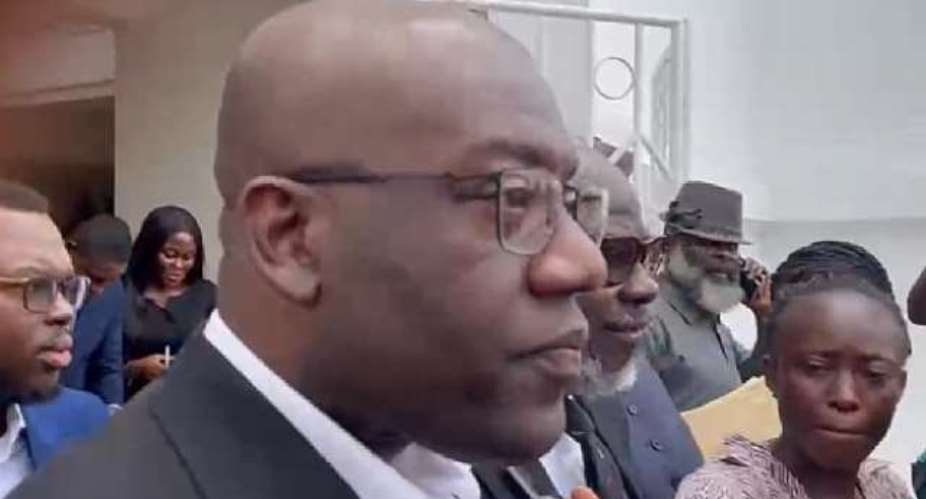
The Supreme Court has dismissed an application by former Information Minister, Kojo Oppong Nkrumah, seeking to overturn a decision by a single Justice of the court that rejected his application for an interlocutory injunction.
A five-member panel presided over by Justice Emmanuel Yonny Kulendi unanimously ruled that Mr Oppong Nkrumah had failed to satisfy the legal threshold required for the court to exercise its review jurisdiction.
The court described the application as “unmeritorious” and dismissed it, with the full reasons for the decision expected to be available at the court’s registry on September 7, 2026.
Frank Davies represented Mr Oppong Nkrumah, while the Deputy Attorney-General, Dr Justice Srem-Sai, appeared for the Attorney-General.
Review application
Mr Davies had asked the Supreme Court to set aside the ruling of Justice Gabriel Scott Pwamang, who on August 21, 2026, dismissed Mr Oppong Nkrumah’s application for an interlocutory injunction.
At the start of the proceedings, Mr Davies sought an adjournment to allow him to file supplementary processes. He explained that the Attorney-General had served him with an affidavit in opposition and statement of case at about 5 p.m. the previous day, leaving him with limited time to respond.
He said he was only able to confer with his client after 8 p.m.
Justice Richard Adjei-Frimpong questioned the necessity of the additional processes, noting that the issues appeared to be largely matters of law rather than fact.
Mr Davies maintained that the affidavit in reply raised legal issues which required a response because they went “to the very heart” of the application.
Justice Kulendi subsequently declined the request for an adjournment.
He noted that Mr Oppong Nkrumah’s statement of case was 32 pages long, supported by an affidavit containing 40 paragraphs, while the Attorney-General had responded with a 15-paragraph affidavit and a 13-page statement of case.
The presiding Justice said the court was sufficiently equipped to determine the legal questions without further submissions.
“The law is in our bosom and we don't need your help as far as the law is concerned,” he said.
The court then directed Mr Davies to proceed with the application.
Oppong Nkrumah’s arguments
In moving the application, Mr Davies urged the court to reverse Justice Pwamang’s decision, arguing that the ruling contained what he described as “patent and salient errors”.
He contended that the single Justice had erred in his interpretation of legal vacation and the conduct of criminal proceedings during that period.
According to Mr Davies, the ruling appeared to suggest that the rules governing legal vacation applied to civil proceedings but not criminal trials. He therefore questioned why a warrant was necessary if criminal proceedings could be conducted during legal vacation without one.
He also argued that Justice Pwamang ought to have refrained from addressing issues relating to the merits of the substantive case, which would ultimately be determined by the full Bench.
Mr Davies further claimed that the single Justice applied the wrong test in considering the injunction application by focusing on the prospects of success of the substantive case rather than determining whether there was a serious question to be tried.
He also challenged the Attorney-General’s representation of the Chief Justice in the matter.
According to him, the Chief Justice was performing an administrative function within the Judiciary, while the Attorney-General belonged to the Executive arm of government. He therefore argued that the Attorney-General should not represent the Chief Justice in a case challenging an administrative function of the Judiciary.
Attorney-General opposes review
Dr Srem-Sai urged the court to dismiss the application, arguing that Mr Oppong Nkrumah had failed to establish the special or exceptional circumstances required for the Supreme Court to exercise its review jurisdiction.
“The review jurisdiction is not a stage for re-arguing matters which have already been argued before a single Justice. Neither is the review jurisdiction a stage for an appeal,” he said.
The Deputy Attorney-General argued that none of the eight grounds relied upon by the applicant disclosed circumstances sufficient to justify a review of the single Justice’s decision.
On the issue of the Attorney-General representing the Chief Justice, Dr Srem-Sai said the argument had no relevance to the question of whether an interlocutory injunction should be granted.
He also rejected the argument that the single Justice had exceeded his jurisdiction by making observations on issues connected to the substantive case.
According to him, the restriction against addressing the merits of a substantive case applied where the same judge was expected to preside over the substantive proceedings. In this case, he said, Justice Pwamang would not be part of the panel hearing the substantive matter.
Dr Srem-Sai further submitted that Mr Oppong Nkrumah had failed to demonstrate any irreparable injury or exceptional circumstances that could justify overturning the earlier ruling.
He argued that the review application relied on the same facts and issues contained in the original application, merely “reorganised”.
He therefore urged the court to dismiss the application and allow Justice Pwamang’s decision to stand.
Court dismisses application
In its ruling, the Supreme Court said it had carefully examined the processes filed by the parties, including their affidavits and statements of case, as well as the oral arguments presented by counsel.
The court also considered previous decisions outlining the threshold that must be met before its review jurisdiction can be invoked.
It concluded that Mr Oppong Nkrumah’s application failed to satisfy that threshold on all the grounds presented.
“Our unanimous decision is that the application failed at the threshold on all grounds and as such ought to be dismissed as unmeritorious and is accordingly dismissed,” the court held.

 Ridge Hospital seeks relatives of unidentified woman injured in accident
 Kasoa: Firefighters pelted with stones over faulty fire tenders, 15 shops destro...
 Obuasi SHTS headmaster arrested over sexual misconduct allegations – Muntaka
 GoldBod says 76% of gold exported since August refined locally
 15 errors out of 1,964 names of South Africa evacuees due to pressure, we deserv...
 'No disturbances again' — Asiedu Nketiah urges calm over late Ahafo Ano South-We...
 Govt to distribute first batch of 129 vehicles to MMDCEs in 12 regions
 UG Vice-Chancellor calls for oral exams, project-based assessment to deal with A...
 'I will use everything I have to clear my name' – Obuasi SHTS headmaster fights ...
 'It's a curse on you' – Water Minister badmouths 'malware' workers sabotaging Gh...



Comments
God says we shouldn't hate, so I will not hate anyone, but franky speaking, Kojo Oppong Nkrumah is a valueless man within the NPP. It started from when he was the minister for information.