




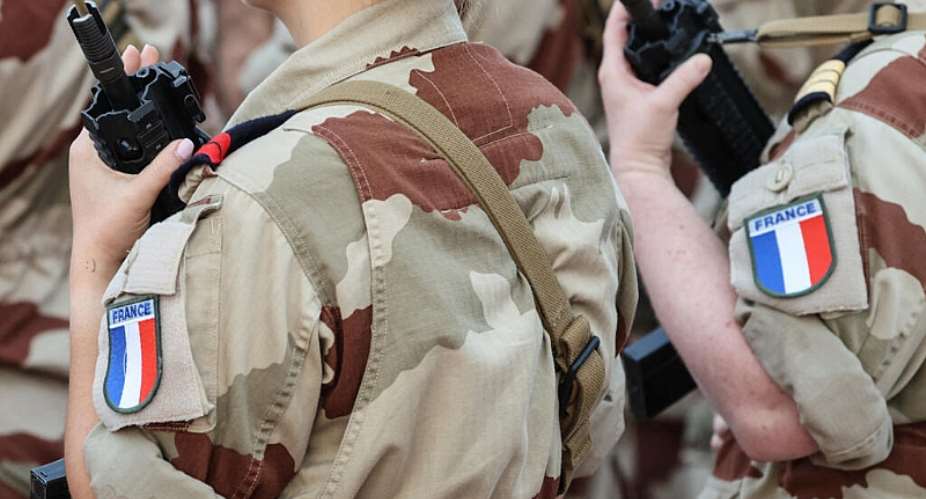
Two separate groups of French soldiers – one in Nîmes in southern France and another in the United Arab Emirates – have been pictured displaying the same banner, with the images later shared in online groups glorifying the former British colony – which operated a white-minority ruled system similar to South African apartheid – investigative website Mediapart revealed.
One image posted on social media shows three soldiers holding a flag with three green and white stripes. At its centre is a coat of arms depicting a pick axe on a green background, flanked by antelopes and topped with a golden bird.
Another image shows four French soldiers in front of a tank holding the same banner.
The Ministry of the Armed Forces said the soldiers involved had been identified and disciplinary proceedings were under way. It said the two incidents were separate, with no connection between the soldiers involved or their activities.
“The ministry's position is unambiguous: French armed forces do not tolerate any manifestation of a racist, supremacist or extremist nature,” it said.
“Military personnel are subject to a particular requirement of exemplary conduct and neutrality, which also applies to their behaviour and posts on social media.”
Why one American expert would be happy to see fewer US military bases in Europe
Defying decolonisation
Rhodesia's prime minister, Ian Smith, unilaterally declared independence from the United Kingdom on 11 November, 1965 in an effort to preserve political power for the white European minority – which made up just 5 percent of the population, fewer than 250,000 people.
Rhodesia's green and white flag was first raised on 11 November, 1968, three years after Smith's declaration, which was made without British agreement or international recognition.
“Rhodesia wanted to signal to the world what it regarded as a betrayal: the fact that the United Kingdom was accepting the decolonisation of Africa,” South African historian Saul Dubow, who teaches Commonwealth history at the University of Cambridge, said.
Rhodesian propaganda portrayed the territory as “threatened by Communism” and therefore forced to defend “civilised standards”.
In practice, this meant defending the social and political superiority of white people, Zimbabwean researcher Bruce Berry wrote in his thesis on Rhodesian identity and its symbols.
African nationalist movements resisted Smith's government, particularly Joshua Nkomo's Zimbabwe African People's Union, known as ZAPU, and Robert Mugabe's Zimbabwe African National Union, or ZANU.
The conflict between Rhodesia's white minority government and African nationalist movements became known as the Bush War, or Second Chimurenga. It killed thousands of people, most of them African nationalists and civilians, and led to the militarisation of Rhodesian society.
As this civil war intensified in the country during the 1970s, Rhodesia became heavily dependent on neighbouring South Africa, then operating an apartheid regime, for its survival.
Negotiations and a ceasefire followed, and Rhodesia became the independent and renamed state of Zimbabwe on 18 April, 1980 – with ZANU leader Mugabe as prime minister.
France's Foreign Legion still built for 'hardest combat' as drones reshape war
Military mythology
With the white population having rallied behind its soldiers and the country's founding myths, those narratives survived beyond the ceasefire and the birth of the new country, feeding nostalgia for a “heroic” past – one in which the suffering of the black population was concealed.
“There is an enormous body of literature written by people who took part in the Bush War. They celebrate their victory and talk about black people in very insulting terms,” Dubow explained.
Many white Rhodesians, he said, became convinced that they had not lost the war, but had instead been abandoned by their leaders and cheated by politics.
“It is the myth of the small white minority that resisted the black majority for 15 years,” said Hugh W Macmillan, a professor from the region.
That fascination with Rhodesia's military past has also surfaced among soldiers elsewhere.
In 2018, Canada's military opened an investigation into some of its personnel accused of running a website selling equipment and memorabilia inspired by the "Fireforce" – a tactic developed by Rhodesian forces to surround and attack independence fighters in the bush.
Flags from apartheid-era South Africa and Rhodesia were among the items sold by the online shop.
The largely unsung role of US former president Carter in southern Africa
Symbol of a 'lost cause'
In some white supremacist circles, Rhodesia provides a similar function to the southern Confederate States in the United States, with both seen as “lost causes” unjustly condemned by history.
In June 2015, white supremacist Dylann Roof opened fire in a church in Charleston, South Carolina, killing nine African American worshippers who had gathered for bible study.
Roof had written a racist manifesto published on a website called The Last Rhodesian. In a photograph that became notorious, he wore the former orange, white and blue South African flag on his jacket lapel, with the green and white Rhodesian flag immediately below it.
As Berry wrote in his thesis: “These flags – Rhodesian and South African – are popular in white supremacist circles because they allow people to signal their beliefs to others who share the same ideas, without exposing themselves as openly as they would by wearing or displaying a swastika."
This article has been adapted from the original version in French by Liza Fabbian

 Kwabena Donkor, former VRA workers, others named as 'person of interest' in Asan...
 Ayitey Powers remanded for one week over alleged death threat
 Reshuffle: Mahama moves Brogya Genfi from Deputy Defence to Presidential Advisor...
 Mahama reassigns Labour Minister Rashid Pelpuo as Minister of State for Special ...
 Police interdict officer over alleged role in Accra Race Course demolition
 Put me on NPP’s frontline in 2028 and I’ll unleash ‘pure fire’ on NDC – Mustapha...
 Ghana’s biggest problem is lack of intentionality about development – KSM
 Traditional leaders must become agents of development, not just ceremonial figur...
 GoldBod never made the GH¢5.5 billion surplus it claims – Tiah Mahama
 GoldBod’s reported profits raise questions over its financials – Gideon Boako

