




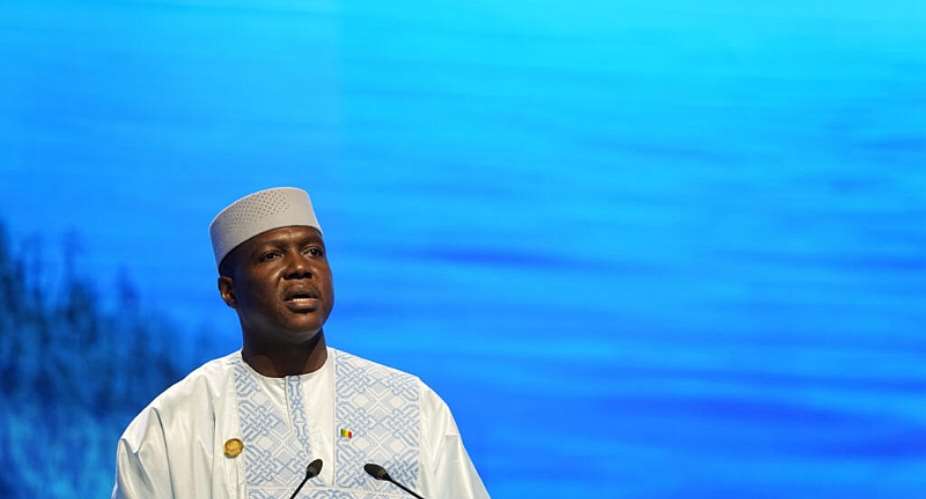
Maiga arrived in Algiers on Monday for a working visit dedicated to strengthening cooperation between Mali and Algeria.
Hosted by his counterpart, Sifi Ghrieb, Maiga is also expected to meet Algeria's President Abdelmadjid Tebboune.
Mali began easing tensions with Algeria in July. Despite a rift dating back more than a year, the neighbours surprised observers by announcing the return of their ambassadors and the reciprocal reopening of their airspace.
RFI's Mathis Slimano asked Bakary Sambe, the Director of the Timbuktu Institute, about the potential impacts of this meeting.
RFI: Tensions between Algeria and Mali emerged right around the time of the 2020 coup d'état – since the Malian junta came to power. What is the reason for these tensions?
Bakary Sambe: Yes, it all stemmed from a specific incident: on the night of 31 March to 1 April, 2025, the Algerian army announced it had shot down a Malian drone near Tinzawaten, on the border between the two countries. Bamako immediately labelled it an act of war, whereas Algiers maintained it was merely defending its airspace.
However, it is important to note that relations were already strained well before that, specifically because Mali had been accusing Algeria of interfering in its internal affairs by hosting Tuareg rebel movements on its soil.
The drone incident acted as a flashpoint. It led to the recall of ambassadors, the closure of airspace, and the Alliance of Sahel States standing in solidarity with Bamako at the time.
Ultimately, there was a happy resolution: after more than a year of estrangement, the two countries finally mended ties in July 2026, with the return of ambassadors and the reopening of airspace.
Relations between Algeria and Mali thaw after year-long rift over drone
RFI: That was last month. We are now in August 2026. The Malian Prime Minister is currently in Algiers. How do you explain this thaw in relations, and why now?
BS: I believe there is one constant: the indispensable nature of sub-regional cooperation right now, particularly following the security vacuum left by the break with traditional international partners, whether bilateral or multilateral.
In my view, there also appears to be a shared interest today in de-escalating conflicts in the region. However, it is often overlooked that Algeria is no ordinary player in the region. It is worth recalling that Algeria supported Mali right from the onset of the current crisis in the north <[a href="https://www.rfi.fr/en/africa/20260704-insurgents-attack-multiple-towns-in-northern-and-central-mali-army-says" rel="nofollow,noreferrer,noopener" target="_blank">Islamist insurgency and Tuareg rebellion], through the Tamanrasset I and II agreements back in 1992 and 1996. Then came the 2015 Algiers Accord, initiated in Burkina Faso, finalised in Algiers, and signed in Bamako.
Algeria has a historic relationship with the region that, in my opinion, helps shed light on this outcome; notably, Algeria has hosted Malian refugees throughout the various cycles of the conflict.
Nowadays, the two countries have no other choice. In fact, the entire Malian zone, from Tinzawaten and Tessalit in the north to Taoudéni, Gao, and Kidal, relies on Algerian resources: food products, subsidized Algerian fuel, and cross-border weekly markets. This demonstrates that the two countries are historically linked and, to a significant extent, economically interdependent.
RFI: In recent days, we have witnessed the release of several Malian soldiers, some of whom had been held captive for years by Tuareg rebels and jihadists. Algeria appears to have played a role. Is this the kind of cooperation Mali's President, Assimi Goita, expects from his neighbour – closer collaboration on security matters?
BS: Yes. I believe Assimi Goita hopes, at the very least, to reduce the intensity of the violence and, furthermore, to cut off supply lines to the armed groups. And I believe Goïta expects Algeria to use its influence over certain factions and key figures to secure a new agreement, one more advantageous than the Algiers Accord. This is firmly on the diplomatic agenda. For its part, Algeria also hopes for a return to a traditional alliance to foster a more favourable climate and counter Moroccan influence.
Morocco becomes Africa's top arms importer, amid tensions with Algeria
RFI: Speaking of Morocco, is Mali playing a double game? We learned that it was thanks to Moroccan mediation that Bamako released the French intelligence agent Yann Vézilier. Doesn't this visit risk ruffling Rabat's feathers?
BS: Yes, strategic interests are always at play. Regarding the rapprochement signalled by the Malian Prime Minister's visit, Algeria hopes for greater access to sub-Saharan Africa, an opening Mali could provide. We must remember the rivalry with Morocco, particularly regarding Morocco's Atlantic Initiative.
Rabat is banking on "influence diplomacy," whereas Algeria holds a genuine strategic foothold in the Sahel, sharing borders with two West African nations, Mali and Niger. Algeria has recently strengthened bilateral ties with the latter, notably through the historic visit of General Abdourahmane Tchiani. Yet, beyond all this, Russia is the one calling the shots. And I believe that Mali has realised that.
This interview has been adapted from the original version in French by Mathis Slimano.


 Ayitey Powers arrested over alleged death threat against Yaw Ampofo Ankrah
 It lies with Sammy Gyamfi to prove his extortion allegation against Afenyo-Marki...
 ‘I’m ready to submit myself for investigation into Sammy Gyamfi extortion allega...
 Osahen Afenyo-Markin sues Sammy Gyamfi, others over extortion allegation
 CID yet to submit report on alleged assassination attempts on Kissi Agyebeng – M...
 NDC’s ‘love’ will soon end as Ghanaians demand results — Bryan Acheampong
 Court adjourns Tuba murder case to September 28 as Police prepare to forward doc...
 Mother seeks justice after four daughters allegedly abused by father at Gomoa Do...
 Muntaka reveals how prime suspect in 2024 Tolon election violence wins NPP const...
 'I have not landed GoldBod contract to provide platform for buying and selling g...

