




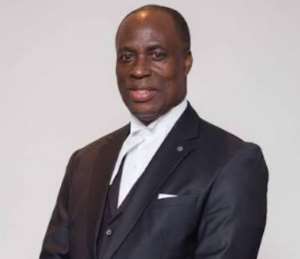
A businessman who changed an industry overnight
When Stephen Kwabena Boateng, popularly known as Kwabena Kesse or simply "Kessben," launched Kessben 93.3 FM in Kumasi in 2004, he did not enter Ghana's most competitive regional radio market quietly. He entered it the way a serious businessman enters a fight he intends to win by going straight for the best talent his rivals had.
Kessben, who has since passed away at 68 after a battle with illness, leaves behind a media legacy that reshaped how radio stations in the Ashanti Region competed for audiences, advertisers, and above all, presenters.
The poaching that shook Oseikrom's airwaves
Kessben FM began test transmission in October 2004 and went fully commercial the following month, becoming the 14th radio station on Kumasi's crowded FM dial. But what made its entry a genuine industry event was not its frequency it was its recruitment strategy.
Within weeks of launch, Kessben FM had assembled a roster built almost entirely from the established stars of rival stations: Mikki Osei Berko (known on air as Master Richard) arrived from Happy FM; Akwasi Donkor, Joojo Le Maire and Kwamina Sam Biney came from Luv FM; Joe Amee, Ohene Djan and Joe Laka moved over from Fox FM; and Wofa Aduse Poku, Abigail Amoah and Patty Dabbs left Kapital Radio. Naana Hayford, who had already moved through Otec FM, Fox FM and Invisible FM, also joined to anchor women's issues programming a measure of just how much movement Kessben FM's arrival triggered across the entire Kumasi radio landscape, popularly known by its Twi name, Oseikrom.
A contemporary Graphic Showbiz report on the episode noted that as the industry absorbed the shock of the reshuffle, Kessben FM had "gained most from the poaching," with even more presenters reportedly in negotiations to follow.
Academic research on the Kumasi radio industry later confirmed the scale of the disruption: 2004 recorded the highest level of staff movement between stations in the preceding five years, with roughly thirty presenters and producers changing stations a wave researchers attributed directly to the near-simultaneous emergence of Kessben FM and a second new entrant, Hello FM.
Money, cars, and a new market reality
What made the moment a genuine turning point in Kumasi's media economy was not simply that presenters moved radio staff had always moved between stations from time to time but the scale and terms on which Kessben FM built its inaugural line-up.
Industry accounts from the period describe a recruitment drive built on financial packages and vehicles substantial enough to draw established, audience-tested names away from stations where they had built their reputations, virtually overnight. It set a new competitive benchmark: to compete for Kumasi's listenership going forward, a station needed the resources to compete for its established personalities too.
The pattern repeated in smaller waves in subsequent years, including around the 2007 launch of Angel FM, but nothing matched the scale of the 2004 disruption Kessben FM set in motion.
Beyond the airwaves
Kessben's radio gambit was, in retrospect, consistent with the broader pattern of his career. Born on September 12, 1957, and raised at North Suntreso in Kumasi, he built the Kessben Group of Companies into a sprawling conglomerate spanning media (Kessben FM, Kessben TV, and the gospel-focused Aseda TV), banking (Multi Credit Savings and Loans), education (Kessben University College, of which he was Chancellor), travel, shipping, and hospitality.
He later expanded Kessben FM into Accra with a 92.9 FM frequency, and set up Wesleyan Television for the Methodist Church in appreciation of his decades of support for the denomination.
He earned a first-class honours degree in Economics and Law and an MBA in Finance, both from the Kwame Nkrumah University of Science and Technology, and served on Ghana's National Peace Council between 2004 and 2010.
A legacy that outlasted the controversy
Two decades on, Kessben FM remains one of the most listened-to stations in the Ashanti Region and consistently ranks among Ghana's top ten nationally by audience share.
The presenters whose 2004 moves once dominated Kumasi's media gossip columns became, in many cases, the faces most associated with the station's rise. For an industry built on personality and trust between presenter and listener, Kessben's willingness to bet heavily in cash and in cars on assembling that trust overnight remains one of the boldest, and most consequential, business decisions in the history of Ghanaian regional broadcasting.
Damirifa due.
Mustapha Bature Sallama medical Science communicator, Private Investigator, Criminal Investigation and Intelligence Analysis,United States Institute of Peace (USIP), [email protected] +233555275880


 Accra-Kumasi return flight now costs up to GH¢5,000 despite lower inflation — Ak...
 NDC using 24-hour markets to cover failure to implement 24-hour economy — Okyere...
 'No African country can solve the problem of road crashes alone' — Transport Min...
 ORC announces temporary disruption to e-Registrar services
 NDC’s GoldBod is a copy of NPP’s plan but implementation has failed — Ocquaye Jr
 Sammy Gyamfi’s words on Afenyo-Markin were harsh; I wouldn’t use them on such pl...
 Bawumia, Japanese Ambassador discuss digitalization, fintech, artificial intelli...
 Supreme Court to rule on bid to halt High Court trials during legal vacation on ...
 Accra–Tema Motorway project reaches 50% completion as roads minister demands fas...
 Nationwide blackout: Power supply expected to stabilise next month – Energy Mini...

