




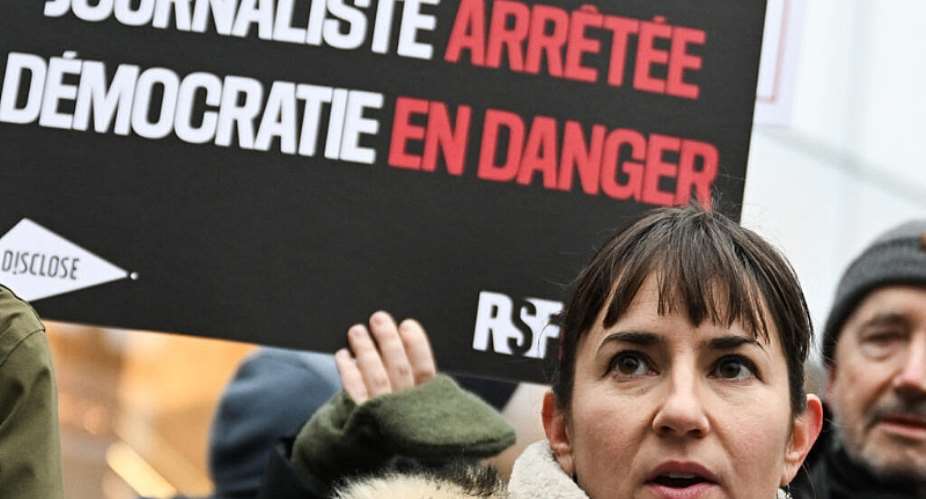
The publication of the Egypt Papers investigation by French non-profit investigative journalism site Disclose in 2021 prompted France's defence ministry to file a legal complaint against its co-author, journalist Ariane Lavrilleux, for allegedly disclosing classified information.
In 2025, following three years of judicial proceedings, anti-terrorism judges ruled there were no grounds to prosecute her, saying the reporting was in the public interest.
But on 8 July, the Paris Court of Appeal ordered the investigation to be reopened, following a request from the Paris public prosecutor's office.
"We thought all this was behind us, after 40 hours in police custody, months of extraordinary surveillance and geolocation tracking," Lavrilleux told RFI. "Now we're starting another battle.
Press freedom organisation Reporters Without Borders (RSF) said the case signals a worrying trend – the "criminalisation of journalism".
Lavrilleux, a defence specialist and deputy editor at Disclose, agrees that the court decision could affect investigative reporters across France.
"What happened to me could now happen to my colleagues," she said. "It's deeply worrying."
Her lawyer, Christophe Bigot, says the appeal court has adopted an exceptionally broad interpretation of the protection of journalistic sources.
"Today we have judges calling for a news organisation's sources to be tracked down," Lavrilleux said. "That's extremely serious because it goes far beyond my own case or Disclose." Ariane Lavrilleux, deputy editor at Disclose, in RFI's studios.
Whistleblowing is on the rise in France, but expert says support remains lacking
'Enormous resources' deployed to intimidate
The Egypt Papers investigation revealed how information from a French counter-intelligence operation – codenamed Sirli and launched in Egypt in 2016 – was turned away from its original purpose.
Officially, Sirli was intended to help Egypt combat terrorism by monitoring movements along its border with Libya.
But Lavrilleux and her fellow journalists discovered that the Egyptian state was using it for a campaign of arbitrary killings against smugglers rather than to identify terrorists.
Once identified they were bombed by Egyptian forces, and civilians were killed.
French military personnel repeatedly raised the alarm in reports sent to the authorities, including presidents François Hollande and Emmanuel Macron, she said.
"But the mission continued. That's the state scandal at the heart of this case."
Lavrilleux notes that the French authorities never challenged the authenticity of the documents Disclose revealed.
Jean-Yves Le Drian, then armed forces minister, ordered an internal inquiry, saying the revelations raised legitimate questions.
However, that investigation concluded within three months that there had been no wrongdoing. It remains classified.
Meanwhile, the criminal investigation aimed at identifying the sources behind the reporting has continued.
"The justice system has deployed enormous resources to intimidate Disclose and identify those who provided these documents," Lavrilleux said. "At the same time, those responsible for, or complicit in, these state crimes have not been investigated."
Rights groups condemn arrest of French journalist over Egypt spy report
Anti-terrorism resources used to track journalists
Lavrilleux was subject to extensive surveillance over three years, including tracking through geolocation technology.
In September 2023, anti-terrorism officers searched her home. Her notebooks, computer and phone were seized and she spent almost 40 hours inpolice custody.
She discovered the extent of the surveillance nearly a year later, after gaining access to the case file.
"There were hundreds of pages covering my bank accounts and my train journeys since 2020," she said. "You ask yourself how anti-terrorism resources could have been diverted to target a journalist who goes to the supermarket, teaches journalism and meets friends for a drink."
She also says officers from France's domestic intelligence agency, the DGSI, kept watch outside Disclose's Paris newsroom.
"Seeing so many resources deployed against journalists made me very angry, and that anger still gives us the strength to keep fighting."
Although Disclose remains determined to continue its investigations, Lavrilleux fears the case could discourage whistleblowers and journalists working on defence and national security.
"The Egypt Papers case could do real damage to press freedom in France. [But] if we win, we could strengthen protection for journalists and their sources".
France sees ratings plunge in global freedom of expression report
Protecting sources
Lavrilleux believes the case has exposed weaknesses in France's 2010 law protecting journalistic sources.
While the legislation prevents journalists being forced to reveal confidential sources, it allows investigators to identify those sources through surveillance, searches and police custody whenever there is an overriding public interest.
"The problem is that nobody has ever defined what that [public interest] means," she said.
And yet protecting sources, including whistleblowers, remains paramount to her profession.
"Protecting sources is essential," she said. "People contact journalists because they have confidential but crucial information about lies, crimes or injustices. Because they take risks, we have to protect their anonymity."
Together with RSF and nearly 110 professional organisations, she is calling for the law to be rewritten.
The government began discussions on reform but hasn't acted on the proposals.
France accused of aiding 'bloody' Egyptian repression through arms sales
Lavrilleux believes attitudes towards reporting on defence and national security have hardened.
"Many journalists before me, and before Disclose, revealed classified defence information without being prosecuted or even summoned for questioning, because governments accepted that, in a democracy, journalists have to investigate – including stories that embarrass those in power – because that's essential for informing the public and for democratic debate."
In 2018, after Disclose revealed that French-made weapons were being used in Yemen against civilians, the journalists involved were summoned by investigators and intelligence.
"They were effectively told, 'Don't do it again' – it was a warning."
Despite the latest court ruling, Lavrilleux says Disclose will continue fighting to make sure the Egypt Papers case does not set a legal precedent. "We can't stop doing our job of informing the public."


 Missing 8-month-old baby found safe in Kpando
 Captain Smart cuts sod for first DVLA office in Gomoa enclave
 Committee tasked to review Adamus Resources Limited licence revocation petition ...
 'The Tribunals Bill appears to preempt constitutional review recommendations' — ...
 'Tribunals are prone to political manipulation' — Kofi Bentil cautions
 'The fear is completely unfounded' — Akwatia MP defends Tribunals Bill
 'Let's start; if it doesn't work, we can review it' — Martin Kpebu backs Tribuna...
 Spain face Argentina in battle for World Cup supremacy
 Ex‑NAFCO Boss Petitions AG: ‘I’m Being Harassed, Detained and Tortured’ — Abdul‑...
 “No Table Will Turn”: Gaming Commission Deputy Tells NPP to Stop Politicising EO...

