




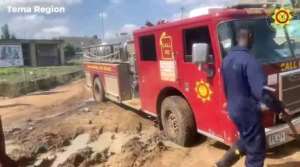
Poor planning and blocked routes continue to delay emergency response, putting lives and property at greater risk.
Firefighters in Ghana are increasingly facing a challenge that has little to do with equipment or manpower. Across many urban and rural communities, poor or non-existent access roads are preventing fire tenders from reaching emergency scenes quickly, allowing fires to spread and causing avoidable loss of lives and property.
The Ghana National Fire Service (GNFS) has repeatedly emphasized that the first few minutes after a fire breaks out are critical for containing the blaze. However, in many communities, response times are extended because emergency vehicles cannot navigate narrow roads, congested settlements, blocked access routes, or deteriorated feeder roads.
The problem is particularly evident in busy commercial centres such as Makola, Kaneshie, Kejetia, and Aboabo markets, where densely packed structures and encroached access lanes often prevent fire tenders from reaching the heart of an outbreak. In several incidents, firefighters have been forced to park at a distance and stretch hoses through crowded alleys while flames continued to spread.
Residential communities face similar challenges. Many neighbourhoods have developed without proper layouts, leaving little or no space for emergency vehicles. During emergencies, firefighters often have to carry equipment on foot over long distances before they can begin extinguishing the fire.
Rural communities are not spared. During the rainy season, poor feeder roads become muddy and impassable, delaying emergency response and, in some cases, making it impossible for fire engines to reach affected villages.
Urban planners and fire safety experts attribute the problem to rapid and unplanned urbanization, weak enforcement of planning regulations, and the widespread encroachment of public access roads by unauthorized structures, kiosks, containers, and refuse dumps. In many cases, building permits have been granted without adequate consideration for emergency vehicle access or other fire safety requirements.
The consequences are devastating. Delayed response increases the likelihood of fatalities, particularly among children, older persons, and individuals with limited mobility. Families lose homes and possessions, traders lose businesses, and communities suffer significant economic setbacks. Fires that could have been contained within minutes often escalate into disasters because emergency responders cannot reach the affected areas promptly.
According to official GNFS statistics, Ghana recorded more than 5,000 fire outbreaks in 2024, resulting in property losses worth millions of cedis. Fire officers indicate that access constraints contributed significantly to the scale of destruction in many of these incidents.
Addressing the challenge requires coordinated action from government agencies, local authorities, developers, and communities. Metropolitan, Municipal and District Assemblies must enforce planning regulations by preserving road setbacks and creating emergency access routes in densely populated settlements and markets. Fire safety considerations should become mandatory in the approval of all building developments, with adequate provision for access roads, hydrants, and emergency assembly points.
Public education is equally important. Residents, traders, and business owners must understand that blocking roads and emergency access routes places entire communities at risk during disasters.
The GNFS could also strengthen its operational capacity by expanding the use of smaller, more mobile firefighting equipment, including portable pumps, rapid-response motorcycles, and compact fire vehicles capable of operating in narrow streets and congested neighbourhoods. Training community fire volunteers to provide immediate first response before professional firefighters arrive would further improve emergency preparedness.
As Ghana continues to urbanize, ensuring access for emergency services must become a national planning priority. Roads are not only essential for transportation and economic activity—they are lifelines during emergencies.
Communities that cannot be reached by firefighters remain vulnerable to avoidable disasters. Without proper access roads, even the most modern firefighting equipment and the best-trained personnel cannot effectively protect lives and property. Building safer communities therefore begins with ensuring that those entrusted with saving lives can reach them when every second counts.


 Judge halts Ex-NAFCO CEO's trial until ruling on seized phones
 Manhyia South MP who resisted arrest reports to EOCO a day after arrest warrant ...
 "Show us evidence" —Upper West teacher unions demand proof of payment before end...
 Adenta: Bolt driver jailed 25 years for cutlass attack and robbery of beautician...
 EOCO drags Manhyia South MP to former law firm, residence for search
 BNI investigates Yaw Ampofo Ankrah over alleged World Cup visa facilitation sche...
 EOCO arrests three over drone flights at headquarters during arrest, probe of Ma...
 Police arrest three suspected kidnappers over Yendi abduction
 Prof Emmanuel Osei Sarpong appointed Acting NSA Director-General
 NSA Boss Yaw Ampofo Ankrah suspended over US$623,000 World Cup visa allegations


