




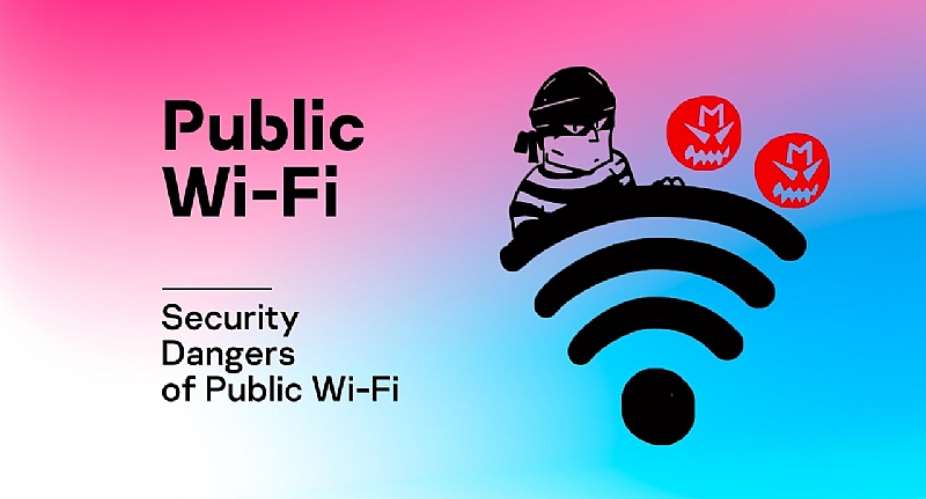
With the cost of living soaring, a publicly accessible wireless internet connection provided free of charge is just what many people need to ease the burden of staying connected.
From airports and hotels to banks, public parks, and restaurants, free public Wi-Fi has become commonplace. Connecting to these networks feels normal and routine, but is it really safe?
A recent study by HighSpeedInternet.com, a U.S.-based company that helps consumers compare internet service providers (ISPs), check broadband availability, run internet speed tests, and learn about home networking and Wi-Fi, revealed that 69% of internet users access public Wi-Fi at least once a week, while about 40% connect daily.
So, what is the true cost of free Wi-Fi to our digital security, and how can we reduce the risks associated with using these networks?
Free public Wi-Fi is often an open or lightly secured network, meaning it may not always require strong authentication or encryption. In many cases, especially in public spaces, the lack of robust security controls makes it easier for anyone within range to connect and, in some situations, allows attackers with the right tools to intercept data transmitted across it.
These characteristics are exactly why public Wi-Fi should never be trusted for sensitive online activities. Connecting to an unsecured network can expose users to several cybersecurity threats.
The Rogue Wi-Fi (Evil Twin Attack)
Also known as an evil twin attack, a rogue Wi-Fi network is a fake wireless network created by cybercriminals to imitate a legitimate one.
Imagine you're at a restaurant and see two available networks: Food_Free_WiFi and Food_Free_wifi. At first glance, both appear identical and harmless. One belongs to the restaurant; the other belongs to an attacker.
Connecting to the fake network may allow the attacker to monitor your online activity, redirect you to malicious websites, or trick you into entering sensitive information. Most victims never realise they connected to the wrong network.
Man-in-the-Middle (MITM) Attacks
Once a victim connects to a rogue Wi-Fi network, the attacker can position themselves between the user's device and the internet, a technique known as a Man-in-the-Middle (MITM) attack.
While the user believes they are communicating directly with a legitimate website or online service, their data first passes through the attacker's system. This can allow cybercriminals to intercept sensitive information such as usernames, passwords, banking details, email credentials, and, in some cases, payment information.
Malware Distribution
Cybercriminals can also use unsecured public Wi-Fi networks to distribute malware.
On an unprotected network, attackers may exploit software vulnerabilities, redirect users to malicious websites, or trick them into downloading infected files disguised as software updates or legitimate applications. Once installed, malware can steal sensitive information, monitor online activity, or provide attackers with unauthorised access to a victim's device.
The risk is far from theoretical. According to a consumer survey conducted by Norton, approximately one in four people who have used public Wi-Fi have experienced some form of security issue, including malware infections, account compromise, or other cyber incidents.
Data Collection: When Free Wi-Fi Isn't Really Free
Beyond direct cyberattacks, another often overlooked risk of free public Wi-Fi is data collection.
Many legitimate Wi-Fi providers, such as those in airports, shopping malls, hotels, and cafes, require users to sign in through a captive portal. In doing so, users may be asked to provide personal details such as email addresses, phone numbers, or even social media logins.
In some cases, this data is collected and analysed for marketing, analytics, or user behaviour tracking purposes. While not necessarily malicious, it raises important privacy concerns, as users may unknowingly trade personal information for internet access.
This highlights the importance of treating public Wi-Fi as an untrusted network and taking appropriate precautions before transmitting sensitive information.
Highlighting these risks does not mean public Wi-Fi is inherently unsafe. However, it should always be used with caution. The following practices can significantly reduce your risk:
- Verify the network name with staff before connecting.
- Avoid accessing banking or financial services on public Wi-Fi.
- Ensure websites use HTTPS.
- Disable automatic Wi-Fi connections.
- Keep your device and apps updated.
- Use a reputable Virtual Private Network (VPN) when handling sensitive information.
- Turn off file sharing while connected to public networks.
The Bottom Line
Free public Wi-Fi offers convenience, but convenience should never be mistaken for security.
The next time you see a "Free Wi-Fi" sign, remember that the cost may not appear on a bill. It could be paid in personal data, lost privacy, or exposure to cyber threats.
Elliot Nuertey is a journalist, web developer, cybersecurity enthusiast, and digital safety advocate.

 Mahama announces review of Airport enclave road network amid growing development
 'He collected GH¢82 million' — Angry Agbodza gives Top International Friday dead...
 Talensi: Minerals Commission orders Nanlamtaaba Enterprise to halt mining in Gba...
 'I faced those who openly insisted that there’s no galamsey going on' – Prof Gya...
 Trump threatens to not reopen Kennedy Center after board blocks renaming
 Minority boycotts Foreign Affairs Committee meeting on South Africa evacuation o...
 Police arrest two over 192 parcels of suspected cocaine in Wa
 Challenging Heights reveals how Ghanaian girls are recruited into sex trade thro...
 Education Ministry to review 'problematic' CSSPS after Catholic Bishops’ concern...
 Family of Salormey Baffoe appeals for her release from alleged National Security...


