




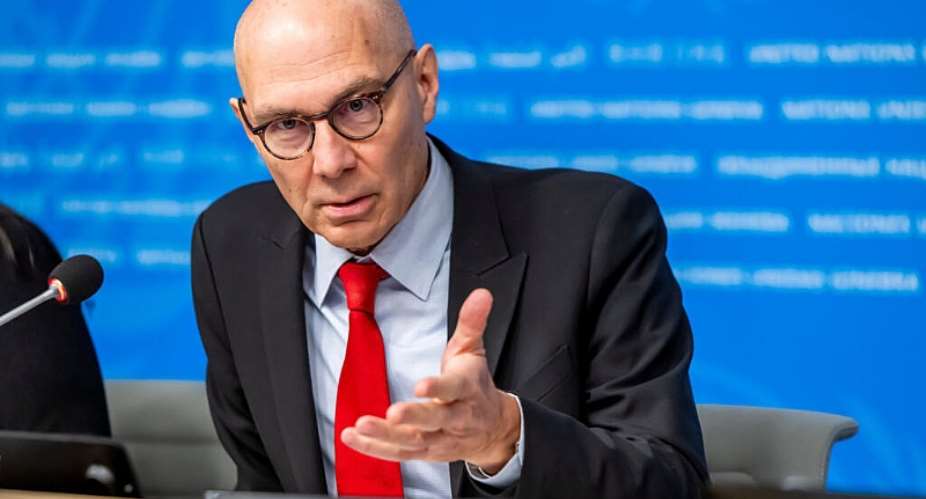
Speaking to RFI this week, Türk warned that civilians are paying the highest price for the war between Iran, Israel and the United States – from worsening repression inside Iran to wider instability across the Middle East.
He also raised the alarm over the spread of drone warfare, the rise of autonomous weapons and the use of sexual violence as a weapon of war in Sudan, while insisting that international law still matters – even when powerful states break it.
RFI: Four months after the outbreak of war in the Middle East, the agreement reached between the US and Iran still seems very fragile. Are you concerned that the conflict might flare up again?
VT: It is exactly as you say. It is fragile and unpredictable. My thoughts are particularly with the Iranian people, who are caught between a rock and a hard place.
I can see that repression has intensified. We saw and experienced what happened in January – mass arrests, executions and killings. I fear that is exactly what is happening right now. So we must think of the Iranian people.
RFI: What was the point of this war? Is the world any safer as a result of this conflict?
VT: What we have seen, particularly with the closure of the Strait of Hormuz, is an impact on the global economy. That affects developing countries in particular, but also vulnerable people within those countries.
So it is clear that the economy is affected, people are affected and the impact on civilians is significant. We can see the situation in Lebanon too. So no, the world has not become a safer place.
Fear of mines alone could disrupt Strait of Hormuz shipping, warns French admiral
RFI: The conflict in Iran has had a devastating effect on human rights throughout the region and across the globe. Do we have a proper understanding of the scale of the repression that has been unleashed upon the people? Do you, as High Commissioner for Human Rights, have a measure of that?
VT: One of the problems was that internet access was cut off. Iran did this for an extremely long period.
RFI: Three months.
VT: Almost three months. And that, of course, makes it extremely difficult to access information.
But at the same time, through all the contacts we have, we were still able to see that there have been at least 6,000 arrests since the outbreak of the war – probably more. We have seen shocking executions. In fact, we are seeing executions rise and the civic space that once existed has now disappeared.
RFI: So would you say the Iranian authorities have used this war to intensify the repression?
VT: Exactly. We are seeing an intensification of the crackdown on society.
It is clear that there is a lack of trust between the Iranian people and the government or state institutions.
RFI: From a broader perspective, do you think this war in the Middle East has marked a tipping point for international law?
VT: We often talk about tipping points. But it begins with every violation of the United Nations Charter.
Unfortunately, we saw what happened in Iraq 20 years ago. We saw what Russia did in Ukraine. We are seeing what is currently happening in the Middle East.
At the same time, international law is there. It is our compass. It also gives us a way of looking at things and establishing the facts. For that reason, international law is extremely important.
I often see cynicism towards it. But it is like – I think I have used this analogy before – traffic and the rules of the road. If someone drives through a red light or drives at much higher speeds, that does not mean the Highway Code is no longer valid.
RFI: But when those who do not follow them are the big players, the powerful ones, the empires – is the challenge even greater for you?
VT: Yes, but the vast majority of member states are still there. They too have power. And that power must be exercised.
For example, in the United Nations General Assembly, you still have the vast majority of states that must, and indeed do, speak out in favour of international law, the Charter and human rights.
I think we need to give a voice to those states that defend international law. We must not underestimate the power of the vast majority.
RFI: Do you think that is still possible, despite the current context?
VT: Yes, because we do not talk often enough about the situations where it works. In most situations, international law does work. Our lives depend on it.
Personally, I have a lot of contact with political leaders from small countries who tell me that they are, of course, very concerned, but at the same time, they are asking for more international law, not less – even when the issues are difficult for them.
French NATO jets destroy mystery drone over Latvia as Ukraine war intensifies
RFI: We have seen with the conflict in Iran, but also in Ukraine, that drone warfare is becoming more widespread. We have entered a new era in terms of how war is waged. Is that a cause for concern?
VT: Yes. Just to give you an example: in Sudan, my office has documented an increase in the use of drones since the start of this year, and the impact on civilians is much more severe.
The majority of civilian deaths are due to the use of drones. This is also the case during the rainy season. Normally, there is a reduction in military activity, so there is less impact on civilians. But what we are now expecting with the rainy season is that there will probably also be an increase in deaths and injuries.
Drones are being used, including some autonomous drones controlled by artificial intelligence which, in a way, choose their own targets.
Because of that, we support a ban on all autonomous weapons capable of killing. I hope this ban will be implemented globally.
RFI: The ban is intended to raise the alarm about the development of these autonomous weapons. But do you think a majority of states would support the idea?
VT: I think the majority of states would probably be in favour of it. The problem is that, when it comes to the major powers, we need to convince them, we need to engage them and we need to tell them that the world does not want this.
Sudan's RSF paramilitaries accused of crimes against humanity in El Fasher
RFI: You were on a mission in Sudan, where you also observed the use of sexual violence as a weapon of war and said that the use of rape is becoming widespread.
VT: I think we are probably talking about thousands [of victims]. This is an extremely serious issue. I met 20 victims myself... who told me of horrific experiences. Mass rapes. It is truly impossible to list them all.
Rape, gang rape, sexual slavery, forced marriage, forced prostitution and sexual torture – that is what the term “sexual violence” encompasses.
And it is used as a weapon of war. I think it is extremely important that we do everything we can to bring these cases to justice. There must be no impunity in this regard.
We are going to push very hard for this and I hope that, at some point, those responsible will be brought to justice.
Because it has consequences over the very long term, once sexual violence has been committed against the victims and their communities.
I must say, I was really struck by [the victims'] resilience [and] also by their determination to fight this phenomenon.
I found that very important for society, because they want justice. They want to tell their story. And that is not easy, culturally speaking, in a context like this.
But even so, I found a very powerful strength there. We must give them a voice.
RFI: As UN High Commissioner for Human Rights, are you limited to simply taking stock of the atrocities taking place around the world?
VT: No, because at the same time, we are making a difference. We do have a certain amount of influence.
Last year, we secured the release of 5,000 people who were being arbitrarily detained. We influenced the drafting of more than 140 pieces of legislation and policies worldwide to bring them into line with human rights.
RFI: So you are making a difference in some way?
VT: Yes, and we are also in demand. We are a beacon of hope for victims, for human rights defenders and for civil society.
I think we need to look at that too. There are millions who are counting on us to do our job, because, to a certain extent, we are their only hope.
This interview has been adapted from the original version in French on RFI's Grand invité international programme and lightly edited for clarity.

 Ounahi stars as Morocco outclass Canada to advance to last eight at World Cup
 Hezbollah, Hamas and Houthi officials attend funeral ceremonies for Iran's Khame...
 World Cup 2026: Ounahi fires Morocco to quarter-finals with decisive brace
 ‘International law is our compass’ in global conflict, UN rights chief tells RFI
 Govt set to name two new military barracks after distinguished generals
 Government begins distribution of relief items to June 29 flood victims
 Accra is technically a flat-lying area, drains alone can’t solve Accra floods — ...
 FDA closes Italian Boy Lounge at Teshie following suspected illicit drug raid
 Sierra Leone President commiserates with Mahama on June 29 flood disaster
 I want to uphold my father's dying wishes, not to chase his properties — Adwoa S...
