




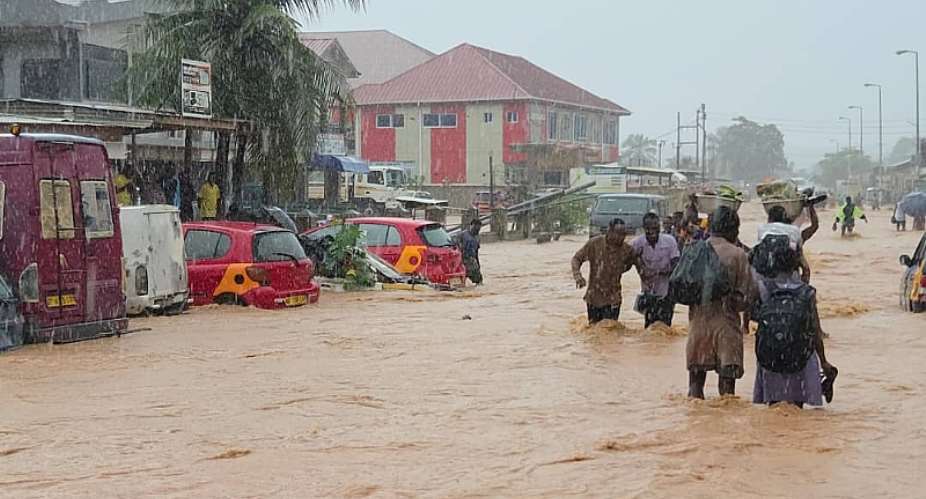
The recent announcement by the Minister for Works and Housing that the dredging of the Odaw River will be completed by December 2027 has been welcomed by many Ghanaians. It is encouraging to see government investing in flood mitigation after decades of devastating floods that have claimed lives, destroyed businesses, displaced families, and imposed significant economic costs on the nation.
The Odaw River is undoubtedly the most important drainage artery within the Greater Accra Metropolitan Area. Increasing its capacity through dredging is therefore an important engineering intervention. However, from an environmental and flood risk management perspective, it is essential to recognise that dredging alone will not solve Accra’s perennial flooding.
Flooding is not simply a river problem. It is a catchment problem. Until Ghana begins to manage the entire catchment rather than focusing on one river channel, flooding will continue to recur despite substantial investments.
Understanding the Real Problem
Every rainfall event produces runoff. Under natural conditions, a significant proportion of this water infiltrates into the soil, replenishes groundwater, and is gradually released into rivers. Urbanisation changes this natural balance.
Over the past four decades, Accra has experienced rapid expansion. Vegetated areas have been replaced by roads, pavements, shopping centres, housing developments, and other impermeable surfaces. Consequently, rainwater that once infiltrated the ground now flows rapidly into drains and rivers.
This dramatically increases both the volume and speed of stormwater reaching the Odaw River.
Even if the river is dredged, the amount of water entering it during intense storms may still exceed its carrying capacity.
The Solid Waste Challenge
Perhaps the greatest contributor to flooding in Accra is poor waste management.
Plastic bottles, sachet water wrappers, household refuse, construction waste, and other debris are routinely disposed of into drains.
These materials eventually accumulate within stormwater systems and rivers, reducing their hydraulic capacity.
A drain that was originally designed to carry large storm flows becomes partially blocked, causing water to back up onto roads and into surrounding communities.
Unless Ghana addresses indiscriminate waste disposal, dredging will only provide temporary relief before sediment and debris accumulate again.
Building on Waterways
Another critical issue is uncontrolled development.
Across many parts of Accra, buildings have been constructed within waterways, floodplains, and wetlands.
Floodplains exist for a reason.
During heavy rainfall they temporarily store excess water before gradually releasing it downstream.
When these natural storage areas are occupied by buildings, floodwaters are displaced into homes, roads, schools, hospitals, and commercial centres.
Removing sediment from a river cannot compensate for the loss of natural flood storage.
Wetlands: Nature’s Flood Defence
Wetlands are among the most effective natural flood management systems in the world.
They slow water movement, store floodwater, trap sediment, improve water quality, and support biodiversity.
Unfortunately, many of Accra’s wetlands have been reclaimed for development.
Instead of protecting these ecosystems, we have progressively destroyed them, thereby removing one of nature’s most effective flood control mechanisms.
Restoring wetlands should become an integral part of Ghana’s long-term flood management strategy.
Climate Change Is Changing the Equation
Climate change is increasing rainfall intensity across many regions of West Africa.
Although annual rainfall totals may not always increase significantly, storms are becoming more intense over shorter periods.
This means drainage systems designed decades ago are increasingly unable to cope with present-day rainfall events.
Engineering designs must therefore consider future climate scenarios rather than historical rainfall records alone.
Flood Management Is More Than Dredging
International best practice demonstrates that successful flood management requires an integrated approach.
Countries that have significantly reduced flood risk combine structural engineering with environmental management and sound urban planning.
Accra requires a similar approach.
Key priorities should include:
- Continuous desilting and maintenance of drains.
- Modernisation and expansion of the city’s stormwater drainage network.
- Strict enforcement against building within waterways and floodplains.
- Protection and restoration of wetlands.
- Effective solid waste collection and public education.
- Sustainable Urban Drainage Systems (SuDS), including detention ponds, infiltration basins, permeable pavements, green roofs, and rain gardens.
- Catchment-wide hydrological modelling to identify flood hotspots and infrastructure bottlenecks.
- Flood forecasting and early warning systems.
- Stronger collaboration among engineers, planners, environmental scientists, local authorities, and communities.
These measures work together as one system. Implementing only one component will deliver only limited results.
From Reactive to Proactive Management
Historically, flood management in Ghana has often been reactive. Major interventions are frequently implemented after severe flood events.
The country must transition towards proactive flood risk management.
Maintenance should become routine rather than emergency-driven.
Drain inspections should occur throughout the year rather than only during the rainy season.
Planning regulations should be enforced consistently rather than selectively.
Environmental protection should be viewed as flood protection.
A Systems Thinking Approach
As environmental professionals often say, every river reflects the condition of its catchment.
The Odaw River cannot function effectively if the upstream drainage network is blocked, if wetlands continue to disappear, if floodplains are occupied, and if waste continues to enter the drainage system every day.
Dredging improves one part of the system.
Flood resilience requires improving the entire system.
Conclusion
The government’s decision to dredge the Odaw River is both welcome and necessary. It deserves support because increasing river capacity forms an important component of flood risk reduction.
However, Ghanaians should not expect dredging alone to eliminate Accra’s perennial flooding.
The lasting solution lies in integrated catchment management—where engineering, environmental stewardship, urban planning, waste management, ecosystem restoration, and responsible governance operate together.
If Ghana embraces this systems approach, Accra can become a city that is not only more resilient to flooding but also healthier, cleaner, and better prepared for the challenges of climate change.
The challenge before us is therefore larger than dredging a river. It is about redesigning how we manage water across the entire city.
By Philip Kyeremanteng, MSc, CSci, FCIWEM
 2026 World Cup: Africa sets new record with seven teams reaching knockout stage
 2026 World Cup: Black Stars secure Round of 32 qualification ahead of Croatia cl...
 I’ve put Uri Gellar in a bottle for challenging his spiritual powers – Kwaku Bon...
 GCB Board Chairman Prof. Joshua Alabi promises $100,000 winning bonus for Black ...
 President Mahama cuts sod for 24-hour economy market at Assin Bereku
 Big Push projects have slowed down because of heavy rainfall — Mahama
 I've lifted the curse I placed on Harry Kane – Kwaku Bonsam
 Mahama begins Central Region Resetting Ghana Tour
 2026 not a year for major public sector salary renegotiations – Vice President O...
 Govt to introduce new rent law to strengthen tenant protection


