




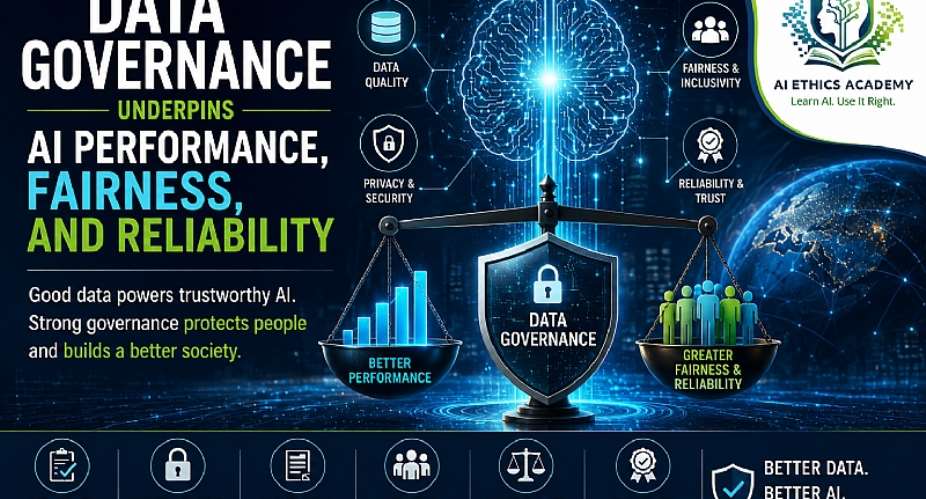
The real power of Artificial Intelligence is not hidden in fancy dashboards, impressive chatbots, or the loud promises of technological transformation. It is hidden in something less glamorous but far more decisive: data. Data is the raw material, the memory, the instruction, and the moral compass of every AI system. When data is well governed, AI can support better decisions, improve efficiency, reduce human error, and expand access to services. When data is poorly governed, AI can become inaccurate, biased, unreliable, discriminatory, and dangerous. That is why any serious discussion about AI governance must begin with data governance.
For many countries, institutions, and businesses rushing to adopt AI, the temptation is to focus on the tool rather than the foundation. We celebrate the model, the platform, the algorithm, and the automation, but we often pay less attention to where the data came from, how it was collected, who was represented, who was excluded, whether consent was obtained, whether the data is accurate, whether it is protected, and whether it is fit for the purpose for which the AI system is being used. That is like building a beautiful house on weak soil and hoping prayer alone will hold the foundation. Technology does not forgive bad foundations.
AI performance depends heavily on data quality. A system trained on incomplete, outdated, poorly labelled, or inaccurate data will produce weak results no matter how advanced the algorithm may appear. In agriculture, poor rainfall or soil data can mislead farmers. In healthcare, incomplete patient data can distort diagnosis. In banking, weak financial records can affect credit scoring. In public administration, dirty data can lead to the wrong targeting of citizens. In recruitment, historical data reflecting past discrimination can reproduce the same unfairness under the cover of automation. The machine may look neutral, but the data may already be carrying society’s old biases in a new digital suit.
This is where fairness enters the conversation. AI does not become fair simply because it is digital. Fairness must be designed, tested, monitored, and governed. If women, rural communities, young people, minority groups, persons with disabilities, low-income citizens, or informal workers are poorly represented in datasets, AI systems may fail them. In Africa, this risk is particularly serious because many datasets used to develop digital systems do not fully reflect local languages, informal economies, rural realities, cultural contexts, or institutional gaps. An AI system that works well in Brussels, Berlin, London, or New York may perform poorly in Wa, Tamale, Kumasi, Lagos, Nairobi, or Accra if the data does not reflect local realities.
This is why data governance is not merely a technical issue for IT departments. It is a governance, ethics, legal, and development issue. It asks hard questions. Who owns the data? Who controls access? Who benefits from its use? Who is harmed when it is wrong? Who is accountable when an AI system makes a damaging decision? These are not small questions. They go to the heart of public trust, institutional responsibility, and human dignity in the AI era.
The European Union has already shown why data governance must be treated as a serious pillar of responsible AI. The General Data Protection Regulation, widely known as the GDPR, is built on important principles such as lawfulness, fairness, transparency, purpose limitation, data minimisation, accuracy, storage limitation, integrity, confidentiality, and accountability. These principles matter because personal data is not ordinary raw material. It carries people’s identities, behaviours, choices, vulnerabilities, and rights. In simple terms, data protection is human protection.
The EU AI Act also places strong emphasis on data governance, especially for high-risk AI systems. Its provisions on data and data governance require attention to training, validation, and testing datasets, including their relevance, representativeness, errors, completeness, data collection processes, bias, and suitability for the intended purpose. This is important because high-risk AI systems may affect people’s access to jobs, education, healthcare, credit, justice, public services, and security. In such areas, “garbage in, garbage out” is not just a technical warning. It can become a social injustice.
For Ghana and Africa, the lesson is clear. We cannot build credible AI systems on weak data systems. We need a national data infrastructure that is secure, interoperable, inclusive, and ethically governed. We need institutions that understand data stewardship. We need public agencies that collect data responsibly and update it regularly. We need private companies that do not treat citizens’ data as free digital fuel. We need universities and researchers to build locally relevant datasets. We need regulators who can ask the right questions before harm occurs. Above all, we need citizens to understand that their data has value and deserves protection.
Data governance must also support innovation, not suffocate it. Some people wrongly think regulation is the enemy of progress. That is not true. Bad regulation can slow innovation, but smart governance strengthens it. Investors, citizens, governments, and development partners are more likely to trust AI systems when there are clear rules on data quality, privacy, security, transparency, accountability, and redress. Trust is not a decorative word in technology. Trust is the currency that allows innovation to scale.
In practical terms, every organisation using AI must begin with a data governance checklist. What data are we using? Why are we using it? Is it legally obtained? Is it accurate? Is it representative? Is it biased? Is it secure? Who can access it? How long will it be kept? Can affected people challenge decisions made with it? Can the organisation explain how the data influenced the AI output? If these questions cannot be answered, then the organisation is not ready for responsible AI deployment.
The future of AI will not be won by countries that merely download tools. It will be shaped by countries that build strong data systems, protect citizens’ rights, and align innovation with public good. For Ghana, this is a major opportunity. As the country positions itself for AI adoption, data governance must not be an afterthought. It must be treated as national digital infrastructure, just like roads, electricity, water systems, and education. Without it, AI adoption may become noisy, expensive, and unreliable. With it, AI can support better governance, stronger businesses, smarter agriculture, improved healthcare, climate action, and more inclusive development.
AI is powerful, but data gives it direction. If the data is weak, the system limps. If the data is biased, the system discriminates. If the data is unprotected, citizens are exposed. If the data is well governed, AI becomes more accurate, fair, reliable, and worthy of public trust. That is the simple truth. In the age of Artificial Intelligence, data governance is not a back-office function. It is the backbone of responsible digital transformation.


 Surrogacy: Supreme Court judge warns of citizenship and inheritance challenges f...
 Ghana has a surrogacy law, but… - Supreme Court Justice
 Ghana faces challenge to persuade Brics it deserves a seat at the table
 Stop the Sermon Before the Engine Starts: Why Ghana Regulates Preaching on Movin...
 Don’t let speed of information become your judgement — Chief Justice tells new l...
 ‘Big Push’: Government assures contractors of prompt payments
 GES to develop plan to recover teaching time lost during teachers’ strike – Clem...
 'All human emotions': French astronaut Sophie Adenot's first words since returni...
 French astronaut recounts 'astonishing' emotions after return to Earth
 India's 'cockroach' movement chief detained ahead of major protest


