




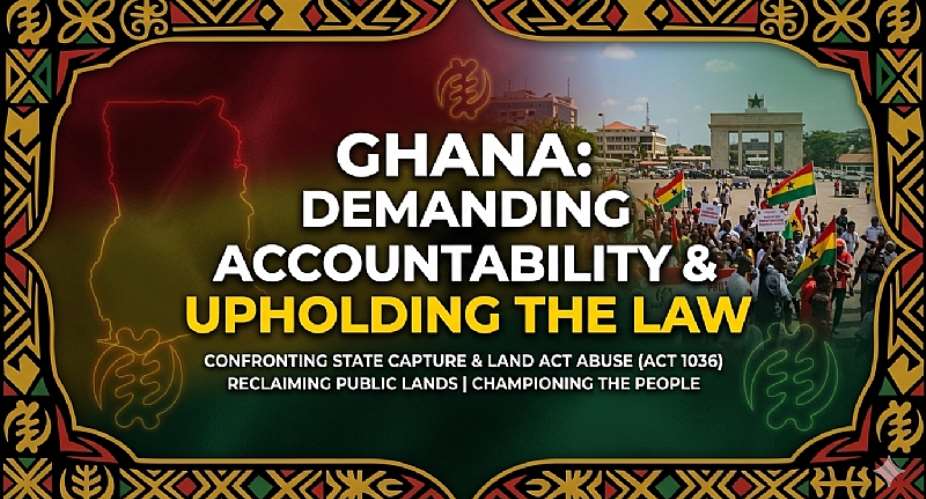
Ghana stands at a critical socio-economic crossroads where public resources are increasingly treated as private inheritance. The recent exposure by the Tema Development Company Limited (TDC) regarding the concentration of luxury serviced plots in Tema Community 24 to political elites and their associates is not an isolated administrative error. It is a visible symptom of a broader, more dangerous phenomenon: State Capture.
State capture occurs when powerful individuals and political networks reshape systemic rules, state-owned enterprises, and laws to enrich themselves at the expense of the collective populace. For the Ghanaian youth, whose futures are bound to the survival of public institutions, understanding this crisis is no longer a matter of passive political observation—it is a requirement for national survival.
Key Findings from the TDC Controversy
Preliminary internal audits have pulled back the curtain on a deeply entrenched system of asymmetric access, revealing that up to 30 percent of premium plots in specific zones were systematically routed to a single family network under an allied management tenure. In the wake of these revelations, defenders of the transaction have scrambled to erect an open-market fallacy. They argue that the transactions were entirely legal because the plots were advertised publicly. However, this defense intentionally conflates technical legality with ethical public administration, ignoring the reality that ordinary Ghanaians entirely lack the insider leverage, networks, and capital to fast-track such acquisitions.
What makes the Community 24 scandal particularly alarming is the clear elite consensus it exposes. Counter-claims and ownership verifications show that political bigwigs across both major political parties own land within the exact same enclave. This highlights a shared, bipartisan political culture where national assets are divided among an insulated ruling class behind closed doors, even while they clash publicly on the campaign trail. This case mirrors a wider, devastating national pattern of systemic encroachment, where lands compulsorily acquired for state infrastructure or ecological preservation—such as the ecologically sensitive Sakumo Ramsar Site—are quietly de-gazetted and converted into high-end private real estate.
Comparative Analysis: State Capture Across Africa
To fully comprehend the danger facing Ghana, one must look at the continental landscape, where state capture has historically dismantled entire economies through distinct narrative mechanisms.
In South Africa, the definitive modern textbook case occurred when a single private family systematically compromised the presidency. This compromise allowed them to dictate cabinet appointments, siphon billions from critical State-Owned Enterprises like Eskom and Transnet, and aggressively reshape procurement rules to benefit private pockets, leaving the nation with a crippling energy crisis.
Further north, Angola experienced decades of public asset diversion under a model of familial consolidation. Strategic national entities—most notably the state oil giant Sonangol—were placed under the direct control of presidential relatives. This effectively blurred the boundary between national treasuries and personal bank accounts, enriching an elite few while the broader populace languished in poverty.
Meanwhile, Zimbabwe offers a stark warning regarding the weaponization of land. Prime agricultural tracts were repeatedly cornered by political elites and security chiefs under the guise of redistribution. This partisan accumulation completely collapsed the agricultural sector and demonstrated how elite land grabbing directly destroys a national economy from its foundation.
Strengthening the Legal Argument: Ghana’s Land Act, 2020 (Act 1036)
The tragedy of the Ghanaian situation is that our laws explicitly prohibit these practices, yet enforcement remains selective. Ghana’s Land Act, 2020 (Act 1036) outlines strict provisions regarding fiduciary duty and trusteeship. Under Sections 9 and 13, managers of public, stool, or family lands act strictly as trustees for the people. This means that allocations must serve the collective populace, and prioritizing familial networks represents a direct breach of this sacred trust.
Furthermore, the legal framework is weaponized with punitive measures. Section 236 of the Act explicitly criminalizes the unlawful appropriation, sale, or conveyance of public land, providing a clear path for prosecution. Crucially, Part Seven of the Act outlines strict compulsory acquisition constraints. The state’s power to compulsorily acquire land is legally restricted to valid public infrastructure or social utility projects. Re-zoning land that was acquired from traditional authorities for public use, and turning it into luxury estates for well-connected insiders, violates both the spirit and text of the law.
Strategic Reforms and Structural Discipline
Reversing this slide into oligarchy requires immediate structural changes to how State-Owned Enterprise (SOE) boards operate. First, Ghana must implement independent appointment frameworks that strip ministries of sole discretionary power to appoint board members, introducing instead competitive vetting overseen by independent bodies. Second, statutory cooling-off periods must be codified into law, banning immediate family members or close associates of executive officials from purchasing assets managed by SOEs during their active tenure. Finally, the state must mandate digital asset ledgers, publishing a real-time, searchable national registry of beneficial ownership for all public land allocations to ensure absolute transparency.
This battle must also be fought across academic and professional disciplines, with specific mandates for Ghana's student body:
- For Law Students: The mandate is to challenge mere technical legality, master the tools of public interest litigation, and aggressively utilize Article 284 of the Constitution to reverse irregular asset sales.
- For Town Planning Students: The mission is to defend urban equity, resist intense elite rezoning pressures, and champion the implementation of digitized land registries.
- For Political Science Students: The objective is to deconstruct the bipartisan duopoly, study the raw mechanics of state capture, and document exactly how SOEs are weaponized to build oligarchies.
A Demand for Direct Reversal and Civic Re-purposing
The ultimate remedy for the structural exploitation of public assets cannot be limited to toothless fines, endless audits, or partisan media battles. To regain citizen trust, the state must take immediate, radical corrective action.
First, there must be an immediate executive forfeiture and reversal. The state must revoke and reverse all irregular land allocations in Tema Community 24, returning them back into state custody under the strict enforcement of the Land Act, 2020.
Second, the state must initiate a process of repurposing these areas for public workers. These reclaimed acres should be re-zoned for high-density, affordable Worker’s Flats and social housing.
Nurses, teachers, civil servants, and police officers—who are currently priced out of the very communities they serve—must be the primary beneficiaries of these reclaimed plots. Turning elite enclaves into social assets flips the script of state capture and proves that public property belongs to the people.
The systematic transfer of public land into private hands is a direct threat to the economic future of Ghana’s youth. When public spaces, corporations, and resources are captured by an elite few, the state loses its capacity to provide affordable housing, infrastructure, and opportunity for the majority.
Ghana’s youth must reject the cynical narrative that state-backed nepotism is simply “business as usual.” True patriotism requires holding institutions accountable, demanding absolute transparency in national property management, and ensuring public assets serve the public good. The land belongs to the republic—not to the regimes that temporarily manage it.
✍️ Retired Senior Citizen
For and on behalf of all Senior Citizens of the Republic of Ghana 🇬🇭
Teshie‑Nungua
[email protected]


 GoldBod’s gains must be weighed against full cost to Ghana – Prof. Bokpin
 ‘Afenyo-Markin’s smear campaign against me is about extortion’ – Sammy Gyamfi
 August 22: Cedi sells at GHS12.30 on forex market, GHS11.13 on BoG interbank
 There is a deliberate smear campaign against GoldBod from Minority – Sammy Gyamf...
 ‘If GoldBod wants credit, it must accept blame for losses’ – Dr Owusu Sarkodie
 Akosombo control system to be restored next month – Energy Minister
 ‘Temporary Akosombo system not very robust’ – Energy Minister on recent power ou...
 Mike Ocquaye Jr reacts to Adwoa Safo’s reported return to NPP Dome-Kwabenya race
 Foreign Affairs Ministry urges Tijjaniya pilgrims to Senegal to travel by air ov...
 Bono Police Arrest 36‑Year‑Old in GH¢1.1M Fake Gold Deal; Hunt for Three Others ...

