




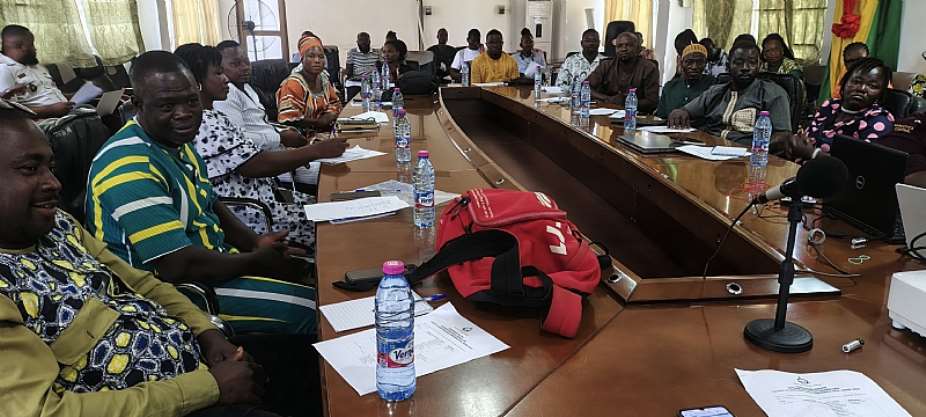
The Upper East Regional Commander of the Narcotics Control Commission (NACOC), Mr. Saeed Abdul‑Aziz, has raised serious concerns over the Commission’s inadequate resources, warning that the situation is undermining efforts to curb illicit drug trafficking and rising substance abuse among Senior High School (SHS) students in the region.
Speaking at a seminar organised for school counsellors to mark World Drug Day, Mr. Abdul‑Aziz stressed that education and sensitisation remain critical tools in preventing drug use among young people. However, he noted that the Commission’s ability to carry out routine operations and public awareness campaigns has been severely constrained by a lack of logistics.
“The fight against illicit drugs requires constant engagement with communities and schools. Unfortunately, inadequate resources — including vehicles, motorbikes and other operational logistics — are making it difficult for us to effectively reach schools and conduct regular sensitisation programmes,” he said.
He added that the region’s proximity to Ghana’s northern borders presents unique security challenges, making intensified surveillance and monitoring essential.
“Our porous borders make the region vulnerable to the movement of illicit substances. Without adequate logistics, our efforts to monitor these areas and carry out enforcement operations become extremely challenging,” he noted.
The seminar brought together school counsellors from various institutions to discuss practical strategies for reducing drug abuse among students and addressing recurring incidents of indiscipline and riots in some SHSs.
Mr. Abdul‑Aziz underscored the pivotal role of school counsellors, describing them as the first line of support for students dealing with emotional, psychological and social difficulties.
“Counsellors are key stakeholders in the fight against drug abuse. Through guidance, counselling and early intervention, they can help students make informed decisions and avoid behaviours that could jeopardise their future,” he said.
Deputy Regional Director of the Ghana Education Service (GES), Mr. John Anku, also addressed the media, describing the fight against drug abuse in schools as a shared responsibility requiring the collective efforts of parents, teachers, security agencies, religious bodies and corporate organisations.
He expressed concern over emerging trends in which students consume drug‑infused products disguised as everyday snacks and beverages.
“Some students are now turning to substances concealed in biscuits, toffees, sobolo, energy drinks and other consumables. Many of these items contain harmful substances that pose serious risks to their health, academic performance and overall wellbeing,” he cautioned.
Mr. Anku urged parents to pay closer attention to their children’s habits, while encouraging schools to strengthen counselling units and intensify awareness creation on the dangers of substance abuse.
The seminar forms part of ongoing efforts by NACOC and the GES to promote drug‑free learning environments and equip school counsellors with the knowledge and skills needed to support students effectively.
Stakeholders at the event called for increased government support, improved logistics and stronger institutional collaboration to enhance the fight against illicit drugs and safeguard the future of Ghana’s youth.
 Consumers cannot be paying for ECG’s inefficiencies — Minority
 Release investigation report on unusual prepaid credit depletion — Minority to E...
 Rock Estate Housing project in Upper East stalls years after high-profile sod-cu...
 Full reasons ECOWAS Court dismissed Justice Torkonoo's case against Ghana
 'The law is the law' — Thaddeus Sory reacts to ECOWAS Court ruling on Torkornoo ...
 June 24: Cedi sells at GHS12.25 on forex market, GHS11.21 on BoG interbank
 Gender Ministry renews commitment to disability rights on National Day of Person...
 Due process was observed in removal of Justice Torkonoo as Ghana's Chief Justice...
 NDC is complete scam, they use 419 to rally fake promises but does nothing — Osa...
 Dankwa-Busia-Dombo tradition remains blueprint for Ghana's prosperity — Osahen A...


