




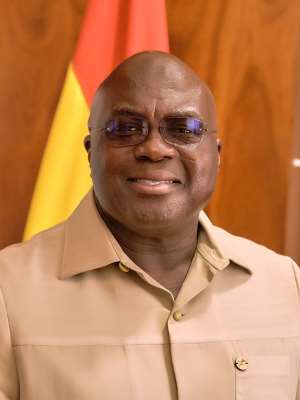
In Ghanaian politics, power rarely announces itself loudly. It accumulates quietly through loyalty, grassroots organization, and institutional trust built over decades. That, in many ways, is the story of Julius Debrah, and it is why conversations about who will succeed President John Dramani Mahama as leader of the National Democratic Congress (NDC) increasingly point in one direction.
Julius Debrah currently serves as Chief of Staff to the President of Ghana, a role he assumed on January 7, 2025, following President Mahama's return to power. It is not his first time in that seat he previously served as Chief of Staff between 2015 and 2017 during Mahama's first administration, and has also held the positions of Minister for Local Government and Rural Development, Eastern Regional Minister, and Greater Accra Regional Minister.
Now, the question is whether that distinguished career in service is the foundation for something larger: the presidency itself.
The Race Taking Shape
President John Dramani Mahama, who previously served between 2013 and 2017 and won a second term in 2024, is term-limited and cannot contest to lead the party in 2028. Several party bigwigs, including NDC Chairman Johnson Asiedu Nketia, Chief of Staff Julius Debrah, Finance Minister and MP for Ajumako-Enyan-Esiam Cassiel Ato Forson, and Minister of Education and MP for Tamale South Haruna Iddrisu, have been touted as frontrunners for the position.
The contest is already producing data. A nationwide survey conducted by Africa Policy Lens (APL) between April 17 and 19, 2026, sampled 2,408 constituency executives of the NDC across all 276 constituencies. Its most significant finding was that neither Julius Debrah nor National Chairman Johnson Asiedu Nketia has secured a decisive advantage defining the current landscape as a tightly contested, early-stage race.
Strategically, the race remains wide open. Both Asiedu Nketiah and Julius Debrah have consolidated strong but limited bases, yet neither has demonstrated the ability to expand beyond their core supporters. The battle to succeed President Mahama is shaping up to be one of the most competitive internal contests in the NDC's recent history.
Youth and Civil Society Rally Behind Debrah
The groundswell of support from organized groups has been notable. The Youth for Presidency-NDC, a youth advocacy group within the NDC, officially endorsed Julius Debrah as its preferred presidential candidate for the 2028 general elections. The endorsement was announced by the group's National Coordinator, Emmanuel Kofi Aguzey, during a press conference on April 28, 2026, in the Ashanti Region. Aguzey described Debrah as a hardworking and visionary leader who has consistently demonstrated humility, intelligence, and strong commitment to national development the right person to lead Ghana after President Mahama.
Civil society has added its voice. Citizen Eye Ghana, a civil society organization committed to democratic governance, conducted a strategic assessment of potential presidential candidates within the NDC and concluded that Julius Debrah stands out as the most qualified, strategic, and unifying choice to lead the party into 2028. The group assessed contenders across four dimensions: regional balance, age and energy, executive governance experience, and leadership qualities.
The report noted that Debrah's background and political profile align closely with the needs of the party and the electorate, and that he occupies what analysts describe as a "sweet spot" combining maturity with vitality at age 59. The group concluded: "In a time of political uncertainty and governance fatigue, the NDC must prioritize unity, competence, and credibility. Julius Debrah represents more than a candidacy. He symbolizes a path to national renewal."
The Prophets Have Spoken
As is tradition in Ghanaian political culture, the clergy have weighed in. Prophet Emmanuel Badu Kobi, founder and leader of Glorious Wave Church International, prophesied that Julius Debrah will emerge as the NDC's presidential candidate for the 2028 general elections, claiming God revealed the outcome to him as far back as March 2025 barely two months into President Mahama's second term. "As for the NDC, I would say it with humility that two months into their term, I had already mentioned who the flag bearer would be. God informed me that I should tell Ghanaians that Julius Debrah would be the next flag bearer," he declared.
Not all spiritual pronouncements have been favorable, however. Prophet Clement Quansah Testimony, when asked whether Julius Debrah was a potential candidate, suggested through a prophetic vision involving two buffaloes fighting one with a broken horn that "got injured, angry, and left" that the path to the presidency may not be straightforward for Debrah.
A Profile Built for the Long Game
Julius Debrah was born in Suhum in the Eastern Region and educated at Mpraeso Secondary School, Achimota School, and the University of Ghana. He is celebrated for his grassroots appeal and has a reputation as a savvy retail-politics operator. He is widely seen as the heir apparent to John Mahama, cementing his legacy as one of Ghana's most loyal political allies who stood by Mahama through years of opposition and celebrated their eventual return to power.
Today, conversations about the future of the NDC increasingly include his name. With eyes set on the party's 2028 presidential primary, he is emerging as a potential flag bearer whose candidacy would be rooted not in populist appeal alone, but in organizational strength that of a man who began not at the top, but at the base, and rose steadily, deliberately, toward the summit.
Despite the fervor, the NDC's institutional gatekeepers have sounded a note of restraint. The NDC Council of Elders has stepped into the 2028 presidential race conversation, reminding party members that the NDC Constitution clearly outlines the process for electing a presidential candidate and that no individual is authorized to campaign until the appropriate constitutional procedures have been activated. Referencing Article 42 of the party's constitution, the Council emphasized that only the National Executive Committee has the authority to determine the timetable and guidelines for presidential primaries.
The message is clear: the race is real, the names are known, but the formal contest has not yet begun. Julius Debrah, for his part, has remained largely tight-lipped about his personal ambitions a restraint that his supporters interpret not as indifference, but as the quiet confidence of a man who knows exactly where he is headed.
SOURCES / REFERENCES
Adomonline.com "Youth for Presidency-NDC Endorses Julius Debrah for 2028 Presidential Race"
Mustapha Bature Sallama.
Medical/ Science Communicator,
Private Investigator, Criminal investigation and Intelligence Analysis.
International Conflict Management and Peace Building.USIP
[email protected]
+233-555-275-880


 'We don't reject partnerships, but those partnerships must be on our terms' — Ma...
 Mahama receives five reports ahead of Ghana’s 2027 AU chairmanship
 Police arrest suspect in GH¢1.1m fake gold deal in Berekum
 C/R: Wildlife Guard shot dead by suspected poacher at Kakum Forest Reserve
 Here are areas affected by planned power interruption on Sunday from 3 AM to 6 P...
 Upper East youth raise concern over ‘snail-paced’ development
 Gold buyer reportedly shot dead in daylight robbery at Manso Adubia
 50 Aspirants Pick Forms for 11 National Executive Positions in NPP Elections
 Amoah: Minority’s Questions on GoldBod Are Legitimate and Necessary

