




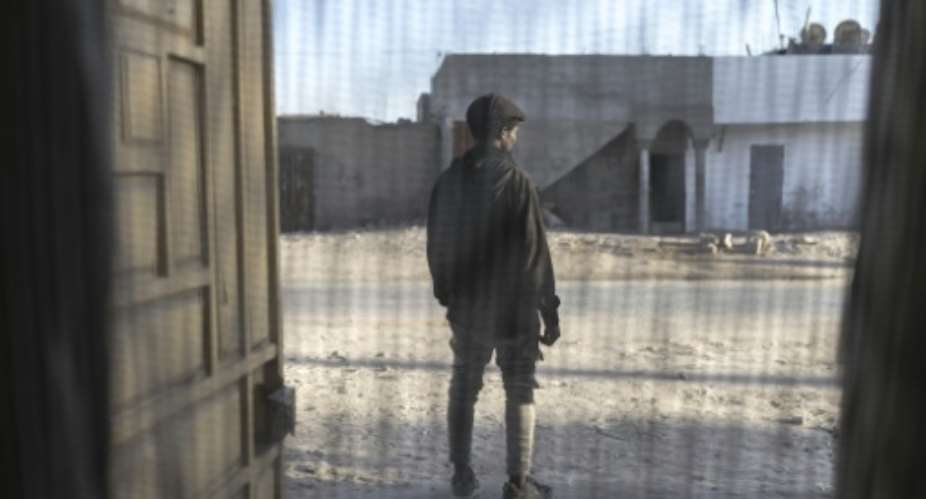
From the Mauritanian coast, Ahmed, a Senegalese man, looks towards Europe, the place he dreams of being but fears he will never reach due to heightened security against migrants in the west African country.
"Everyone wants to leave," said the 34-year-old, who keeps a low profile in Mauritania to evade constant police checks.
But "since security was stepped up, no one can get through", added Ahmed, whose name has been changed for security purposes.
Thousands of west Africans are living in Nouadhibou, hoping to board large, rickety canoes known as pirogues and head on a two-day journey to Spain's Canary Islands.
Such irregular migration has come to a sudden halt, however, following a crackdown by Mauritania, a vast, desert nation on the edge of the Atlantic, which serves as a major migration departure point.
Document checks, mass expulsions, coastal surveillance and smuggler arrests have caused migration to plummet over the past year.
A few months after signing a migration management partnership with the European Union, Mauritania launched its sometimes brutal campaign, outraging some of its neighbours who say migrants' human rights have been violated.
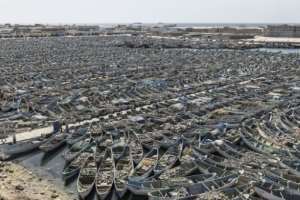 Migrants use rickety wooden canoes or pirogues to make the trip. By PATRICK MEINHARDT (AFP)
"You have to keep a low profile," said Ahmed, adding: "Police come looking for people including inside their homes."
He was already expelled back to Senegal once in 2024, but returned to Mauritania where he now works as a mason, hoping to save the 1,200 euros ($1,400) necessary to embark on the journey again.
Departure point
Nouadhibou is teeming with young men like Ahmed who are fleeing poverty.
A massive fishing port located on a peninsula shared with Western Sahara, the city is a key departure point for migrants.
They come to work in Nouadhibou before setting sail from the peninsula's Western Sahara side, a quasi no man's land under Moroccan control.
On the streets, patrols for undocumented migrants are a common sight.
Authorities say the operations are "routine" and target individuals without legal status, but have not released figures on the scale of their activities.
According to the Mauritanian press, at least tens of thousands were expelled in 2025.
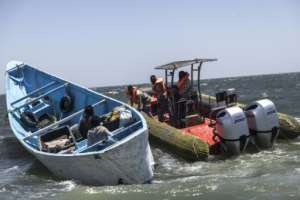 Mauritania's coastguard conduct patrols and check fishing boats for documents and permits. By PATRICK MEINHARDT (AFP)
Abuses by Mauritanian authorities include serious human rights violations such as torture, rape, physical abuse, extortion, and summary or mass expulsions, according to a 2025 report by Human Rights Watch.
Even those with refugee status have not been spared from expulsion.
Most days at dusk, women and children filter onto a bus outside the Senegalese consulate in Nouadhibou, bound for the border city of Rosso, where they hope to obtain documents and thereby avoid police harassment.
Baby on lap, Ramatoulaye prepared to spend the night on the bus.
"You can't go out or go to the market, because if you're on the street, they pick you up and expel you," said the 34-year-old Senegalese woman, who has lived in Mauritania for years.
EU partner
The crackdown began a few months after Mauritania signed a partnership with the European Union in 2024 as part of the EU's policy of externalising border controls.
The 210-million-euro EU package provided funds for initiatives such as border surveillance, increased sea rescue capabilities and halting smuggling networks, plus development projects.
Brussels is increasingly establishing these types of deals with transit countries such as Tunisia and Egypt, with the expectation that they halt departures in exchange for the aid.
Many migrants view the agreement as the trigger for their forced return.
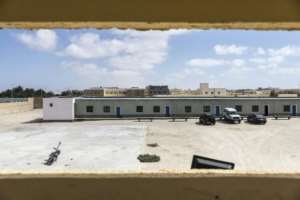 The EU funds two temporary reception centres for migrants, including in Nouadhibou. By PATRICK MEINHARDT (AFP)
"This is not something we requested, either directly or indirectly. What we asked for was proper migration management and a crackdown on smuggling networks," said Joaquin Tasso Vilallonga, EU ambassador to Mauritania.
"We expressed our concerns" to Mauritania, he added.
The EU funds two temporary reception centres: one in the capital, Nouakchott, and another in Nouadhibou, which AFP visited.
Managed by the Mauritanian Red Crescent, the centres aim to provide dignified accommodation for migrants rescued at sea as they undergo registration to determine whether they are vulnerable or eligible for international protection.
Following their traumatic journeys, migrants eat, rest and receive medical care at the centres, where they stay for no more than 72 hours.
"The goal of these centres is to receive and ensure the protection of migrants who have been trafficked... in accordance with (Mauritania's) international commitments", Cheikh Tourad Abdel Malick, director of the National Authority to Combat Trafficking in Persons and Migrant Smuggling, told AFP.
If the individuals are deemed ineligible for asylum or not vulnerable, they are deported.
Two similar centres are set to open in Senegal.
Mauritania is a "key partner on immigration issues", said European diplomat Pierre Beziz, explaining that the country is a stable force in the Sahel "amid a highly volatile regional landscape".
Ebb and flow
At the height of the migration crisis, bodies frequently washed up onto Mauritanian beaches, including lone, unclothed individuals likely thrown overboard.
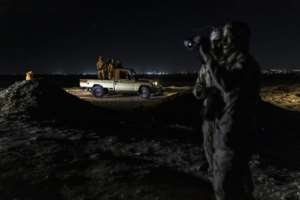 Coastguard officers are on the lookout for suspicious activity. By PATRICK MEINHARDT (AFP)
In 2024, approximately 10,000 people died while attempting the Atlantic migration route, departing from Mauritania as well as Senegal, The Gambia and Guinea.
Eyes glued to binoculars, Coast Guard officer Cheikh Vadel scanned the night as head of a patrol for departing pirogues.
"We used to find several (groups) a day," he said, but more recently "all the smugglers were arrested, the departure points closed".
In the Coast Guard compound, hundreds of boat engines confiscated from smugglers are lined up.
But the target is always moving: in recent weeks departures have resumed farther south, particularly from The Gambia, with more than 1,100 migrants taken in by the Mauritania Coast Guard in less than two weeks.
Visas desired
Laylay, whose name has been changed for security reasons, has already attempted the sea crossing three times, driven by the despair of being unable to support his family.
"Death was better than the life I had in Senegal," the mason said quietly.
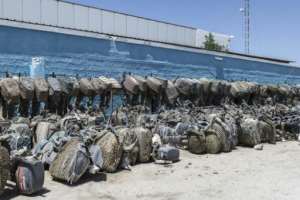 Confiscated motors used on pirogues for illegal fishing and illegal migration are impounded. By PATRICK MEINHARDT (AFP)
He arrived in Nouadhibou a year ago and is now waiting, just like everyone else.
He believes stemming illegal immigration starts with visa access: "We would go work (abroad) and then come back home," he said.
But in Europe, the mood is shifting to the right.
Earlier this year, the European Union unveiled outlines for its future migration policy, confirming a significant hardening, notably with the creation of centres outside its borders for failed asylum-seekers.
The main architect of the shift, European Commissioner Magnus Brunner, set the tone, bluntly stating: "The priority is clear: reducing the number of illegal arrivals."


 AI risks, Iran war to take center stage at UN
 ‘I had never heard of Eswatini’: Deported by the US to a country that rejects th...
 Transport fares increased 8% from September 26
 Golokuati residents call for operationalisation of abandoned ECG office
 Frank Danquah declared wanted over alleged narcotics offences
 Ghana TVET Service warns against collection of fees in TVET institutions
 16 arrested as National Security uncovers counterfeit currency printing syndicat...
 Work without fear or favour — Shamima Muslim urges broadcasters
 MFWA begins 5-day training for journalists from northern sector on media law and...
 Law student petitions CHRAJ over alleged military killing of Gbewaa Training Col...


