




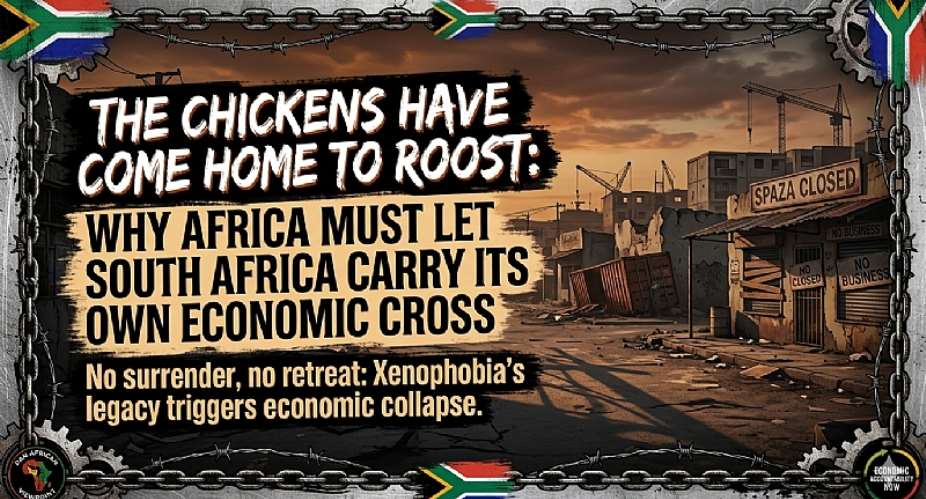
No Surrender, No Retreat: Township Collapses Prove South Africa Weaponized Xenophobia to Its Own Ruin
Following decades of targeted xenophobic violence, state-sanctioned regulatory crackdowns, and populist scapegoating, a massive exit of foreign businesses has triggered a severe economic depression within South Africa’s township economies. The very communities that cheered the violent eviction or regulatory harassment of fellow Africans are now facing an economic wasteland. As supply chains break down and food security plummets, South Africans find themselves begging for the return of the same entrepreneurs they violently expelled.
For the rest of the continent, the response must be unyielding: no surrender, no retreat. For too long, South Africa has reaped the benefits of continental trade while treating African migrants with brutal disdain. It is time for sub-regional blocs like the Economic Community of West African States (ECOWAS) and the Southern African Development Community (SADC) to cease all economic interventions. South Africa engineered this disaster; South Africa must carry its own cross and absorb the bitter lessons of its intolerance.
A Timeline of Brutality: The State-Sanctioned War on Foreign Capital
The current collapse did not happen in a vacuum. It is the culmination of nearly two decades of state-tolerated violence, populist policies, and administrative warfare aimed at destroying non-national black businesses, heavily fueled by inflammatory remarks from high-profile leaders:
- The May 2008 Pogroms: A horrific wave of violence swept through townships like Alexandra and Diepsloot, leaving over 60 people dead, hundreds injured, and thousands of foreign-owned shops looted and burned to the ground.
- The 2015 Durban and Johannesburg Attacks: Triggered by xenophobic rhetoric, mobs targeted foreign traders, forcing the deployment of the military. This violence was widely attributed to statements made by the late Zulu King Goodwill Zwelithini, who publicly declared that "foreigners must pack their bags and go home," effectively painting a target on the backs of migrant entrepreneurs.
- The 2019 Commercial Cleansing: Violent mobs launched synchronized attacks on foreign-owned storefronts in Johannesburg's Central Business District (CBD). The state's defensive stance was mirrored by top officials; during this era of rising tension, then-Johannesburg Mayor Herman Mashaba notoriously stated that "illegal immigrants are holding our city hostage," directly validating vigilante actions. This forced countries like Nigeria to execute emergency mass evacuations of their citizens via private airlines.
- The Rise of Institutional Harassment (2020–2024): Rather than protecting human rights, the state weaponized its bureaucracy. The introduction of aggressive municipal bylaws, systemic immigration raids, and the rise of state-tolerated vigilante groups like Operation Dudula effectively institutionalized the economic strangulation of foreign African nationals. This hostile political environment was further codified when government ministers openly suggested that certain sectors, like hospitality and informal retail, should be legally reserved exclusively for South African citizens.
The Total Collapse of the Township Economy
By forcing out foreign operators, South Africa successfully dismantled the operational core of its informal retail sector. The resulting economic devastation has proven catastrophic:
- Shattered Supply Chains: Foreign-operated spaza shops functioned as the logistical heartbeat of low-income areas, providing highly efficient, low-cost supply chains for daily necessities.
- Emergence of Food Deserts: The mass closure of these neighborhood shops has left millions of impoverished township residents with no local access to basic commodities, causing absolute desperation.
- The Evaporation of Rental Income: Millions of poor South African families who sustained their own households by renting out portions of their land or storefronts to foreign businesses have seen their primary source of income vanish overnight.
- Exploding Inflation and Corporate Monopolies: Without the healthy competitive pricing driven by agile foreign entrepreneurs, massive domestic corporate supermarkets have monopolized the market, spiking the cost of living out of reach for everyday citizens.
SADC and ECOWAS: The Time for Diplomatic Capitulation is Over
Historically, sub-regional bodies have responded to South African xenophobia with weak diplomatic statements and toothless appeals to "Pan-African unity." This submissive approach must end immediately. Both SADC and ECOWAS must enforce a rigid strategy of economic accountability:
- SADC Must Terminate the Culture of Impunity: Despite South Africa being a dominant member of the Southern African Development Community, the bloc has consistently ignored the state's failure to uphold basic human rights protocols. SADC must formally censure South Africa and condition all regional security and transport cooperation on the absolute protection of regional migrants.
- ECOWAS Must Enforce Reciprocal Retaliation: West African nationals, particularly Nigerian and Ghanaian traders, have historically borne the brunt of commercial looting in South Africa. ECOWAS must leverage its massive market power by targeting the vast network of South African multinational corporations generating billions of dollars across West Africa.
- Sharpening the Regulatory Blade on SA Corporates: If West African entrepreneurs cannot safely operate small retail shops in Johannesburg, then South African corporate giants must face heavily restrictive regulatory frameworks, aggressive taxation, and strict localization audits within the ECOWAS bloc. This includes telecom giants like MTN, retail conglomerates like Shoprite and Pepkor, entertainment monopolies like MultiChoice (DSTV), and financial institutions like Standard Bank (Stanbic). True diplomacy requires reciprocity: if our micro-traders are hunted abroad, their mega-corporations must feel the regulatory squeeze at home.
- Defending Free Movement Frameworks: South Africa cannot continue to enjoy lucrative access to continental markets through the African Continental Free Trade Area (AfCFTA) while actively undermining the AU Protocol on Free Movement of Persons and local trade integration protocols.
An Urgent Call to Action for Regional Leaders: Rebuild at Home
African heads of state, policymakers, and regional leaders must completely alter their response to this crisis. The solution is not to renegotiate terms for our citizens to return to a hostile territory. During the height of the xenophobic attacks, South African mobs and politicians sent a clear, unyielding message: "Go back and build your own countries."
It is time for African leaders to take that statement literally. Instead of pleading for access to a broken system, regional leaders must take the following urgent steps:
- Ban the Promotion of Return Migration: Governments across West, East, and Central Africa must issue strict travel advisories and cease any programs aimed at reintegrating traders into South African townships. Do not send our citizens back to be used as economic scapegoats when the next domestic crisis hits.
- De-Risk Domestic Business Environments: Leaders must aggressively slash bureaucratic red tape, eliminate port corruption, and lower interest rates in home countries so that local entrepreneurs can thrive safely on their own soil.
- Create Local Micro-Credit Schemes: Divert state funds into specialized grants and low-interest loans specifically tailored for returning diaspora traders, allowing them to replicate their successful spaza and wholesale models in local markets like Accra, Lagos, Nairobi, and Kumasi.
- Establish Sovereign Protection Zones: Direct regional capital into expanding local manufacturing and agro-processing hubs, ensuring that West and East African talent stays home to build local industrial capacity rather than exporting wealth to a hostile economy.
Strategic Recommendations: Learning From Ghana's Export-Import Architecture
To permanently break the cycle of scapegoating and protect continental wealth, African governments should look to Ghana’s robust, sovereign trade architecture. Ghana employs a highly protective, automated, and strategically aggressive trade framework engineered to insulate local industries and retain economic power within national borders. Backed by solid economic fundamentals—including a staggering $31.1 billion in total exports generated in 2025, fueled heavily by $20 billion in gold receipts and GH₵108.6 billion in export value in Q4 2025 alone—Ghana provides a blueprint the rest of the continent must replicate to build independent economies:
- Implement the GIPC Negative List Framework: African states must emulate the Ghana Investment Promotion Centre (GIPC) laws, which legally bar foreign nationals from participating in market stalls and the informal retail sector. By ring-fencing micro-trading exclusively for indigenous citizens, nations protect their vulnerable populations from external corporate dominance.
- Enforce Localization Bans and Import Substitutions: Following Ghana’s Ministry of Finance directives, regional economies should deploy regulatory restrictions on strategic imports to aggressively protect local manufacturing hubs and correct trade deficits.
- Adopt Land-Transit Commodity Restrictions: Governments must implement Ghana's strict land-border trade policies, banning the land transit of high-volume commodities (like sugar, flour, and pharmaceuticals) and routing them exclusively through scanned maritime ports to systematically halt cross-border smuggling.
- Prohibit Raw Material Exports: To prevent the continent from acting merely as an extraction economy, leaders should enforce strict processing mandates on natural resources—similar to Ghana's absolute bans on unprocessed timber and gold export controls—forcing domestic value-addition.
- Deploy Automated Single-Window Customs Enforcements: Integrate all cross-border cargo routing into centralized digital systems like Ghana's Integrated Customs Management System (ICUMS), which has generated over GH₵120 billion in revenue via port modernisation technology, driving customs collections past $3.17 billion by late 2025. This creates an unalterable digital trail that freezes undervalued foreign shipments at the port of entry and tracks all continental free trade transparently.
Let Them Carry Their Cross
The economic misery currently blanketing South Africa's townships is not an unpreventable tragedy—it is a completely self-inflicted wound. For generations, the rest of the continent poured its blood, resources, and diplomatic capital into liberating South Africa from the shackles of apartheid. To be repaid with decades of violent pogroms, commercial looting, and state-sanctioned exclusion is an insult to the foundational ideals of Pan-African solidarity.
The illusion that foreign Africans were the root cause of South Africa's deep systemic failures has been decisively shattered. Now that the shops are empty, the jobs are gone, and the local landlords are broke, the reality is undeniable: hatred is an economic luxury that no nation can afford. The continental stance must remain completely uncompromising. No bailouts, no premature returns, and no structural assistance.
South Africans told the continent to go home and build. It is time for African leaders to listen, keep their people home, utilize defensive trade instruments like Ghana’s GIPC and ICUMS models, and build the future of Black Africa within our own borders. South Africa willed this economic void into existence, and South Africa must navigate its way out alone. It is time for them to carry their cross.
✍️By A Concerned Retired Senior Citizen
For and on behalf of all Senior Citizens of the Republic of Ghana 🇬🇭
Teshie-Nungua
[email protected]

 KMA Deploys Vacuum Sweepers to Tackle Dust, Waste and Flooding in Kumasi
 UCC Probes Death of Level 200 Student Found at Hutchland Beach
 BoG Cracks Down on Crypto Dollar Wallets; Orders Banks to Cut Ties Immediately
 BoG Extends IMTO Registration Deadline to July 31 — Non‑Compliant Operators Face...
 Ato Forson Pushes for New ‘Auditors’ Court’ to Tackle Waste, Strengthen Accounta...
 Big Payout, Big Changes: MMMF Declares 30p Dividend, Endorses New Board
 C/R: Missing UCC student found dead at Hutchland Beach
 Man collapses and dies in front of pharmacy at Abura in Cape Coast
 Gov’t Should Have Anticipated Partey Visa Trouble — Asafo-Adjei Ayeh Fires
 Swiss Vote on Population Cap Sparks Fierce Immigration Debate Ahead of Sunday Re...


