




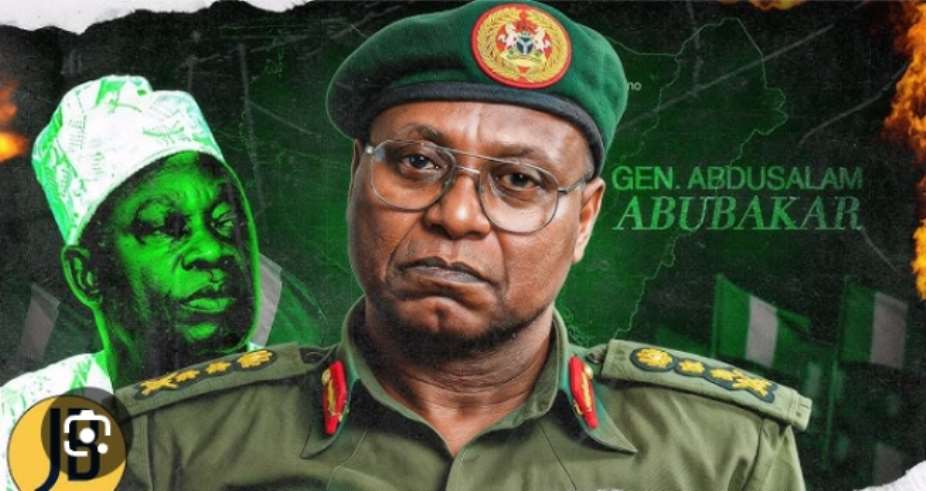
There are years in a nation's history that compress entire eras into twelve months. For Nigeria, that year was June 1998 to May 1999. In that brief, breathless span, a feared military dictator died unexpectedly. The presumed winner of a stolen election died in custody. A nation held its breath on the edge of another prolonged military era. And then, against expectation and against pressure, one man chose to let power go.
That man is General Abdulsalami Abubakar. He turned 84 this week. And he has finally told his story.
At a ceremony at the Presidential Villa in Abuja, attended by President Bola Tinubu's representative Vice President Kashim Shettima, former presidents Olusegun Obasanjo and Goodluck Jonathan, former Head of State Yakubu Gowon, and a gathering of statesmen from across Africa, Abdulsalami unveiled his autobiography, A Call of Duty: My Autobiography, alongside two companion volumes Mediating for Peace in Africa: A Festschrift in Honor of General Abdulsalami A. Abubakar and Nigeria's Grand Patriot: Abdulsalami Alhaji Abubakar, GCFR at an event titled "The Legacy of a Statesman @ 84."
What emerged from the pages of Call of Duty and from the reflections of those who spoke around it was not merely a personal memoir. It was a reckoning with the most consequential period in Nigeria's post-independence history, told for the first time in the voice of the man who stood at its centre.
The Morning of June 8, 1998: A Deception, a Death, a Destiny
Abdulsalami has revealed how he was locked up with retired Major General Ishaya Bamaiyi inside a waiting room at Aso Rock for about an hour after the sudden death of General Sani Abacha. He wrote: "On Monday, 8 June, I received a call very early in the morning that he (Abacha) wanted to see me. I quietly prayed that he would not send me to Togo where there was going to be an ECOWAS summit."
He arrived at the Presidential Villa expecting a routine summons. What he found instead was a locked door, a prolonged and unexplained wait, and eventually the Inspector-General of Police arriving to open the room carrying news that would change Nigeria's history. Abacha was dead. And Abdulsalami, the Defence Minister and Chief of Defence Staff, was suddenly the most consequential military officer in the country.
Former South African President Thabo Mbeki, speaking virtually at the event, highlighted the chaotic circumstances that brought Abdulsalami to power, saying: "Following his appointment as head of state by the Provisional Ruling Council, he recognized the urgent need for stability and democratic governance and hence chose to commit to a short transition period."
That short transition period eleven months from June 1998 to May 1999 would prove to be the hinge on which Nigeria's democratic future swung. But it was not achieved without resistance.
The Pressure to Stay and the Decision to Go
Perhaps the most striking confirmation of behind-the-scenes pressure came from Major General Aliyu Abdulrasheed (rtd), chairman of the event's organizing committee, who revealed that influential figures within the military establishment urged Abdulsalami to extend his transition programme after assuming office. Many considered the timetable overly ambitious. Others feared the country was too fragile for a rapid return to civilian rule. But Abdulsalami refused and stood his ground.
The former Nigerian leader was in office for eleven months between June 1998 and May 1999, when he handed over power to a democratically elected government headed by Olusegun Obasanjo.
Obasanjo, speaking at the event, said Abdulsalami had "sagaciously managed the seeming confusion and uncertainty that followed Abacha's death," adding: "You emerged from the clouds and carefully proceeded to untangle the nation politically."
Former President Goodluck Jonathan echoed the sentiment, crediting Abdulsalami with laying the foundation for Nigeria's democratic stability by resisting pressure to remain in office beyond the transition period, saying his decision to hand over power strengthened public confidence in the democratic process and spared the country from further political uncertainty.
In a continent where military transition programmes have historically served as vehicles for self-perpetuation, Abdulsalami's choice to honor a tight timeline and exit the stage stands as a genuinely rare act of institutional selflessness.
The Death of MKO Abiola: Setting the Record Straight
Of all the revelations in Call of Duty, none has generated more public interest or more controversy than Abdulsalami's account of the final hours of Chief Moshood Kashimawo Olawale Abiola, the presumed winner of the annulled June 12, 1993 presidential election.
Abiola had been in detention since 1994 after declaring himself President. His death came just over a month after that of General Sani Abacha, fuelling widespread speculation that he had been eliminated to prevent his release and inauguration. For nearly three decades, that allegation of poisoning has remained one of the most persistent and inflammatory claims in Nigerian political discourse.
Abdulsalami now dismisses those claims unequivocally in Chapter 21 of the 264-page memoir. According to him, an autopsy conducted by pathologists from four countries requested by Abiola's own family found no evidence of poisoning. Instead, the examination concluded that the businessman and politician died of natural causes linked to pre-existing health conditions. The former Head of State disclosed that Abiola had been managing hypertension and serious heart-related ailments long before his detention.
Drawing from medical reports and eyewitness accounts, Abdulsalami reconstructed the events of July 7, 1998. According to Susan Rice's account, quoted in the memoir, Abiola began coughing heavily shortly after a meeting with a visiting American delegation commenced before showing signs of severe distress. Tom Pickering similarly recalled that Abiola struggled to breathe as officials rushed to secure emergency medical assistance. Despite efforts by doctors, he could not be revived. Abdulsalami recalled receiving the devastating news from his Chief Security Officer and described the shock that followed: "My head went blank," he wrote.
Whether this account fully closes the question of Abiola's death is something Nigerians will debate for years. What it does represent is the most detailed official narrative yet from the man who was in power when Abiola died and it carries the weight of eyewitness accounts from senior American diplomats.
The Abacha Loot Question: "Pure Fantasy"
Beyond Abiola's death, the memoir confronts another long-festering allegation one that has shadowed Abdulsalami's reputation for nearly three decades. Following Abacha's death, widespread claims emerged that Abdulsalami had personally received a share of Abacha's legendary looted funds.
The former Head of State addressed allegations that he received $500 million in cash following Abacha's death, describing the claim as "pure fantasy" and "an absolute imagination." He stated: "I want to put it on record that nobody gave me $500 million or any amount, bigger or smaller. Is it possible to collect half a billion dollars in cash and only one person in the world would know about it?"
It is a rhetorical question that carries its own logic. The Abacha loot billions of dollars systematically stolen from Nigeria's oil revenues and stashed in banks across Europe, the Middle East, and North America has been the subject of international legal proceedings, diplomatic negotiations, and partial repatriations for over two decades.
It is among the most documented cases of state kleptocracy in African history. That any such transaction involving a sitting Head of State would remain a secret known to only one person is, as Abdulsalami suggests, difficult to sustain as a credible claim.
What the memoir does not fully resolve and what no individual account can is the broader question of how Abacha's looting was allowed to continue for so long, how deeply it penetrated the structures of the Nigerian state, and what full accountability for those funds would look like. Speculation about Abacha's hidden wealth has endured for nearly three decades, forming part of a broader set of unresolved controversies from that turbulent era. Abdulsalami's denial is important. It is not the end of the conversation.
The Legacy of a Man Who Let Power Go
For a man who once wielded the immense powers of Nigeria's military presidency, General Abdulsalami Abubakar's most enduring legacy may not be the authority he exercised, but the power he willingly relinquished. Nearly three decades after Nigeria's return to democratic rule, many of the defining events of that turbulent era remain caught between history and controversy.
Abdulsalami's tenure as Head of State lasted less than a year. Yet within those few months, Nigeria witnessed the death of Abacha, the death of Abiola, the dismantling of military rule, the restoration of democratic governance and the birth of the Fourth Republic. In a country where leaders are often remembered for the power they accumulated, Abdulsalami is remembered largely for the power he surrendered.
That verdict power surrendered over power accumulated is rarer than it should be anywhere in the world, and rarer still in the African political context of the late 1990s. The continent was littered at that moment with military rulers who had found reasons, one by one, to extend their mandates, rewrite constitutions, and cling to office. Abdulsalami looked at the same temptations and chose differently.
Call of Duty will not resolve every controversy from that period. No memoir can.
But it does something important: it inserts a first-person voice into a historical record that has, for too long, been shaped almost entirely by rumor, speculation, and partisan memory. Nigeria owes it to itself and to the generations, who have grown up knowing only the democratic order that Abdulsalami helped deliver to read this account seriously, debates it vigorously, and use it as a foundation for the kind of honest historical reckoning that the country still needs.
June 8, 1998 changed Nigeria. What General Abdulsalami chose to do with that day changed it for the better. At 84, he has earned the right to tell that story in his own words.
Source:
"Abdulsalami at 84: The Untold Stories Behind Nigeria's Democratic Turning Point," The Guardian Nigeria, June 14, 2026. https://guardian.ng/news/abdulsalami-at-84-the-untold-stories-behind-nigerias-democratic-turning-point/
Mustapha Bature Sallama is a journalist, columnist, and peacebuilding practitioner based in kumsi, Ghana. He holds professional credentials from the Al Jazeera Media Institute and the United States Institute of Peace (USIP), and writes on African affairs, international security, and governance. He holds the traditional title Sallaman Sardaunan Katsina. [email protected] +233555275880

 GCB denies robbery attempt at Labone Branch after Police shoot two suspects
 Death toll rises to 12 in Pokuase-Achimota multi-vehicle accident
 'He's not one of us' — Hajj Office denies arrested ‘Papa Angola’ seen assaulting...
 Two gunned down as Police foil robbery attempt at GCB Bank branch in Labone
 President Mahama sets 2028 deadline for completion of Upper East Regional Airpor...
 Upper East Airport to open region to investors, boost economic activity — Mahama
 NDC will not take lessons from NPP on economy — Joyce Bawah
 Man seen assaulting suspect at police station not a member of Hajj Board — Pilgr...
 Police gun down two suspects, arrest one over Labone GCB robbery attempt
 Ofankor crash: Stop publishing graphic images, videos — Oppong Nkrumah urges med...

