




A committee established to investigate the recent fire outbreak at the Akosombo Substation has attributed the incident to insulation failure in ageing electrical cables and ruled out any deliberate human involvement.
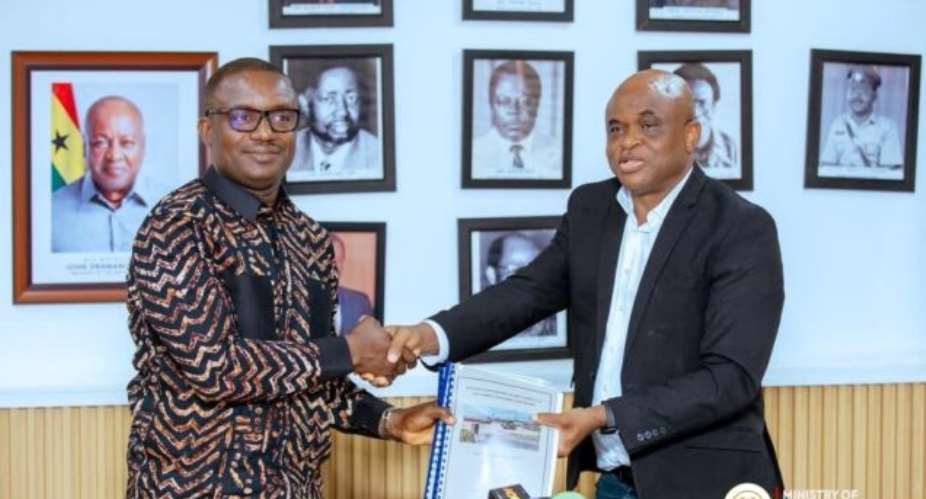
The seven-member committee presented its report to the Minister for Energy and Green Transition, John Abdulai Jinapor, on Thursday, outlining the circumstances that led to the blaze, which disrupted power supply to parts of the country.
According to the committee, the fire originated in the changeover section of the low voltage panel, where cables that had been in service for decades had deteriorated significantly.
Chairman of the committee, William Amuna, explained that the ageing cables had become brittle over time, resulting in insulation failure that caused abnormal electrical current flow.
He said the initial power supply system detected the fault and automatically tripped at 311 amps. However, a second transformer immediately took over power supply and continued feeding electricity into the faulted section.
"The second transformer nearby took over and started supplying. So it means it was feeding into the fault," Mr Amuna said.
According to him, the backup transformer was configured to trip only at 450 amps, allowing the fault to persist and generate excessive heat.
The heat subsequently ignited the plastic insulation surrounding the cables, triggering a fire that spread rapidly through the facility.
Mr Amuna explained that the affected low voltage panel was linked to another panel and surrounded by numerous control cables serving the substation's 11 outgoing circuits, enabling the flames to spread quickly.
"They started burning and within a short time the whole place was ablaze," he said.
He stressed that investigations found no evidence of sabotage or human interference.
"It actually started from insulation failure from some of the cables in the LV panel, and not anybody going to turn something or twist something or whatever," he stated.
As part of its recommendations, the committee proposed the construction of a modern control building to replace the existing facility.
Mr Amuna said the proposed structure should be modelled on the control systems at the Pokuase Substation, which meets modern safety standards.
"We should have a state of the art permanent control building. I expect that such a building should come up between 18 and 24 months," he said.
Receiving the report, Dr Jinapor commended the committee for its work and assured that government would fully implement its recommendations.
"We will take this report seriously. We will digest all the content of the report and implement the report to the letter," the Minister pledged.
He noted that although engineers worked swiftly to restore power following the outage, any individual found culpable of negligence would still be held accountable.
Dr Jinapor described the incident as a wake up call for the energy sector, stressing the need for stronger maintenance practices, improved emergency response systems and greater investment in transmission infrastructure.
"This should be a lesson that teaches us to avoid a future occurrence of this unfortunate situation. It is obvious that a lot should have been done over the years. We must strengthen the system, improve our maintenance culture and invest in the grid to build a more resilient energy sector," he said.
The fire at the Akosombo Substation, operated by Ghana Grid Company Limited, caused significant power supply disruptions and renewed concerns about the condition of critical electricity infrastructure across the country.
 Stay focused and be faithful — Bishop Dr. Dogbe advises Bawumia
 'Bawumia is a person of great integrity' — Bishop Dr. Hilliard Dogbe
 2026 FIFA World Cup: 'Let’s stop rooting against South Africa' — Michael Blackso...
 Police arrest suspect over attempted theft of cocoa beans from stranded truck in...
 Abuamang-Acha Ablor youth accuses GTEC of move to block DACE report
 Ghanaians repatriated from Ivory Coast will receive support to rebuild their liv...
 Cocoa farmers to continue receiving GH¢2,587 per bag in 2026 light crop season —...
 NAIMOS hands over 141 seized firearms, nearly 2,000 rounds of ammunition for des...
 “No illegal mining on Wenchi Stool lands” — Paramount Chief warns divisional chi...
 My withdrawal from Wontumi's Samreboi case due to disagreement with the court — ...


