




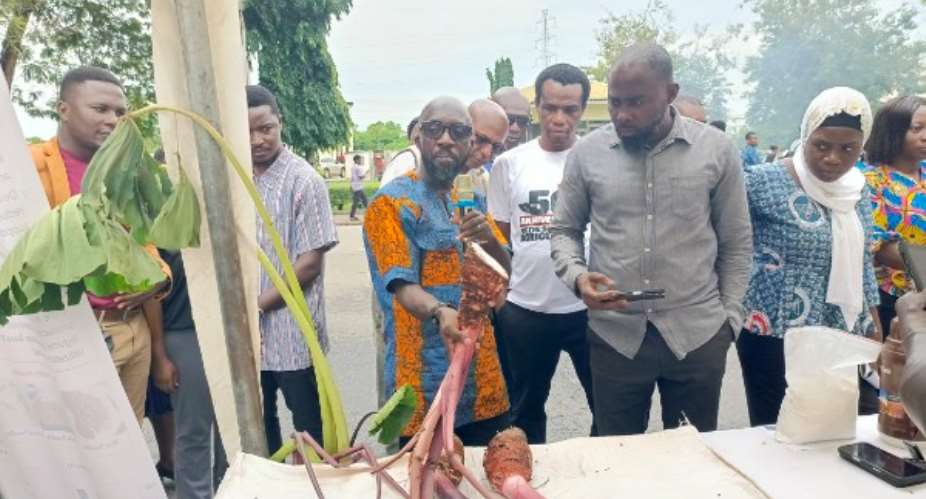
The Department of Crop Science of the University of Cape Coast (UCC), School of Agriculture, has launched a Taro Product Innovation Exhibition and Training at the forecourt of the Sasakawa Centre on the campus.
The event, held on Thursday, June 11, 2026, aimed to showcase the diversity and potential for value-addition of taro, also known as Brube or Kooko in Ghana (Colocasia esculenta), by demonstrating how this underutilised crop can be transformed into a range of nutritious, marketable food products. The exhibition also aimed to raise awareness of taro's contribution to food security, income generation, and dietary diversification in Ghana. The aim of the training on Taro Processing and Food Preparation is to equip women agro-processors and smallholder farmers with practical, hands-on skills in taro flour production and the preparation of taro-based food products, enabling them to establish and grow small-scale taro processing enterprises that add value, improve incomes, and strengthen local food systems.
Welcoming guests to the gathering, Prof. Julius Kofi Hagan, speaking on behalf of the Dean of the School of Agriculture, explained that the school has three core mandates: teaching, research, and community service. "This activity demonstrates our commitment to community service," he said. "We have a team of researchers who devote their time to doing things that benefit farmers, society, and the world at large." He urged participants to seize the opportunity to learn more about taro and explore the variety of products that can be derived from the crop.
Prof. Michael Osei Adu, lead researcher for the project and Head of the Department of Crop Science, noted that the programme would not have been successful without the collaborative efforts of the CSIR-Plant Genetic Resources Research Institute (CSIR-PGRRI, Bunsu), the CSIR-Crop Research Institute (CSIR-CRI Fumesua, Kumasi), and the GAEC-Biotechnology and Nuclear Agriculture Research Institute (GAEC-BNARI, Accra). At UCC, Prof. Adu, a specialist in Crop Ecophysiology and Improvement, further underscored that although the project is housed at the Department of Crop Science, the team has also collaborated with the Department of Agrifood Systems and Technology and the Department of Agricultural Economics and Extension (both in the School of Agriculture), as well as the Department of Biochemistry of the School of Biological Sciences, UCC.
Explaining the rationale behind the project, Prof. Adu stated that it fundamentally aims to breed taro for climate resilience and to commercialise the crop. He noted that the Department of Crop Science has carved out a niche in root and tuber crop breeding. "So far, the department has released 11 cassava varieties," he revealed, adding, "We had to focus on another equally important but neglected tuber — taro, also known as Brube or Kooko in Ghana."
Drawing on his experience and recalling the counsel of his mentor, Prof. J. P. Tetteh, who shared an experience from a previous project with him, Prof. Adu said Prof. Tetteh and his colleagues had worked with the Root and Tuber Improvement Programme (RTIP), which led to a glut in cassava harvests. That programme later evolved into the Root and Tuber Improvement and Marketing Programme (RTIMP) when they realised that the first attempt had neglected marketing. Learning from this, we have resolved that all our breeding work will have a commercialisation dimension, Prof Adu remarked. "So, we focused on breeding taro not only to grow around water bodies but also on uplands," he said. "We also bred taro that is tolerant to leaf blight disease."
Prof. Adu argued that to make their work more economically viable, the team had to examine the entire value chain of taro production — producing a crop resilient to climate change by being tolerant of drought and disease, increasing yields, and making taro available to farmers. "After this programme, we will distribute about 30,000 planting materials to farmers to plant," he emphasised.
The Head of Department explained that although the breeding aspect is incomplete, the exhibition aimed to show Ghanaians that beyond boiling and eating taro, there are other economically viable products from the crop. This is the commercialisation, entrepreneurial, and marketing aspect of the project, he stressed.
Highlighting the uses of taro, Dr Rosemond Godless Dadzie, from the Department of Agrifood Systems and Technology who led the food processing team, shared that "most of the baked products Ghanaians enjoy can be made from taro." She stressed, "100% taro flour can be used to make noodles, cakes, doughnuts, and more." She further revealed that some of these products were the result of student ingenuity — one student developed taro noodles, and another developed fortified taro porridge for a healthy breakfast for children and the entire family.
On the relevance and impact of collaborative research, Mr Isaac Eliot Nyieku, speaking on behalf of Prof. Rofela Combey, Provost of the College of Agriculture and Natural Sciences (CANS) at UCC, encouraged greater collaboration among the college's various schools. "We want to see more collaborations among our researchers across schools and departments to serve the community and the country better," he advised. He added that the college is poised to continue pursuing such partnerships and collaborative endeavours to provide meaningful solutions to the nation.
Mrs. Victoria Dansoah Abankwah, District Director for the Komenda-Edina-Eguafo-Abirem (KEEA) Department of Agriculture, representing the Ministry of Food and Agriculture (MoFA), noted that there has always been collaboration between MoFA and UCC in disseminating technologies and innovations to farmers. However, she disclosed that the major challenge with such projects has always been the availability of planting materials for farmers to access, as well as the long-term sustainability of the projects. "I pray we can ensure the sustainability of the programme for MoFA to run with it over the long term," she said.
She reminded the gathering that MoFA had previously embarked on a similar project involving cassava products, which are no longer available on the market.
The Taro Product Innovation Exhibition and Training was held at the Sasakawa Centre, UCC, showcasing the economic potential of a range of value-added products. A follow-up Taro Processing and Food Preparation Training is scheduled for Saturday, June 13, 2026, at Laboratory 1 in the School of Biological Sciences, UCC.

 June 12: Cedi appreciates, sells at GHS12.50 on forex market, GHS11.06 on BoG in...
 'Unemployment requires deeper structural reforms, not slogans' – Stephen Amoah c...
 UE/R: Sandema flooded as heavy rains cut off major road
 Nigeria killed 13,000 'terrorists' in past year — President Tinubu
 Take the path to greatness through constitution review — Barker-Vormawor to Maha...
 Ghana evacuates over 500 citizens displaced by Abidjan demolition exercise
 Youth keep acquiring degrees with no end in sight due to lack of jobs — Sammi Aw...
 2026 World Cup: Black Stars arrive in Rhode Island for final phase of preparatio...
 Adu-Boahene trial: Prosecution witness denies claims of inter-branch fund transf...
 Sales boy captured on CCTV cameras stealing GH¢217,000 from employer jailed 36 m...


