




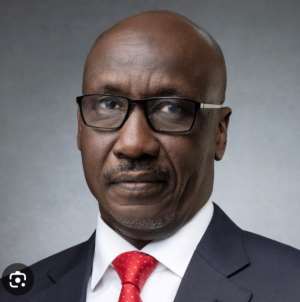
The Nigerian Senate's Committee on Public Accounts has issued an arrest warrant against Mele Kyari, the immediate past Group Chief Executive Officer of the Nigerian National Petroleum Company Limited (NNPCL), escalating what is already one of the most consequential accountability probes in Nigerian legislative history. The warrant, issued on Wednesday, June 10, 2026, follows Kyari's repeated failure to appear before the committee over alleged financial discrepancies totaling ₦210 trillion approximately $155.1 billion at today's exchange rate of ₦1,354 to the dollar in NNPCL's audited accounts spanning 2017 to 2023.
BACKGROUND TO THE PROBE
The Senate Committee on Public Accounts, chaired by Senator Aliyu Wadada of Nasarawa West, launched the legislative inquiry under its constitutional mandate to ensure accountability, transparency, and value for money in the management of public funds, backed by Sections 85, 88, and 89 of the 1999 Constitution and the Senate Standing Orders.
The committee is specifically investigating 19 audit queries raised by the Office of the Auditor-General of the Federation concerning NNPCL's financial records between 2017 and 2023. The queries cover unresolved financial entries, variations, and discrepancies that, when aggregated, produce the staggering $155.1 billion figure now at the centre of Nigeria's most explosive oil sector accountability crisis in years.
ANATOMY OF THE $155 BILLION FIGURE
The disputed sum is composed of two broad categories of unresolved financial entries. NNPCL claimed that ₦103 trillion approximately $76.1 billion represented cumulative amounts expended by NNPCL Joint Venture partners from JV Cash Calls from 2017, a response the committee deemed unsatisfactory and which it ruled remained unresolved.
The subsidy receivables, according to NNPCL's audited financial statements, stood at ₦107 trillion roughly $79 billion as of December 2023, recorded as sundry receivables allegedly owed by different banks and other entities. When combined, these amounts total ₦210 trillion, which lawmakers say remains unresolved.
Beyond the headline figure, the probe unearthed additional layers of concern. The committee observed an alleged duplication of subsidy deductions amounting to ₦3.8 trillion (approximately $2.8 billion), which it said was deducted from crude oil proceeds in the accounts of NAPIMS and also from petroleum product proceeds in the books of NNPC. The panel also raised concerns over ₦5 trillion (about $3.7 billion) charged as direct production costs between 2017 and 2021.
And in a question that drew particular public attention, lawmakers queried why the national oil company allegedly spent approximately ₦5.9 billion around $4.4 million on the change of name from the defunct Nigerian National Petroleum Corporation to NNPC Limited.
THE SUMMONS AND THE ARREST WARRANT
Among those summoned to appear before the Senate are Kyari as immediate past GCEO, former Chief Financial Officer Umar Ajiya Isa, and former head of the National Petroleum Investment Management Services (NAPIMS), Bala Wunti. (Pulse Nigeria) The current NNPCL GCEO, Bayo Ojulari, was originally expected to lead the company's delegation but was excused and represented by the company's current Chief Financial Officer.
The motion for the arrest warrant was moved by Senator Victor Umeh and seconded by Senator Adams Oshiomhole. Oshiomhole accused Kyari of failing to account for the alleged mismanagement of trillions of naira during his tenure, insisting that the committee should not delay in exercising its constitutional powers. His language was characteristically incendiary he declared that Kyari should be brought before the committee "dead or alive," a phrase that immediately ignited controversy and which the Senate leadership was later compelled to address.
Committee chairman Dankwambo subsequently ruled: "For Mele, I agree with you. We hereby rule that anywhere Mele Kyari is, the former GCEO, should be arrested and brought before the committee immediately."
KYARI'S RESPONSE: MEDICAL TREATMENT ABROAD
Kyari reacted swiftly, expressing shock at the warrant. In a letter dated June 10, 2026, he stated that he had previously written to the committee on May 8, with that correspondence received on May 11, informing lawmakers that he was abroad on medical grounds and unable to attend the hearing physically. He maintained that his absence was solely due to health reasons and not an attempt to obstruct the committee's work, pledging his full cooperation with the investigation.
The former NNPC boss added that he had offered to respond to any questions from the committee in writing to avoid delaying its work. Some lawmakers had appealed to the committee chairman to grant Kyari another opportunity, citing reports that he was receiving medical treatment in Germany. The standoff between institutional impatience and individual medical circumstance has added a human dimension to what is fundamentally a structural accountability failure.
CFO'S DEFENCE: THE NUMBERS DO NOT ADD UP
One of the most significant moments in the hearing came from former CFO Umar Ajiya Isa, who appeared before the committee and mounted a robust arithmetical defence of the former management. Ajiya insisted that the ₦210 trillion figure cited in the audit query was an aggregate sum that actually exceeds the ₦54.5 trillion approximately $40.2 billion total gross revenue generated by NNPCL during the entire 2017–2023 period under review.
"N210 trillion is an enormous sum. NNPC's total revenue during the period under review was about ₦54.5 trillion, even before deducting production costs. It is impossible for ₦210 trillion to be missing or unaccounted for," Ajiya stated emphatically. His point is arithmetically devastating: a company that earned $40.2 billion over seven years cannot have lost $155.1 billion.
The former CFO argued that the figures generating public controversy arose from accounting treatments involving different entities within NNPCL's corporate structure and had been wrongly interpreted as evidence of missing funds.
Ajiya also rejected allegations that ₦5.8 billion was spent on the registration of NNPC Limited, insisting the claim was misleading and unsupported by facts.
SENATE DISOWNS THE WARRANT AND OSHIOMHOLE
In a dramatic reversal less than 24 hours later, the Senate on Thursday distanced itself from the warrant of arrest issued against Kyari by its Committee on Public Accounts, and also distanced itself from comments attributed to Senator Adams Oshiomhole, who reportedly described the NNPC as a bunch of criminals and thieves during the committee's hearing.
Senate President Godswill Akpabio warned that any attempt by a Senate committee to independently issue or execute a warrant of arrest without authorization from the Senate President could amount to an unlawful exercise of power. The episode exposed a significant procedural fault line within the legislature itself raising urgent questions about the jurisdictional limits of committees and whether the Senate's oversight machinery is sufficiently coordinated to deliver credible accountability outcomes.
WHAT THE PROBE MEANS FOR NIGERIA
The Kyari affair sits at the intersection of oil governance, legislative oversight, and the long-standing demand for transparency in a country whose petroleum revenues have historically flowed with more opacity than accountability. NNPCL, even after its conversion to a limited liability company under the Petroleum Industry Act, remains the custodian of revenues that dwarf every other stream of government income.
The $155.1 billion figure, shocking as it is in absolute terms, must be understood with caution. At today's rate of ₦1,354 per dollar, it represents nearly 43 percent of Nigeria's entire GDP, and is almost four times the country's 2025 federal budget. It exceeds the combined GDP of Senegal, Mali, Burkina Faso, Niger, and Chad. No reasonable reading of Nigerian oil sector history troubled as that history is supports the conclusion that a sum of this magnitude simply vanished. What it more likely reflects is years of unconsolidated intercompany entries, unreconciled subsidy receivables, and joint venture ledger aggregations that were never adequately explained to the public auditor.
That, however, is itself the indictment. The failure to explain $155 billion in financial entries whatever their ultimate accounting nature over a period of seven years is not a clerical oversight. It is a governance failure of the first order.
Kyari himself faces a separate corruption trial since leaving office. His illness abroad if verified creates a genuine procedural dilemma: a man who claims willingness to cooperate, medically unable to travel, facing a warrant from a committee whose own parent institution has since partially disowned it. The legal and political theatre that follows will test Nigeria's institutional capacity for accountability in ways few cases have before.
The ₦210 trillion $155.1 billion question hangs unanswered over Nigeria's oil sector. At ₦1,354 to the dollar, that is not just a number. It is the measure of a transparency deficit that Nigeria's democracy can no longer afford to defer.
Mustapha Bature Sallama.
Medical/ Science Communicator,
Private Investigator, Criminal investigation and Intelligence Analysis.
International Conflict Management and Peace Building.USIP
[email protected]
+233-555-275-880

 Visa rejection dashes World Cup hopes of Ivory Coast and Senegal fans
 'Your citizens will still leave our country' — South African activist fires back...
 Anti-LGBTQ bill: 'It's not true that Parliament cannot reconsider a passed bill'...
 New NAIMOS Operations Director pledges stronger fight against galamsey
 Ghana attracting bad actors through ECOWAS free movement system — GIS laments ab...
 Court grants Abronye DC permission to travel abroad for master’s programme
 Afari Hospital Project: “They slept on a 3-year project for eight years” – Brogy...
 Chairman Wontumi seeks plea deal in GH¢30m Exim Bank fraud case
 GH¢7 million Navrongo Youth Resource Centre stalled for nearly nine years amid l...
 BECE graduate feared dead after drowning in River Osen


