




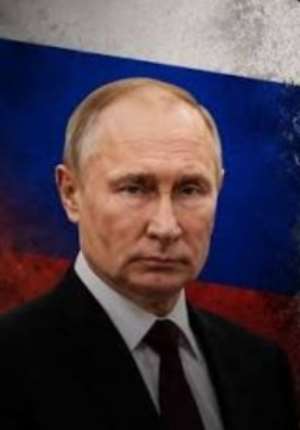
When a government allocates nearly two billion dollars not to feed its people, not to build roads or hospitals, but to shape what foreign populations think and believe, that is not a communications budget. It is a weapon. Russia's 2026 federal budget makes exactly that investment, and Africa West Africa in particular sits squarely in its crosshairs.
THE RECORD BUDGET
Russia has allocated a record $1.85 billion for foreign propaganda operations in its 2026 federal budget, a 54 percent increase from the previous year, according to Ukraine's Foreign Intelligence Service. The agency stated that the funds bankroll the systemic promotion of Russian narratives, sustain Russian state offices abroad, finance networks of Russian Houses, support loyal foreign organizations, and launch new information platforms.
To place that figure in continental context: $1.85 billion exceeds the entire annual education budget of several West African states. It is more than double Ghana's 2025 capital expenditure on infrastructure. It is a figure that signals not a communications strategy but a sustained, industrialized campaign of cognitive warfare one that has been expanding its African theatre with deliberate and accelerating intensity.
Russia's broader mass media allocation in 2026 stands at 146 billion rubles approximately $1.78 billion up 6.6 percent from the previous year, with roughly $317 million of that directed to the Institute for Internet Research alone. These are not separate budgets. They are overlapping instruments in a single architecture of global narrative control.
THE MACHINERY: HOW THE MONEY MOVES
Russia's influence apparatus in Africa operates through a layered system of overt and covert instruments, each serving a distinct function in the broader strategic design.
At the visible layer sit the Russian Houses cultural centers coordinated by Rossotrudnichestvo, the Russian federal agency for international cooperation that reports directly to the Foreign Ministry. Since 2022, and despite Russia's growing isolation from Western sanctions, the activities and franchises of Russian Houses have been expanding across Africa, from Dakar to Luanda. At first glance, their function resembles the Alliance Française or Germany's Goethe-Institute: language courses, scholarship fairs, cultural events. The resemblance is deliberate and deceptive.
Rossotrudnichestvo signed agreements in 2024 to formally establish Russian Houses in the Central African Republic, Chad, Equatorial Guinea, Guinea, Nigeria, Sierra Leone, and Somalia. Russian Partner Houses now operate in Burkina Faso, Mali, Ghana, Nigeria, the Central African Republic, and a number of other countries, offering language courses, lectures, film screenings, and assistance with admission to Russian universities.
At least eight Russian Houses have opened across the continent since 2024, mainly in Francophone West Africa, offering grants and programming that often doubles as low-level propaganda for domestic consumption. One video produced in cooperation with Rossotrudnichestvo shows Burkinabe children in Ouagadougou singing a song in Russian to celebrate Russia Day, while another in the Central African Republic shows people singing a tribute to the Russian air force in front of a Russian jet.
THE COVERT LAYER: PAID JOURNALISM AND MEDIA CAPTURE
Beneath the cultural veneer operates far darker machinery. An unprecedented leak of confidential documents from a network of Russian influence agents operating in Africa revealed how Russia managed to place hundreds of articles in 35 different West African French-language media outlets. A line-by-line analysis of these documents reveals nearly 650 articles published in West African media outlets between June and October 2024 alone.
The network recruited local journalists to disseminate propaganda, spending $300,000 per month on media placements ranging from $600 per article in Benin to $10,000 in Libya amplifying disinformation across co-opted outlets. Agents also formed covert relationships with opposition leaders, military personnel, and intelligence agents through lobbying and bribery to disrupt national politics.
Backed by significant financial resources and directed by Russia's Foreign Intelligence Service, the SVR, these operations extend from Mali to Bolivia via South Africa, each aimed at shaping public opinion and consolidating Moscow's interests abroad. Forbidden Stories and its partners gained access to 1,431 pages of internal documents detailing Russia's global influence strategy in 2023 and 2024.
The objectives are not subtle. Agents mapped target countries' political landscapes to identify exploitable grievances, and then systematically primed the information environment for political disruption. General Michael Langley, then head of United States Africa Command, publicly warned in June 2024 that Russian disinformation campaigns were systematically eroding US and French credibility across Africa. Both nations withdrew from Niger within months of that warning, and Russian forces subsequently began operating from the same bases in Niamey.
WEST AFRICA AS STRATEGIC THEATRE
While a 2022 report identified just one Russian disinformation campaign in Burkina Faso, that number had surged to eight by 2024 the same count as in Mali that year. The significant increase illustrates the growing scale and intensity of Russian information manipulation in West Africa.
The Sahel has been the most consequential arena. In Mali, where Russian Africa Corps personnel now operate alongside the Malian Armed Forces following the departure of French and UN peacekeepers, the information campaign preceded and enabled the military foothold. Jama'at Nusrat al-Islam wal-Muslimin has imposed a selective blockade of Mali's capital Bamako since September 2025, burning fuel trucks and imposing gender segregation in transport. Although the Malian Army with the help of an estimated 1,000 Russian combatants from the Africa Corps was able to secure some convoys, access to fuel had still not fully resumed in Bamako in early 2026.
Russia sold the partnership as security; it delivered continued instability with a Russian flag on it.
In Chad, the ambition was checked barely. Russian operatives worked in Chad in 2024 to pull the country closer to Moscow and away from Western influence, with efforts to build ties with Chadian authorities, spread anti-Western narratives, and target opposition figures. At the opening of the Russian House in N'Djamena in September 2024, Chadian soldiers moved in and arrested two Russian operatives immediately after the ceremony. Two other Russian operatives had already been detained on arrival at the airport two days earlier.
THE GHANA AND NIGERIA DIMENSION
Ghana and Nigeria are not peripheral to this campaign. They are targets. Russian Partner Houses currently operate in Ghana and Nigeria, offering language courses, lectures, film screenings, and pathways to Russian universities.These institutions are the public face of an operation whose private face involves media placement, narrative seeding, and the cultivation of local amplifiers across both countries' media landscapes.
This journalist has visited the Russian House Ghana in Accra and met with its officials. The presentation is polished, the programming professionally delivered, and the scholarships on offer are real. That is precisely what makes the institution effective as a soft power vehicle: it provides genuine value while simultaneously serving as a platform for the broader information campaign that Moscow funds to the tune of $1.85 billion globally.
Russian Houses promote pro-Russian narratives, criticize Western policies, and shape public opinion in favor of Russia work that became especially important after the invasion of Ukraine, when Russia sought international support or neutrality. Investigations suggest that some Russian Houses are also linked directly or indirectly to recruitment efforts, with Africans offered jobs or training opportunities, some of whom are later redirected into military roles or defence-related work.
Nigeria's media environment, vast and under resourced, is particularly vulnerable to paid placement operations of the kind documented in the leaked Russian agent spreadsheets. With $600 buying a published article in some West African outlets, the $1.85 billion budget can purchase an extraordinary volume of narrative pollution across the region.
THE CHINA PARALLEL
Russia does not operate in isolation. China invests roughly $10 billion annually in international information operations, while Iran dedicates hundreds of millions of dollars to propaganda. The rising budgets for information campaigns in Russia and China reflect a shared strategic intent, with a joint declaration signed between Xi Jinping and Vladimir Putin outlining cooperation in media and information policy, expanding digital diplomacy, and countering what both sides term false information.
Africa's information space is thus contested not merely by Moscow but by an alignment of authoritarian states that have found, in the continent's growing and youthful populations, an audience worth billions of dollars to influence.
WHAT AFRICA MUST DO
The $1.85 billion figure is not simply a number to be noted and filed. It is a statement of strategic intent from a state that has demonstrated, from the Sahel to the streets of Accra and Lagos that it is prepared to invest at industrial scale in the manipulation of African public discourse.
African governments, media institutions, and civil society organizations must understand what they are dealing with. The Russian House is not the Goethe-Institute. The scholarship offer comes with a curriculum. The cultural event is also a data-collection opportunity. The $600 article is a node in a network that stretches from Saint Petersburg to Bamako to Niamey, funded at nearly $2 billion a year and growing.
The defence is not censorship. It is transparency mandatory disclosure of foreign funding for media and civil society; media literacy education integrated into national curricula; regional cooperation among African fact-checkers and investigative journalists; and the political will to call the operation what it is, regardless of which great power is running it.
Africa's sovereignty is not only defended at the border. In 2026, it is defended in the newsroom, the classroom, and the algorithm.
Mustapha Bature Sallama.
Medical/ Science Communicator,
Private Investigator, Criminal investigation and Intelligence Analysis.
International Conflict Management and Peace Building.USIP
[email protected]
+233-555-275-880

 New road rules: Police explain tyre age, tint, parking rules ahead of October 1 ...
 Circle phone dealer murder: Suspect allegedly sold victim’s iPhone 12 for GH¢100...
 Police arrest three suspects over kidnapping, murder of Circle phone dealer
 Adipa residents tell gov’t to halt Agbogbloshie waste transfer
 Mahama says listing 10 state-owned enterprises will curb political interference
 Ghana Jollof saga: Baffour Awuah sues Blakk Rasta, Akwatia MP over alleged false...
 6,079 promoted teachers processed and paid — Controller clarifies
 “We need payment, not meetings” – Striking teacher unions tells Education Minist...
 NPP challenges GH¢2,650 cocoa producer price for 2026/27 season
 Mahama explains why 'humiliating' US, Ghana health deal was thrown out with spee...



Comments
Well done!!! Very informative analysis of the surge of the so called Russia media propaganda in West Africa as described mostly by France.And Ukraine now acting as a proxy for the latter.Your article could easily be seen as a response to that propaganda.Africa has come of age and doesn't need any country to make an informed decision on his choice of a partner at any stage.Russian doesn't need to spend so much money to be accepted by Africans.Their actions on the ground is enough just like thos...