




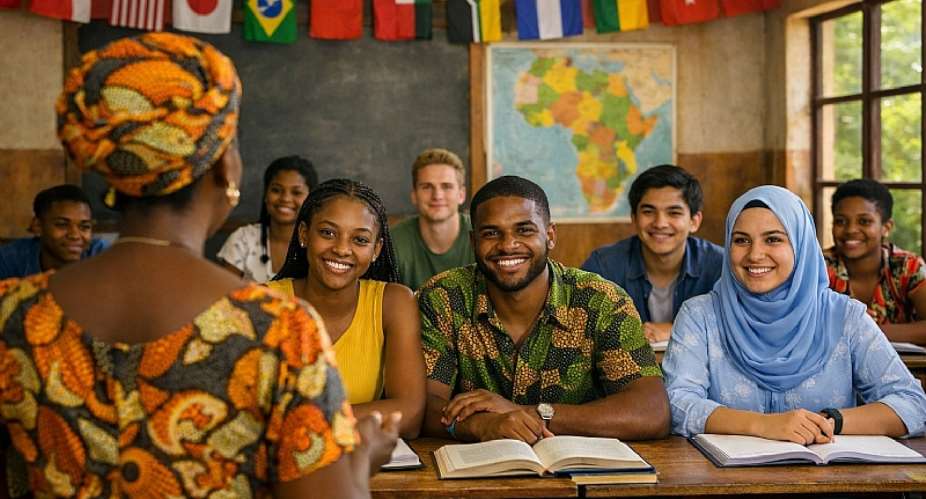
Resetting Ghana begins when education stops producing memorized answers and starts producing intelligent creators, innovators, and nation builders.
Ghana’s Educational Crossroads
There comes a defining moment in the life of every nation when excuses become expensive, and for Ghana, that moment has arrived. Across our classrooms and lecture halls, millions of brilliant young people are graduating with certificates yet struggling to find opportunities in a rapidly changing global economy. Employers continue to demand practical skills while industries complain about weak technical capacity and low productivity. The challenge is not the intelligence of the Ghanaian student; rather, it is an educational structure that has rewarded memorization more than mastery, theory more than innovation, and examinations more than problem-solving. No nation can build a prosperous future when its schools produce consumers faster than creators.
The Shadow Study Revolution
The Shadow Study Technique offers Ghana an important lesson for national transformation. The principle is simple: observe, imitate, practice, reproduce, and improve. A doctor becomes excellent by shadowing experienced physicians. A mechanic masters engineering by studying practical systems repeatedly. Even children learn language first through imitation before innovation. True learning happens when knowledge becomes practical ability. Unfortunately, much of Ghana’s educational system still conditions students to memorize information temporarily instead of mastering productive systems permanently. The future economy will not reward passive learners; it will reward adaptive thinkers, innovators, and solution-driven citizens capable of reproducing excellence consistently.
The Japanese Lesson and the Rise of Artificial Intelligence
After the devastation of World War II, Japan rebuilt itself through discipline, technical education, industrial apprenticeship, and continuous improvement. Japanese schools trained students not only to pass examinations but to solve problems, improve systems, and strengthen production. That philosophy eventually produced global giants such as Toyota, Sony, and Honda. Today, the world is entering another economic revolution powered by Artificial Intelligence. AI is transforming education, healthcare, agriculture, banking, manufacturing, and governance. Nations that strategically integrate AI into education will produce globally competitive innovators and digital entrepreneurs, while those that ignore this transformation risk technological dependency and economic irrelevance.
Why Ghana Must Embrace AI-Driven Education
Artificial Intelligence could become one of the greatest educational equalizers in the history of Ghana if embraced strategically. AI-powered systems can personalize learning, support teachers, improve research, strengthen technical education, and expand access to quality education for students in underserved communities. A student in a rural village should be able to access world-class digital learning opportunities just as a student in Accra can. Ghana must therefore invest aggressively in STEM education, teacher retraining, coding, robotics, digital literacy, and affordable internet infrastructure. Universities and technical institutions must become centres of innovation rather than mere examination factories. The future workforce will require not only literacy, but digital intelligence and technological adaptability.
A National Wake-Up Call
The greatest resource of Ghana is not gold, cocoa, or oil. It is the untapped intellectual capacity of the Ghanaian people. But talent without systems becomes wasted potential. Ghana now stands at a historic crossroads between consumption and creation. We cannot continuously import innovation while neglecting scientific research, technical skills, and productive education. The future global economy will reward nations that can innovate, manufacture, automate, and solve problems independently. This generation must therefore become the bridge between Ghana’s natural intelligence and the technological future of humanity. The time has come to move from memorization to mastery, from certificates to competence, and from passive learning to intelligent national transformation. That is the true meaning of resetting Ghana.
“A nation that only memorizes information but cannot reproduce excellence will forever import solutions from others.”
Bismarck Kwesi Davis Author, Resetting Ghana Series May, 2026 #bismarckinspires #beinformed #ideducate
References
- UNESCO. (2023). Global education monitoring report 2023. UNESCO Publishing.
- World Bank. (2022). Education and economic growth in developing economies. World Bank Publications.
- United Nations. (2015). Transforming our world: The 2030 agenda for sustainable development. United Nations.
- Sahlberg, P. (2015). Finnish lessons 2.0. Teachers College Press.
- Ministry of Education Ghana. (2021). Education strategic plan 2018–2030. Government of Ghana.
- Organisation for Economic Co-operation and Development. (2021). Artificial intelligence and the future of skills. OECD Publishing.


 Appointment of Emelia Agbenyo as EC deputy chair was well calculated, reasoned –...
 Relief for students as GAUA and TUSAAG call off strike; declare return to work o...
 Who gave Cabinet authority to decide for Ghanaians to join BRICS without parliam...
 Mahama urges Ghanaian businesses to tap CSIR innovations
 Partisan EC appointments could set dangerous precedent — NPP's Kamaldeen
 Winneba: Afenyo-Markin commissions police apartments at Fetteh-Osakam
 Council of State failed Mahama over Emelia Agbenyo’s EC appointment – Prof. Asa...
 CDD‑Ghana: EC Deputy Chair Should Step Down Now
 Family Announces October 23 Memorial Mass for Nana Konadu Agyeman-Rawlings
 Eduwatch Urges Nationwide Audit of Sexual Misconduct in Secondary Schools


