




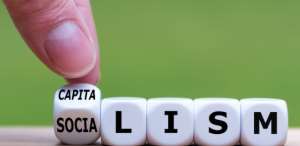
ACCRA, When Kwame Nkrumah led Ghana to independence in 1957 and declared the country's determination to build an African socialist state, he set in motion an ideological contest that has never truly ended. Nearly seven decades later, that battle between state-led development and market capitalism, between African self-determination and Western financial dependency continues to define Ghana's politics, economy, and sense of national identity.
The arc from Nkrumah's socialist experiment to today's neoliberal consensus is not a story of inevitable progress. It is, as many Ghanaian economists and activists insist, a story of betrayal, structural adjustment, and quiet resistance punctuated, in the 21st century, by a renewed socialist movement determined to reclaim what was lost.
The Nkrumahist Vision
Ghana's first post-independence government built its economic philosophy on a clear premise: those African nations could not achieve genuine freedom within the structures of global capitalism designed by and for their former colonizers. Nkrumah and the Ghanaian state constructed complex socialist visions while simultaneously co-opting elements of capitalism and capitalist enterprises a pragmatic balancing act framed within a broader decolonial ideology.
He established state farms to employ and feed the people, using them as watersheds for agro-industry in Ghana, while nationalizing key sectors and directing investment toward industrialization. In 1962, the government went further. The Ghanaian presidential cabinet decided to construct the Kwame Nkrumah Ideological Institute at Winneba to spread the socialist gospel a deliberate effort to train a new generation of citizens in socialist thought.
This project was cut short. In February 1966, a CIA-backed military coup overthrew Nkrumah while he was abroad, and with him fell Ghana's most ambitious experiment in state-led African development.
The Capitalist Turn
The ideological shift was immediate: Ghana moved away from centralized socialist planning toward market-oriented reforms. The National Liberation Council encouraged private enterprise, improved relations with Western nations, and negotiated with the IMF and World Bank.
The most decisive capitalist turn, however, came in the 1980s. Under Jerry Rawlings's administration, the government adopted IMF and World Bank-sponsored Structural Adjustment Programmes that emphasized market liberalization, privatization, reduced state involvement, and deregulation.
Ghana became, in many respects, a poster child of structural adjustment one of the few African countries to maintain consistent GDP growth through the 1980s and into the early 21st century.
But stability, critics argued, depended on who you asked. It was certainly stable for the intergenerational ruling class for people like Nana Akufo-Addo, whose father was president, or John Mahama, who is now president again but whose father served in Nkrumah's first government. For the ordinary Ghanaian worker, the picture was starkly different.
Neoliberalism's Grip on the Fourth Republic
The Fourth Republic, launched in 1993, and institutionalized market capitalism as the operating framework of Ghanaian governance regardless of which party held power. With both major parties, the NDC and the NPP, pushing different variants of neoliberalism, young Ghanaians increasingly began returning to Nkrumah to think about the role of the state, development, and Ghana's place in the world.
The convergence of the two dominant parties was not merely rhetorical. Both Mahama and Bawumia refused to speak about foreign exploitation, and neither was willing to challenge IMF conditionality’s evidence, critics argued, that they were not willing to take any risk for Ghanaians. The master plan, observers noted, remained taxing the poor Ghanaian masses.
Despite occasional rhetoric like "Ghana Beyond Aid," the pattern of IMF engagement including Ghana's 17th IMF programme in 2022 highlighted the entrenched nature of neoliberalism in Ghana's economic governance.
The Socialist Movement Resurgent
Against this backdrop, the organized Left in Ghana has refused to disappear. The Socialist Movement of Ghana (SMG), formerly the Socialist Forum of Ghana, was founded in 1993 by only four members during a period of dictatorial rule. Its mission was to advance the cause of socialism and pan-Africanism, as well as the legacy of Kwame Nkrumah.
By September 2025, the SMG had grown dramatically. The movement convened its Second National Congress at the Amilcar Cabral School with over 300 delegates from 30 collectives across Ghana, under the theme "Imperialism in Crisis: Pan-African Solidarity and Socialist Transformation."
Ambassadors and embassy representatives from Cuba, Palestine, Algeria, China, Iran, and the Sahrawi Arab Democratic Republic attended.
The SMG's 21st century campaigns have moved well beyond intellectual debate. The Women's Wing led the "Don't Tax My Period" campaign in collaboration with other organizations, resulting in the successful removal of taxes on sanitary pads. The movement built strong relationships with all 22 national unions affiliated with Ghana's Trades Union Congress, with collaboration proving key to successful campaigns including opposition to the privatization of the Electricity Company of Ghana.
The SMG's Ho Collective also launched the first Pan-African Youth Club at Mawuli Senior High School, with approval from the Ghana Education Service to expand these clubs which introduce young people to African history and Pan-Africanism to all senior high schools in the Volta Region.
The Unresolved Tension
What Ghana's ideological journey reveals is not a clean arc from socialism to capitalism, but a messier and more contested reality. Even during the first socialist era under Nkrumah, there were free-market tendencies and export reliance. During the market liberalization phase under Rawlings and beyond, some social policies were retained wage supports and state involvement even as the broader trend shifted decisively toward private capital.
Today, that tension has not resolved it has simply moved. The NDC's 2025 Mahama administration speaks the language of "reset" and social investment, with promises of universal health coverage and free primary healthcare. The NDC takes a more interventionist stance pledging to support local businesses in mining to ensure Ghanaians gain greater benefits from natural resources. Yet the structural architecture of IMF debt, foreign corporate dominance, and resource extraction largely remains intact.
As the SMG has argued, every IMF programme is capital reorganizing itself to come back stronger. Austerity measures, suppressed wages, and curtailed employment are not economic corrections they are, in the SMG's analysis, the price ordinary Ghanaians pay for a system never designed to serve them.
The ideological battle that Nkrumah ignited in 1957 is thus still very much alive refracted now through debt negotiations, election manifestos, trade union campaigns, and the quiet persistence of a socialist movement that refuses to concede the future.
Whether Ghana chooses, in the coming decade, to deepen its dependence on international capital or to chart a genuinely sovereign economic path will define not just its own trajectory, but the wider conversation about what development can and should mean for Africa in the 21st century.
Mustapha Bature Sallama.
Medical/ Science Communicator,
Private Investigator, Criminal investigation and Intelligence Analysis.
International Conflict Management and Peace Building.USIP
[email protected]
+233-555-275-880

 APP calls for boycott of NPP’s ‘Ghana Under Attack’ demo, says democracy remains...
 Education Ministry orders probe into violent attack on Obuasi Sec Tech headteach...
 Abolishing delegate system one of the surest ways of dealing with moneytocracy —...
 'Enough of the intimidation' — Prince David Osei joins 'Democracy Under Attack' ...
 PNP joins NPP's 'Democracy Under Attack' demonstration
 Parts of Tema Region to experience two-hour planned power outage on Thursday — E...
 NPP gives Nsawam-Adoagyiri MCE 24 hours to account for alleged missing 250 bags ...
 GoldBod CEO threatens legal action over GH¢200m ‘bodyguard theft' claim
 We have to mourn our dying democracy under Mahama — Nana B
 Democratic Integrity Cannot Be Trumped by Corrupt Plutocrats

