




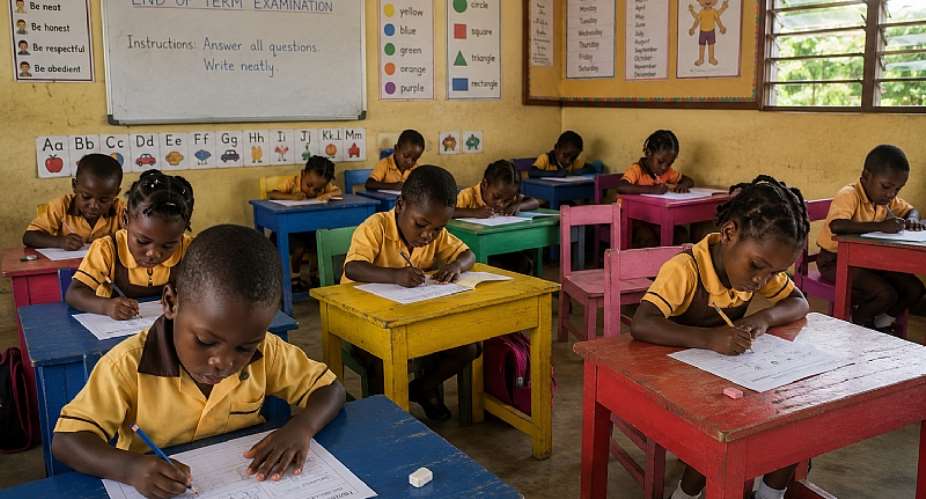
I have seen parents proudly post their children’s KG report cards on social media, especially when the cards show their child’s position in class. Some even go further by sharing examination questions as evidence of their child’s “exceptional ability.” Each time I come across such posts, one question keeps bothering me: what kind of examinations are these kindergarten children writing, and why are they being ranked at such an early stage?
Is this really what 21st-century kindergarten education is about, or has it become a way for schools to convince parents that learning is taking place?
As though KG examinations and ranked report cards are not enough, I have also seen examination papers designed for nursery pupils. We are talking about children between the ages of two and four sitting for formal examinations and taking report cards home. It is important to point out that public schools in Ghana do not operate the creche and nursery system. Formal early childhood education in the public sector begins at KG1. Most private schools, however, run pre-KG classes such as creche, Nursery 1, and Nursery 2, where children are typically between one and three-and-a-half years old.
At that age, learning should be largely exploratory and play-based. Teachers are expected to monitor children’s social, emotional, and physical development rather than place them under academic pressure. Children between the ages of two and five generally do not yet have the attention span or language development needed to produce meaningful academic work consistently. There is therefore little justification for subjecting them to end-of-term examinations and ranking them according to performance.
At the KG level, the most appropriate assessment methods are observational and activity-based. Teachers and caregivers should observe how children interact socially, how independent they are becoming, how they participate in class activities, and how they handle simple tasks. Performance tasks through guided activities can also help assess their development, particularly in the psychomotor domain.
Another useful approach is portfolio assessment, where a child’s progress is documented over time through samples of work, observations, and developmental milestones. From this, facilitators can prepare meaningful reports that highlight areas of improvement and growth instead of reducing children to scores, grades, and class positions.
The early years are meant for building foundational skills such as speaking, listening, phonological awareness, fine motor coordination, and early writing habits. They are not meant for high-pressure summative assessments. The goal at this stage should be to nurture every child’s development, not to separate them based on academic performance.
Unfortunately, many private schools in Ghana push children far beyond what is developmentally appropriate. As a principal in a private school, I have received several complaints from parents who expect their nursery or kindergarten children to write numerals perfectly from 0 to 100. Such expectations often focus narrowly on academic achievement while ignoring equally important areas of development.
At that stage, children need holistic support. Education should not revolve around memorisation or the ability to reproduce information mechanically. In fact, many children at that age are not even developmentally ready for such demands. What matters more is how they are growing socially, emotionally, physically, and cognitively as a whole.
I understand that schools often feel pressured by parents to produce visible academic results. However, should that pressure become an excuse for abandoning professional standards? As educators, we must be guided by best practices and sound educational principles, not simply by parental demands. At the same time, schools must also educate parents and align expectations with accepted developmental standards.
The KG stage forms the foundation of a child’s educational journey. If we fail to get it right at this level, the consequences will continue to appear in later years. This partly explains why many learners in primary school, JHS, and SHS still struggle with reading, writing, and handwriting skills.
National Council for Curriculum and Assessment’s Standard-Based Curriculum for KG strongly advocates child-centred, play-based, and activity-oriented learning. It is time we paid closer attention to those principles and stopped treating early childhood education as a competition.
About the Author
Alpha Osei Amoako is an educational leader, school administrator and education columnist based in Accra, Ghana. He writes regularly on education, society and public affairs for modernghana.com, one of Ghana's leading online platforms for commentary and analysis. He also engages a wide Ghanaian audience through social commentary on Facebook, where he addresses issues at the intersection of education, culture and national development.
[email protected]
+233208007439


 Brazil's President Lula da Silva beats Flavio Bolsonaro to win re-election
 Nurse rescues mother and baby after unplanned delivery in bush
 McCarthy-Mallam road rehabilitation begins amid commuters’ complaints of heavy t...
 TOR briefs IMF on recovery efforts, inherited debt and sustainability plans
 Aseidu Nketia urges NDC contestants to unite after constituency elections
 EC yet to announce Dormaa Central NDC constituency results
 Baaba Cann questions Obuasi SHTS handling of sexual misconduct allegations again...
 Obuasi SHS headmaster case: “It is better to pay for sex with prostitute than ra...
 NDC not worried about NPP’s Kojo Bamba, he is small boy – Azorka
 Resource exploitation fuelling Africa’s conflicts – Mahama


