




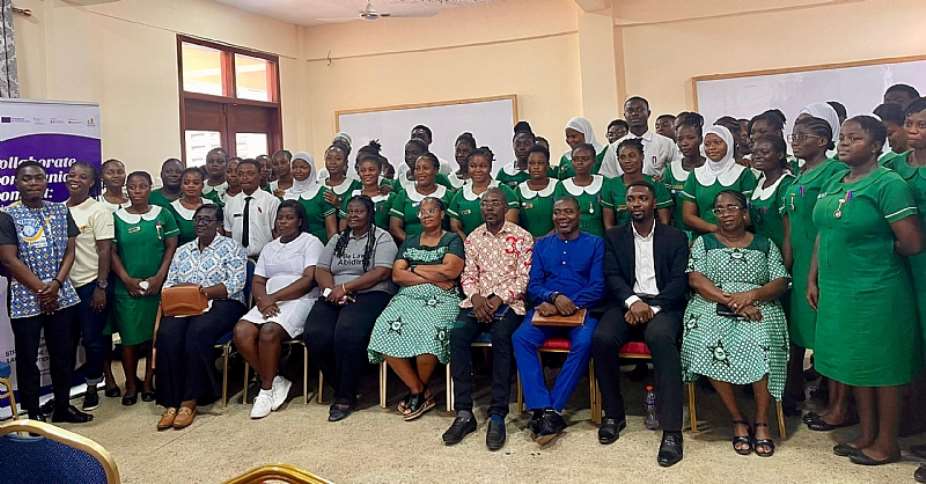
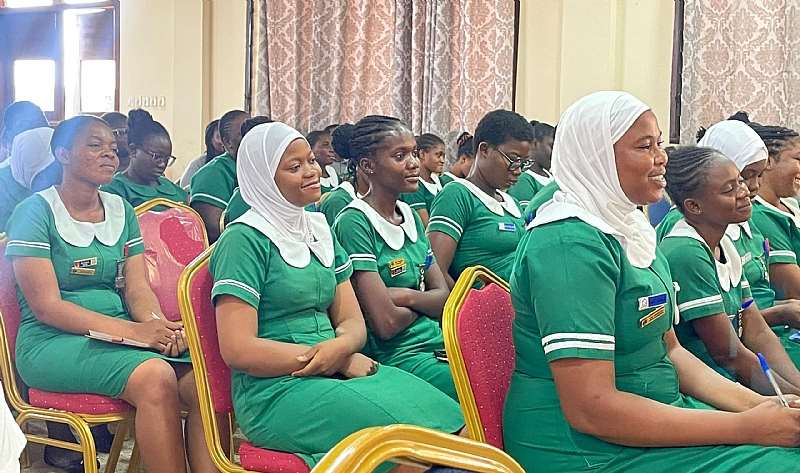
The Commission on Human Rights and Administrative Justice (CHRAJ) has equipped students of the Nursing and Midwifery Training College in Pantang with tools to avoid corruption and to join the fight against it.
The anti-corruption empowerment mechanism was designed to equip the next generation of healthcare workers with an understanding of conflict of interest, offering in-depth exposure to its nature, types, and legal implications.
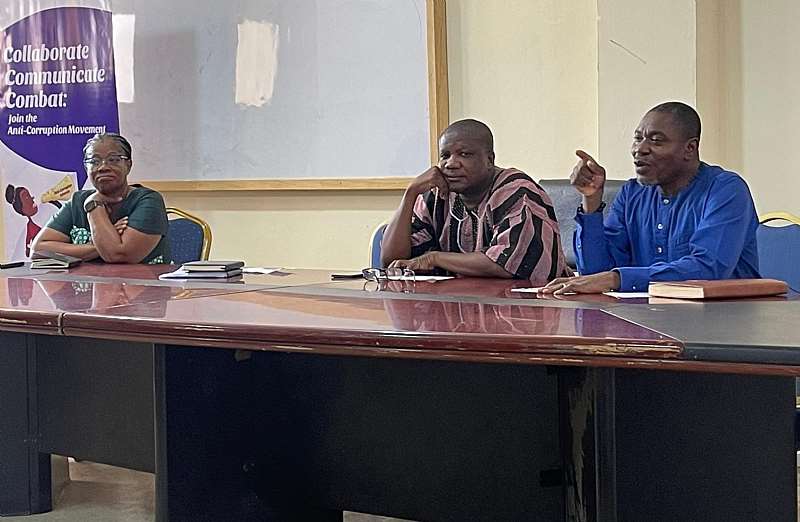
Mr John Ato Breboh, CHRAJ Municipal Director for Madina, used the occasion to walk students through the Commission’s conflict of interest guidelines; the legal definitions of public office and public officers; and the various forms that conflicts of interest can take, including their causes and real-world examples.
He also addressed how public officials can identify when they are in a conflict-of-interest situation and the appropriate steps to take when they find themselves in one.
The anti-corruption empowerment mechanism for the students of the Nursing and Midwifery Training College in Pantang was organised by the National Commission for Civic Education (NCCE), which was facilitated by Municipal Director Mr Mawuli Agbenu.
The engagement was also to serve as a platform to reflect on a broader effort by CHRAJ and the NCCE to embed civic and anti-corruption literacy within professional and academic communities across Ghana, a recognition that the fight against corruption begins long before individuals enter public life.
Mr Breboh was emphatic that the subject carried particular weight for an audience entering the health sector, adding that "nurses occupy significant roles within the public health system, and their professional responsibilities can place them at the centre of conflict-of-interest situations, especially those who go on to serve as public health officials.”
The CHRAJ municipal director also raised issues about the disclosure of confidential patient or institutional information for personal gain, which he described as a clear breach of duty under the code of conduct for public officials.
He also cited moonlighting working secondary jobs that conflict with one’s official duties and the misuse of subordinate staff time as common examples of conduct that crosses ethical and legal boundaries.
Mr Breboh grounded his presentation in constitutional authority, reminding students that Chapter 24 of Ghana’s 1992 Constitution binds public officials and public institutions to a defined code of conduct and that any breach of this code empowers CHRAJ to take action against the offending officer or entity.
The platform also offered the students the opportunity to ask questions on national issues, government architecture, the public sector, security, the role of the Whistleblower Act in combating corruption and political party operations, and Parliament’s approval processes of presidential appointees.
Mr Breboh acknowledged the concern but noted that Ghana’s vetting process is itself a constitutional safeguard; all presidential appointees must be vetted by Parliament before assuming office, providing a structured opportunity to assess their suitability.
He stressed, however, that it is often after the assumption of office that misconduct occurs and that institutions such as CHRAJ, the Economic and Organised Crime Office (EOCO), the Public Accounts Committee (PAC), the Auditor-General, and the Attorney-General each play a role in holding officials accountable.
He added that failure to declare assets upon assuming office could trigger investigations by the Commission.
On the Whistleblower’s Act, Mr Breboh described the act as a powerful tool that enables citizens to report officials engaged in corrupt practices or conflict of interest situations, particularly those with the potential to result in economic crimes or environmental damage.
He affirmed CHRAJ’s view of the Act as a vital complement to the Commission’s work.
Mr Breboh also underscored the role of the courts as the final arbiter, noting that when bodies such as CHRAJ and EOCO bring enforcement actions, it is the judiciary that ensures those findings carry legal weight and that illegal conduct is conclusively addressed.

 Accra Is Sinking Yet Again — Time to Be Truthful With Ourselves
 Fire guts rubber factory at Circle Odawna as flooding hampers firefighting effor...
 Flooding strands commuters on Winneba Cape Coast Highway
 Three feared dead after electrocution in Alajo flooding incident
 Nine missing after floods hit Awutu Senya East
 'Your mother, I should go to heaven and ask Nebuchadnezzar to stop the rain?' — ...
 Flood victim found dead along Alajo Railway track as rescue operations continue
 GMet warns more rain as flooding disrupts movement across Greater Accra
 'You sit on social media and talk nkwasiasem' — Nigel Gaisie blasts critics over...
 Osahen Afenyo-Markin accuses NDC of using GoldBod to promote illegal mining
