




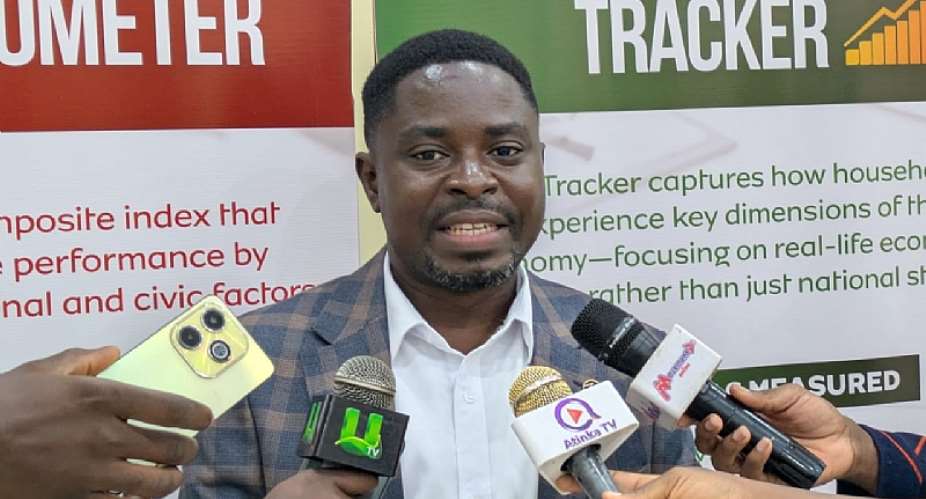
A new survey by policy think tank, the African Policy Lens (APL), has revealed that recent macroeconomic gains are yet to significantly improve the daily lives of Ghanaians.
The report, dubbed the Ghana Wellbeing Tracker, shows that while inflation has dropped sharply and key economic indicators have stabilised, households continue to face pressure from the high cost of living.
The survey, conducted across all 16 regions using 3,698 respondents drawn from the 2024 voter database, highlights a disconnect between national economic performance and household realities.
Speaking at the launch in Accra on Wednesday, the APL’s Director of Research and Administration, Dr. Hayford Mensah Ayerakwa, said the study was designed to capture how ordinary Ghanaians experience the economy beyond official data.
“We have seen some very good progress at the national level, at the macro level, but the lived experience of the average Ghanaian is still not very solid,” he said.
According to the report, the Ghana Wellbeing Index stands at 58.5, indicating a stabilising but still fragile economic condition for households.
The cost of living remains the biggest challenge, with a score of 44.7, reflecting high pressure on households, particularly in areas such as food, transport, and utilities.
Employment and income security recorded a moderate score of about 59, suggesting some stability, but with stagnant income growth and weak recovery in earnings.
“It is not the case that jobs do not exist. Jobs exist, but incomes are not sufficient or stable enough,” Dr. Ayerakwa explained.
The report also found that small and medium enterprises (SMEs) are surviving but struggling to expand due to high production costs and weak demand, limiting job creation.
On financial resilience, households showed relative strength with a score of 78.9, indicating optimism about the future despite ongoing economic pressure.
The survey further revealed disparities across regions, with some areas performing better than others, while women and rural dwellers were found to be worse off compared to men and urban residents.
Also speaking at the launch, President of the APL, Dr. George Domfeh, noted that the findings provide an empirical basis for prioritizing reforms and ensuring that policy interventions respond to citizen needs.

 Accra Is Sinking Yet Again — Time to Be Truthful With Ourselves
 Fire guts rubber factory at Circle Odawna as flooding hampers firefighting effor...
 Flooding strands commuters on Winneba Cape Coast Highway
 Three feared dead after electrocution in Alajo flooding incident
 Nine missing after floods hit Awutu Senya East
 'Your mother, I should go to heaven and ask Nebuchadnezzar to stop the rain?' — ...
 Flood victim found dead along Alajo Railway track as rescue operations continue
 GMet warns more rain as flooding disrupts movement across Greater Accra
 'You sit on social media and talk nkwasiasem' — Nigel Gaisie blasts critics over...
 Osahen Afenyo-Markin accuses NDC of using GoldBod to promote illegal mining
