




Origins and Meaning
The Egungun festival is a traditional Yoruba masquerade tradition originating from the Oyo kingdom in southwestern Nigeria, possibly as early as the 17th century. The word "Egungun" broadly refers to any Yoruba masquerade or masked, costumed figure more specifically, it denotes a masquerade for ancestor reverence, or the ancestors themselves as a collective force.
The word "Egungun" means the spirit of the dead ancestors who are said to return to the physical world during the festival. In Yoruba, the masquerades are also called Ara Orun, meaning "members of the celestial order," a title that reflects the immense spiritual reverence they command.
Spiritual Significance
In the Yoruba religion, the annual ceremonies in honor of the dead serve as a means of assuring ancestors a place among the living. The ancestors are believed to bear responsibility for compelling the living to uphold the ethical standards of past generations.
Through these visitations, ancestors are thought to bestow prosperity and fertility upon devotees, purifying communities of malevolent forces and offering guidance against moral lapses. The festival is thus not merely commemorative it is considered an active, living contract between the generations.
The Masquerades and Costumes
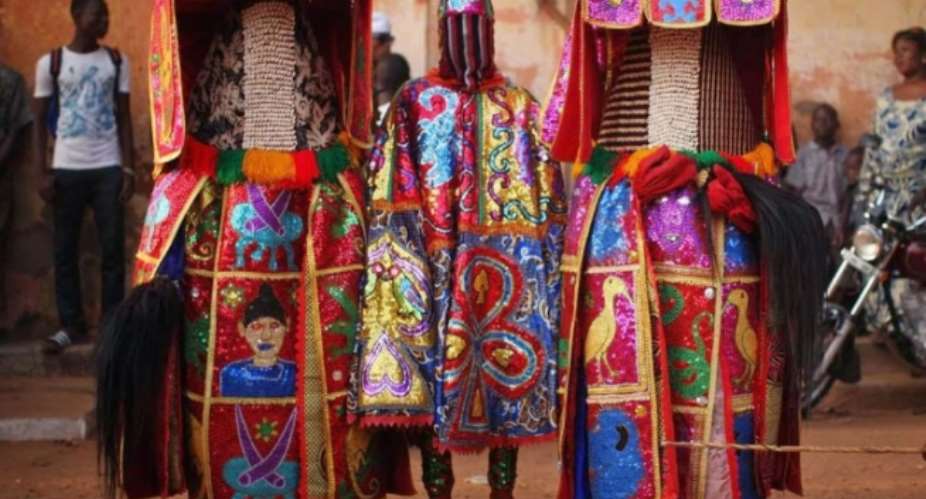
The visual spectacle of the Egungun is one of the most striking aspects of the festival.
The costumes are made up of layers of fabric of different kinds usually the finest available and the more extravagant the costume, the more powerful the masquerade or the family it represents. It is not uncommon to see silk, velvet, damask, cotton embroidered with cowries, colorful beads, and animal skins.
Each layer of the costume holds spiritual significance, representing different ancestors. Through drumming and dance, the robed performers are believed to become possessed by the spirits of the ancestors.
Roles and Structure
An Egungun society is composed of men and women whose lineages have the right to present the masquerade. Men do the masking, while women participate in the chorus that sings oriki praise poems and family histories. Elder women of high title also perform invocations, prayers, and offerings.
The chief priest who invokes the spirit of the ancestors is called the Alapini. The selection process of the masquerades is a closely guarded tradition, with only chosen individuals from specific lineages and families being initiated into the masquerade society.
The Festival in Practice
The festival typically lasts a week. Masquerades parade through the streets and bestow blessings upon the land and the people they encounter. On the seventh day, all performances are conducted at the king's palace and concluded by the Oba (king).
Each dance and gesture is laden with symbolism, portraying the wisdom, virtues, and life lessons imparted by the ancestors. The Egungun masquerades are the physical embodiments of the collective wisdom of those who came before.
While families perform the Egungun dance, the entire community participates in the festival towns come together in fellowship, share food, and narrate their history.
Beyond Nigeria
The Egungun Masquerade culture is centuries old and is common across West Africa among the Yoruba people in Nigeria, Togo, and Benin Republic, as well as among their descendants in the African diaspora particularly in Brazil, the Dominican Republic, Cuba, Barbados, and the United States.
The festival serves as a poignant reminder of the transatlantic slave trade and the remarkable resilience of Yoruba culture across centuries and continents.
A Living Tradition
In recent years, organized events such as the World Egungun Festival have helped globalize the tradition for broader cultural promotion. The colonialism-driven push to modernize caused many communities to lose these cultural links, but slowly and surely, people are finding their way back.
The Egungun festival endures as one of Africa's most profound spiritual and cultural expressions a bridge across time, stitched together with cloth, drum, and dance.
Mustapha Bature Sallama.
Medical/ Science Communicator,
Private Investigator, Criminal investigation and Intelligence Analysis.
International Conflict Management and Peace Building.USIP
[email protected]
+233-555-275-880

 Parliament to reconvene on May 21 following Easter break
 Passengers isolating on cruise after Cape Verde ban over suspected virus deaths
 Stop blaming Akosombo inferno for current dumsor — Okoe Boye tells Energy Minist...
 President Mahama to host global leaders for high-level reparations conference
 Refrain from cheating — United Party advises 2026 BECE candidates
 Support us to serve you better — Fire Service urges public
 BECE 2026: Minority urges candidates to stay focused
 Prisons Service warns public over fake social media accounts soliciting money in...
 Fighting racism 'must be at heart of presidential debate', French mayor tells RF...
 From this year, persons indicted in the Auditor General’s reports will be prosec...


