




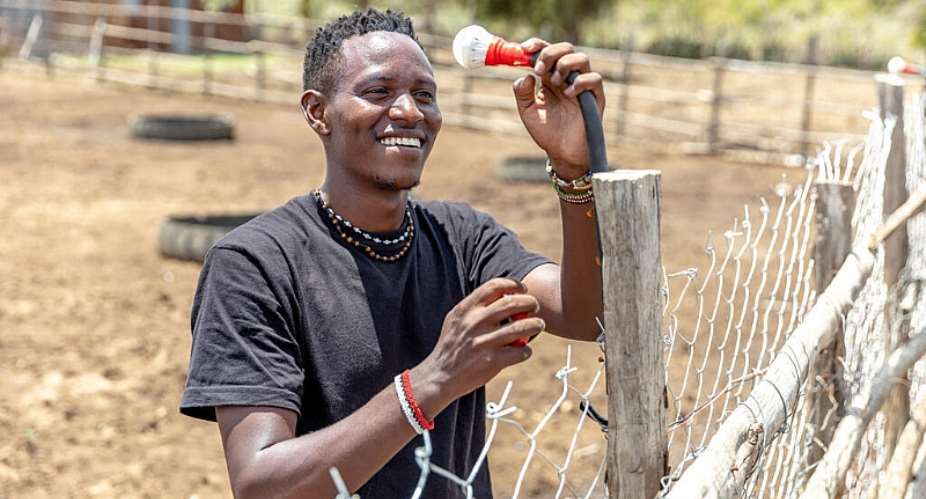
As a boy, Richard Turere saw up close the threat lions posed to his family's livestock – and the threat to the lions in turn. His ingenious solution to the problem is now being used by conservation organisations and wildlife authorities across East Africa.
On the dry plains alongside Amboseli National Park, nights can be stressful for families who rely on livestock for their livelihood. As darkness falls, predators emerge from the surrounding bushes.
For generations of these Maasai pastoralists, lions sneaking into animal enclosures have caused severe losses. And the result is that if lions kill livestock, people will kill lions – a practice conservationists say has greatly contributed to the declining lion population across East Africa.
Richard Turere grew up in one of these communities, where cattle represented money, food and the family's survival. From a young age, Turere was in charge of guarding his family's herd.
During the day, he watched the cattle while they grazed across the savannah. At night, he helped secure them inside a protective pen called a boma, made from thorny branches.
However, the lions were not deterred.
“Lions would come almost every night,” he recalled. "They were not afraid.”
Growing wolf population pushes France to rethink livestock protection laws
Behavioural patterns
The young Turere began to notice a pattern in how the lions approached the cattle enclosure.
When he walked around the boma with a torch, the lions stayed away. But when he returned to the house and the light from the torch stopped moving, the predators came creeping back towards the enclosure.
He realised the lions were more afraid of human activity than of the light itself – and this sparked an idea.
Using spare parts he found at home – old batteries, wiring and bulbs from broken vehicles – Turere built a system of lights around the cattle enclosure.
But instead of shining continuously, he rigged the bulbs to blink in sequence, creating the illusion of human movement. To a lion watching in the darkness, the flashing lights looked like a person walking around the enclosure with a torch.
The effect was immediate: the lions stopped attacking.
Soon, neighbours were asking 11-year-old Turere to set up the same system for their livestock enclosures.
The challenges of protecting wildlife from war in eastern DRC
A conservation tool
The conflict between predators and livestock is one of the toughest challenges for conservationists across Africa.
Dr. Paula Kahumbu, a Kenyan conservationist and wildlife advocate with WildlifeDirect, has stressed that solving human-wildlife conflict is crucial for the survival of large predators.
“Communities must see benefits and solutions,” she said. “Otherwise, wildlife becomes an enemy.”
Today, versions of Turere's lighting system are used in several communities in East Africa. Experts say the technology works because it tackles the root of the conflict.
As for the boy who came up with this solution, Turere is now 23 and working in conservation, as well as expanding Lion Lights.
After his invention gained international attention, he received a scholarship to attend the prestigious Brookhouse School in Kenya, going on to study wildlife conservation – having got a head start at the age of 11, thanks to some discarded batteries and bulbs and one bright idea.

 Accra Is Sinking Yet Again — Time to Be Truthful With Ourselves
 Fire guts rubber factory at Circle Odawna as flooding hampers firefighting effor...
 Flooding strands commuters on Winneba Cape Coast Highway
 Three feared dead after electrocution in Alajo flooding incident
 Nine missing after floods hit Awutu Senya East
 'Your mother, I should go to heaven and ask Nebuchadnezzar to stop the rain?' — ...
 Flood victim found dead along Alajo Railway track as rescue operations continue
 GMet warns more rain as flooding disrupts movement across Greater Accra
 'You sit on social media and talk nkwasiasem' — Nigel Gaisie blasts critics over...
 Osahen Afenyo-Markin accuses NDC of using GoldBod to promote illegal mining


