




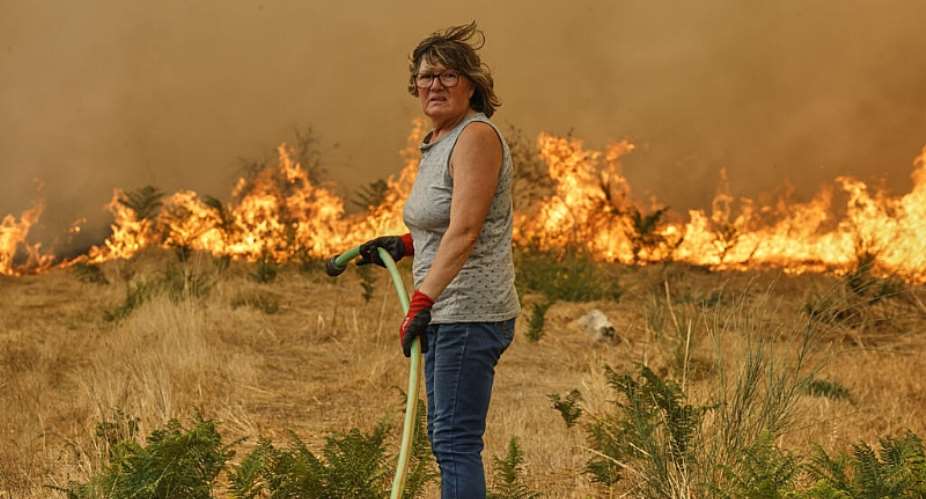
Europe has been warming twice as fast as the global average since 1980, a new report shows, with 2025 marked by extended heatwaves across the continent, from the Arctic to the Mediterranean. RFI examines the reasons why.
The European State of the Climate report, published by the European Union's Copernicus Climate Change Service and the World Meteorological Organization (WMO), shows last year was the third warmest on record.
The average air temperature was 1.47°C above pre-industrial levels – close behind 2024, which saw an average increase of 1.6°C, and 2023.
Europe (extending to Turkey and parts of Russia) has been warming twice as fast as the global average since 1980, at a rate of +0.56°C per decade since 1996 compared to +0.27°C.
In comparison, Africa is warming at an average of 0.36°C, Asia 0.46°C, North America 0.42°C, and Central and South America 0.27°C.
WMO secretary-general Celeste Saulo noted that 2025 was marked by long heatwaves from the Mediterranean to the Arctic Circle which were becoming "more frequent and severe".
Earth records third-hottest year in 2025 as global heat streak grows
Arctic region
Four factors contribute to explaining this phenomenon in Europe, the first of them geographical.
Samantha Burgess, strategic climate leader at the Copernicus Climate Change Service (C3S), said: "Europe includes part of the Arctic region. And the Arctic is warming three to four times faster than the global average."
This, she explained, pulls the average upwards, as the polar region has warmed by 0.75°C per decade.
Fennoscandia, the region encompassing Norway, Sweden, Finland and Russia's Kola Peninsula, experienced 21 out of 30 days in July with temperatures exceeding 10.2°C.
This was unprecedented in its severity, the duration – the previous record was 11 days – and the geographical extent.
"Generally speaking, most of this region experiences up to two days of intense heat per year, where the perceived temperature reaches 32 degrees or higher," Burgess explained.
A peak of 34.9°C was recorded on 17 July in Frosta, Norway, just below the Arctic Circle.
"Changes in atmospheric circulation are contributing to heat waves. These are becoming more frequent and intense, from the Mediterranean to the Arctic Circle," she added, saying that three consecutive weeks of severe heat stress in the Fennoscandia region "highlights the impact of climate change".
Shrinking snow cover
The third reason for Europe's rapid heating may seem contradictory: the reduction of air pollution.
"We have fewer air pollutants or aerosols," said Burgess. "These aerosols form clouds that act like a mirror: they prevent solar energy from reaching the earth. Now that we have improved air quality, the albedo – the reflectivity of clouds – is reduced. We therefore receive more solar radiation."
The fourth factor stems from the same principle: the decrease in snow cover in Europe.
By March 2025, this cover had decreased by 30 percent compared to the 1991-2020 average – the third lowest snow cover on record. This shrinkage also reduces albedo, the reflectivity of white surfaces.
Shrub studies show Alps suffering disastrous decline in snow cover
With less snow and more dark rock to absorb more energy, the Alpine regions of Europe are warming faster than the continental average.
Furthermore, the melting of glaciers, both in the mountains and on the polar ice caps, is accelerating.
Greenland lost 139 gigatonnes of ice in a single year, the equivalent of 100 Olympic-sized swimming pools, while Iceland lost the second largest ice mass in its history.
While this melting contributes to rising sea levels, rising sea temperatures are also an issue – 86 percent of European waters experienced at least one severe marine heatwave in 2025.
For the Atlantic Ocean, it marked the fourth consecutive year of record temperatures. For the Mediterranean, it was the second hottest year on record, just behind 2024.
From rain to fires
Europe experienced multiple extreme weather events in 2025, from storms and floods to drought and wildfires.
Storm Eowyn, which hit Ireland, the United Kingdom and Norway in January last year, was classified by the UK Met Office as the most powerful storm to hit the country in more than a decade.
Over the summer, fires scorched a record 1 million hectares of European land, a large number of them in northern countries such as the Netherlands, England and Germany.
"The fire season started exceptionally early," said Burgess, as early as February in the UK and Ireland.
She added that Portugal and Spain experienced an extremely wet spring, with multiple storms and floods causing regional vegetation to grow very rapidly.
This period was then followed by heat waves.
Spain endured a record of more than 50 days with temperatures exceeding 32°C in 2025. The southern regions of both countries experienced six days of temperatures exceeding 46°C.
The abundant vegetation dried, creating ideal conditions for large fires – 65 percent of the area burned in Europe last year was in these two countries.
"Portugal is located in the part of Europe most severely affected by climate change," Burgess noted.
"[It] could be considered an example of how climate change is already having serious effects in southern Europe, particularly due to extreme heat, drought and forest fires. This situation reflects trends across the Mediterranean region, rather than isolated national anomalies."
Carlo Buontempo, director of the C3S service, said the risks, scale and duration of wildfires are increasing.
"That's where we need to build resilience," he said, citing measures such as clearing brush, protecting national parks and the need for firebreaks to prevent the fire from spreading.
Last year was the third driest for European soils since 1992, and ranks among the top 10 driest of the last 50 years. In May, a third of the continent suffered from extreme agricultural drought.
Average annual rainfall was 10 to 40 percent lower in northwestern and eastern Europe. Approximately 70 percent of rivers had a flow rate below the 1992-2020 average.
Carbon sinks
Last year also saw massive loss of Europe's peatlands – wetlands covered with dense, low-lying vegetation. Falling groundwater levels dry out the peat, making the area highly flammable.
"Fires can spread rapidly and, above all, smoulder underground for weeks or even months, making them very, very difficult to extinguish," said Claire Scannell, an Irish meteorologist.
These ecosystems are vitally important for their role as carbon sinks, while their degradation transforms them into sources of greenhouse gas emissions.
Meanwhile, biodiversity is also suffering in the sea, according to the Copernicus report.
Mediterranean Posidonia seagrass meadows – underwater meadows that extend over nearly 20,000 km² along the coast – are particularly under threat.
"These seagrass meadows are biodiversity hotspots that shelter thousands of fish and provide essential nursery habitats," Scannell explained.
"They protect coastlines from erosion and storm surges. Furthermore, they act as carbon sinks and can store carbon up to 30 times faster than a tropical rainforest. However, over the past 50 years, these meadows have declined by 34 percent, due in part to climate change."
Despite conservation measures being implemented, the report found that: "Europe is not on track to meet most of the objectives of its Biodiversity Strategy. Protected areas are increasing, but the total remains below 20 percent. Bioindicator species, including pollinators and birds, continue to decline."
The renewables path
In a bid to move towards clean energy sources, 14 of the 27 EU member states now generate more electricity from renewable sources than from fossil fuels.
Across much of the continent, the increased amount of sunshine has translated into above-average solar energy production. However, the outlook for hydroelectric energy is less favourable.
Solar power overtakes nuclear and wind to lead EU energy mix for the first time
Flow rates in the European river network were below average for 11 out of 12 months of 2025, putting pressure on energy infrastructure.
"Hydropower, as a form of renewable energy, is one of the sectors most closely linked to climate. We must therefore prepare for increased pressure during peak demand periods. We saw this a few years ago with the drought in northern Italy," said Buontempo.
The European Framework for Adaptation to Climate Change is expected in the second half of 2026.
This article has been adapted from the original version in French by Géraud Bosman-Delzons.
 Korle Bu Teaching Hospital to introduce IVF and Corporate Clinic before end of 2...
 Accra West: Sarpeiman, Medie and other areas to experience power outages on Sund...
 Accra West: Faulty transformer causes outage Pokuase Amanfrom and surrounding ar...
 Restoration of Akosombo turbines not automatic solution to current dumsor — Mira...
 We have enough capacity to meet electricity demand — Energy Minister
 May 2: Cedi maintains value, sells at GHS12.15 on forex market, GHS11.20 on BoG ...
 2024 outages not due to transformer overloads — Energy Minister defends past com...
 US to withdraw about 5,000 troops from Germany
 Rebels take key military base in Mali's north
 Middle East war's impact on shipping hitting refugee aid: UNCHR


